
OpenAI is about to give its Codex developer tool a personality transplant. Buried in the app's settings is a new feature called Avatars, which lets you pick a visual companion that'll pop up on-screen during your coding sessions.
Once you've chosen your digital sidekick, it'll chat with you via speech-bubble messages, adding a dash of character to what's been a pretty no-nonsense utility. Don't want the distraction? The whole thing is toggleable, so you can turn it off and keep your workspace clean without losing any of Codex's core smarts.
https://twitter.com/neocph/status/2045656954421268907
Pixel pals and custom creations
Eight predefined avatars are expected at launch, all rendered in a deliberately cute pixel-art style—think more indie game than corporate mascot. More interestingly, you'll also be able to design your own custom avatar, turning the feature from a simple cosmetic preset into a creative outlet.
This move fits a broader pattern across OpenAI's consumer-facing products, where personality and identity are becoming recurring themes. It echoes the voice personas in ChatGPT and the quiet expansion of personalization options across the product line.
https://twitter.com/neocph/status/2045062233231667379
Following Chronicle's footsteps
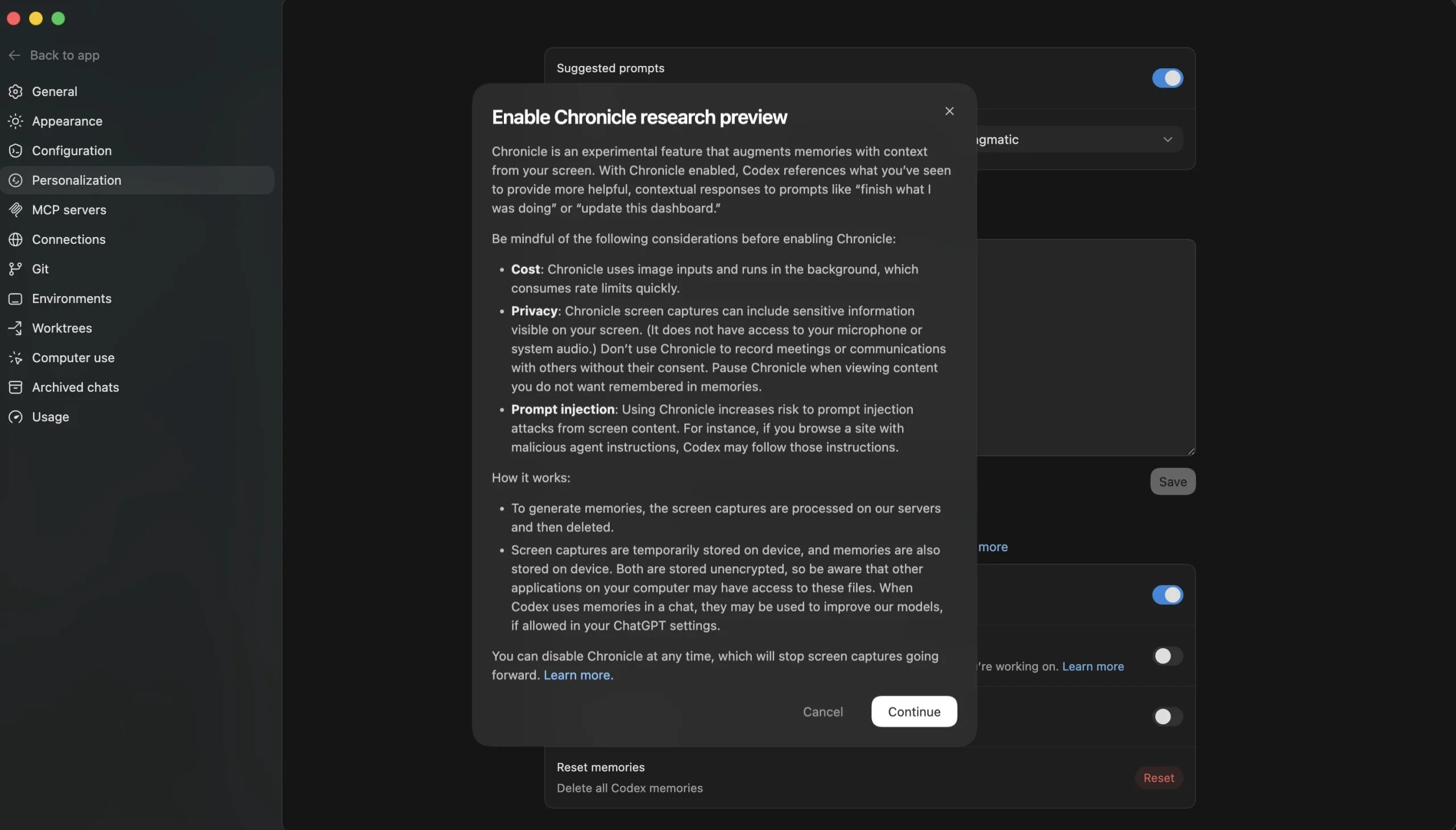
The arrival of Avatars comes hot on the heels of another new Codex feature called Chronicle, which captures screenshots of your work-in-progress and feeds them to a background agent to generate "memories" from that visual context. OpenAI is rolling out Chronicle with significant caveats, warning of higher token consumption and increased exposure to prompt injection risks. That's why the rollout has been deliberately narrow: it's currently limited to Pro users in a Research Preview, excludes people in the EU and UK, and runs only on macOS for now.
From coding assistant to desktop companion
Taken together, Avatars and Chronicle signal a clear shift for Codex. It's evolving from a pure coding assistant into something closer to a persistent, personality-driven desktop companion. This repositioning mirrors how rivals like Anthropic, xAI, and Google are reframing their own agentic coding tools. OpenAI's recent push to turn Codex into a desktop superapp that can click, type, and browse shows this ambition isn't limited to cosmetic features.
There hasn't been an official unveiling for Avatars yet, but the groundwork inside the product suggests it shouldn't be far off. This personality-first approach is becoming a competitive battleground, with companies like Adobe launching AI agents that can boss creative apps around and Google adding prompt-saving 'Skills' to Chrome. The era of purely utilitarian AI tools might be coming to an end.