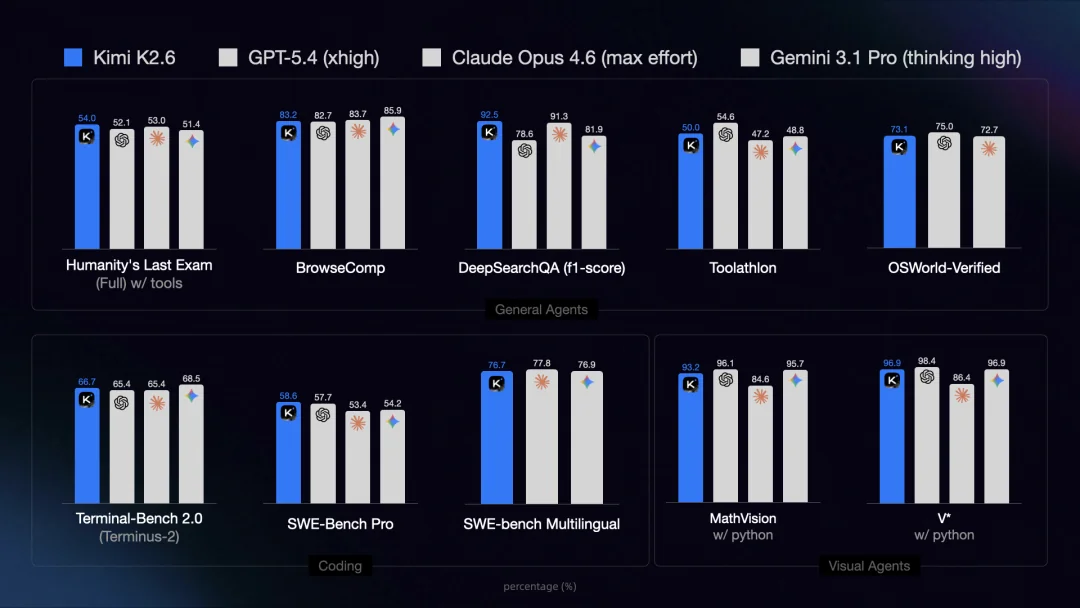
Moonshot AI just open-sourced its latest model, Kimi K2.6, and it's making a bold claim: its coding performance now matches or beats closed-source giants like GPT-5.4, Claude Opus 4.6, and Gemini 3.1 Pro.
https://twitter.com/Kimi_Moonshot/status/2046249571882500354
The model is available now on kimi.com, the latest Kimi app, the Kimi API, and the Kimi Code programming assistant. It's reportedly posting top-tier scores on benchmarks like the notoriously difficult Humanity's Last Exam (full version), the real-world software engineering test SWE-Bench Pro, and the agent-focused DeepSearchQA.
Code is the star
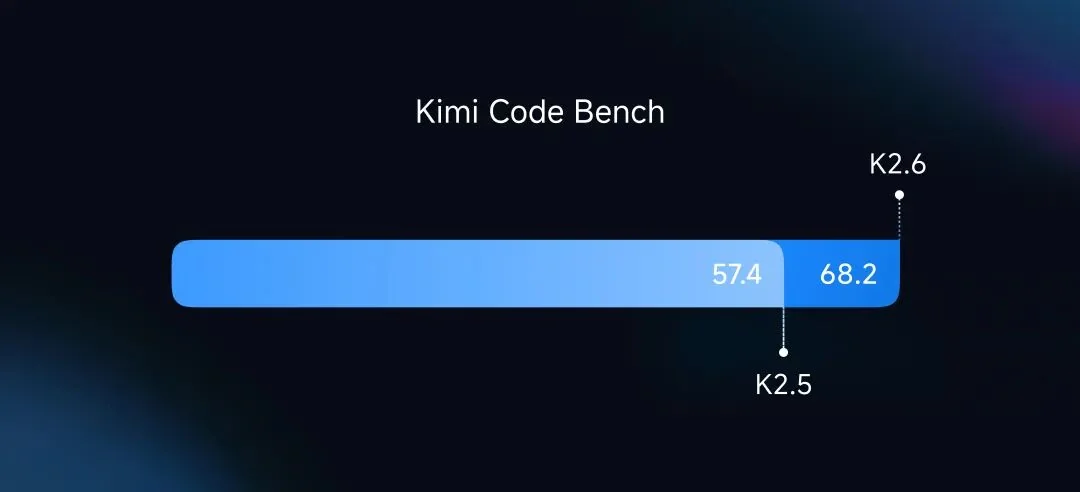
Coding is the headline upgrade. K2.6 scored 68.2 on Moonshot's internal Kimi Code Bench, a roughly 20% jump from K2.5's 57.4.
In testing, the model reportedly coded for 13 hours straight, writing or modifying over 4,000 lines to develop and optimize complex systems. By blending code and visual capabilities, Moonshot says K2.6 can now deliver professional-grade web apps with creative design.
One test case had K2.6 download and deploy the Qwen3.5-0.8B model locally on a Mac, then implement and optimize model inference using the niche Zig programming language.
After more than 4,000 tool calls, over 12 hours of non-stop operation, and 14 iterations, it boosted throughput from about 15 tokens per second to roughly 193 tokens per second—ultimately running 20% faster than LM Studio.
In another case, K2.6 autonomously performed a deep refactor of an eight-year-old open-source financial matching engine called exchange-core. The 13-hour marathon involved 12 optimization strategy iterations, over 1,000 tool calls, and precise modifications to more than 4,000 lines of code. The result? Median throughput jumped 185%, and peak throughput increased by 133%.
Agent upgrades and enterprise testing
The agent cluster architecture driving K2.6 got a major overhaul. It now supports 300 sub-agents working in parallel across 4,000 collaborative steps, with Moonshot claiming significant improvements in task completion and output quality over K2.5.
For proactive agent frameworks like OpenClaw and Hermes Agent, K2.6 demonstrated strong automated task handling, supporting continuous autonomous operation for up to five days.
A roster of enterprise clients, including Baseten, Blackbox AI, CodeBuddy, Factory (Droid), Feishu Miaoda (Lark's low-code platform), Fireworks AI, Nous Research (behind Hermes Agent), Kilo Code, Ollama, OpenCode, Qoder, and Vercel, have been testing the model early.
Their feedback is telling. Baseten says K2.6 can now "go toe-to-toe with leading closed-source models" on programming tasks and shows a deeper understanding of third-party framework logic. Blackbox AI praised its improved instruction-following and ability to uncover deeply hidden bugs. CodeBuddy's internal tests showed a 12% boost in code generation accuracy, an 18% improvement in long-context stability, and a 96.60% tool-call success rate. This release follows Moonshot's recent preview of a trillion-parameter coding model aimed at Claude Sonnet 4.6, signaling a focused push into the high-stakes AI coding arena. It also arrives just as competitors like Anthropic's Claude Opus 4.7 are rolling out with their own major coding upgrades, making the open-source vs. closed-source battle more interesting than ever.