
Cursor let a swarm of AI agents read only the 835-page SQLite manual and rewrite a compatible database in Rust. They had no access to the source code, existing programs, test suites, or the internet. Every one of the final four configurations passed all unreleased SQL tests.
The formal test pitted four combinations. GPT-5.5 and Grok 4.5 each handled both planning and execution. The other two had Opus 4.8 or Fable 5 do the planning, while the cheaper Composer 2.5 handled execution.
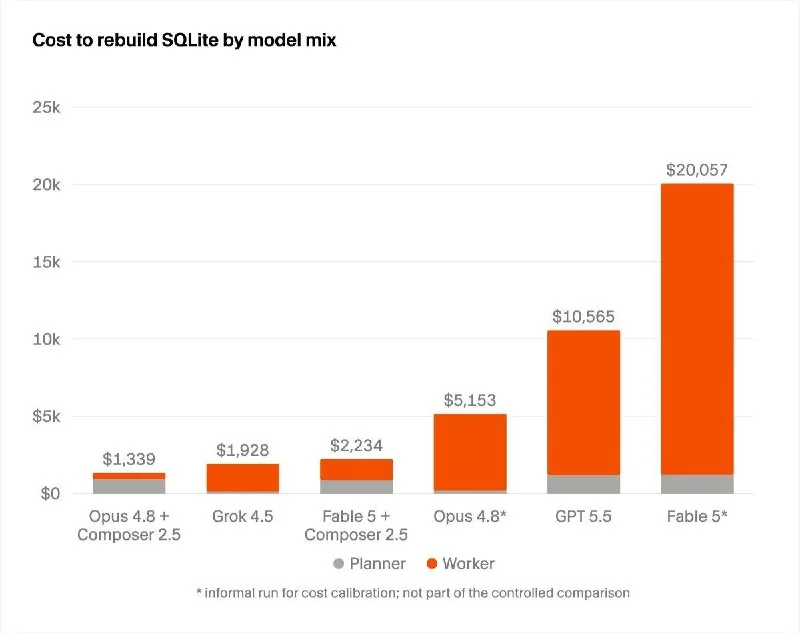
The four configurations cost $10,565, $1,928, $1,339, and $2,234 respectively. The cheapest setup: Opus 4.8 for planning, Composer 2.5 for execution. Execution agents gobbled up most of the tokens; swapping to a cheaper model slashed costs dramatically.
Cursor also ran Opus 4.8 and Fable 5 doing everything themselves, costing $5,153 and $20,057. Those were scored informally and not included in quality comparisons. Just on cost, the highest was roughly 15 times the lowest formal setup.
Leaving the smart models to plan while letting a cheaper model execute might be more economical than using the strongest model for everything.