
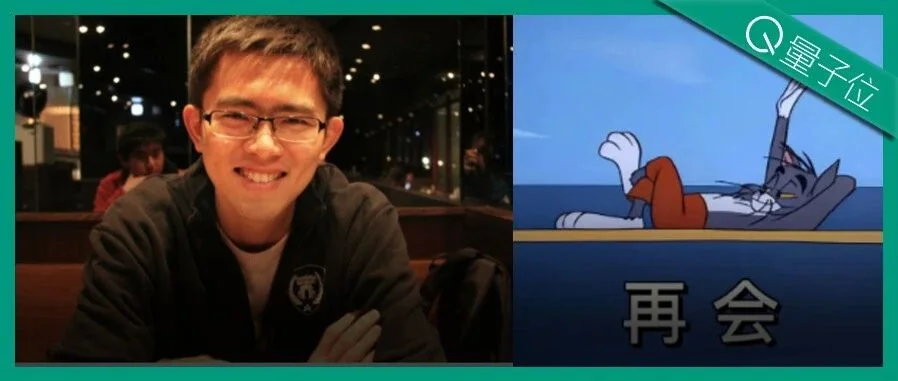
As Wu Yi's move to Meta continues to make waves in the AI community, many have been asking: doesn't he still hold a faculty position at Tsinghua University's Institute for Interdisciplinary Information Sciences?
New developments suggest he may no longer have that academic role.
We've confirmed that Wu Yi's information has been removed from the Tsinghua IIIS official website.
Wu Yi No Longer Listed on Institute Website
On the personnel page of Tsinghua's Institute for Interdisciplinary Information Sciences, Wu Yi's name has disappeared.
However, his personal homepage and Google Scholar profile still list him as an "Assistant Professor at Tsinghua University's Institute for Interdisciplinary Information Sciences."
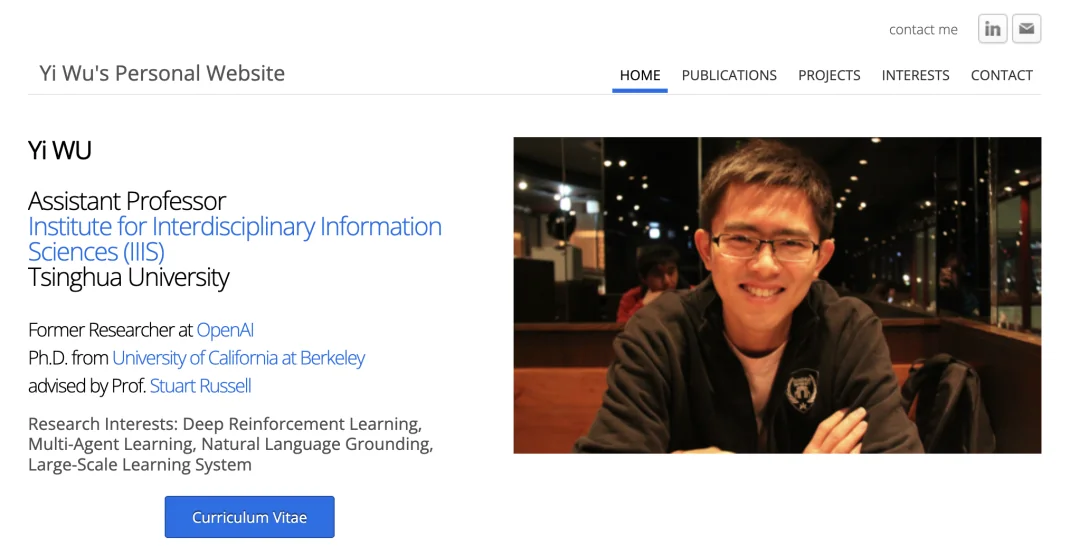
Recently, Wu Yi has become one of the most talked-about figures in AI circles.
Reports confirm he has officially joined Meta's MSL (Meta Superintelligence Labs), reporting to Meta Vice President and MSL co-head Nat Friedman.
Meta MSL is the company's superintelligence laboratory established in July of last year, a core unit following Meta's AI business reorganization.
The lab focuses on developing "superhuman-capable" general intelligence systems to support Meta's "personal superintelligence" strategy.
Insiders reveal that Mark Zuckerberg personally led the recruitment effort to bring Wu Yi on board.
According to sources familiar with the matter, at Meta, Wu Yi will be directly involved in cutting-edge work on superintelligence and multi-agent systems.

Two current faculty recruitment postings from Tsinghua's Institute for Interdisciplinary Information Sciences (in computer science and quantum information) both require the position to be based in Beijing.
By choosing Meta—which has no research and development offices in mainland China—Wu Yi naturally cannot remain in Beijing.
It's currently unclear whether Wu Yi chose Meta first and then resigned from his Tsinghua position, or whether he left his academic role before making the career move to Meta.
Alternatively, it could be related to Tsinghua's strict policies regarding faculty mobility.
Earlier this year, Wu Yi posted on the social platform Xiaohongshu that "three doctoral students are graduating this year," having passed their preliminary defenses in February, with formal defenses scheduled for June.
Meta Internship Background, Brief OpenAI Stint
Born in 1992, Wu Yi won a silver medal at the International Olympiad in Informatics (IOI) in 2010, representing China.
This achievement earned him early admission to Tsinghua's Yao Class at the Institute for Interdisciplinary Information Sciences, where he studied under Turing Award winner Andrew Yao.
During his undergraduate years, Wu Yi completed internships at Facebook (now Meta) and Microsoft Research Asia.
After graduating in 2014, he pursued his PhD at UC Berkeley under renowned AI researcher Stuart Russell, focusing on multi-agent systems, deep reinforcement learning, and general intelligence agents.
During his doctoral studies, Wu Yi began making his mark at top-tier conferences.
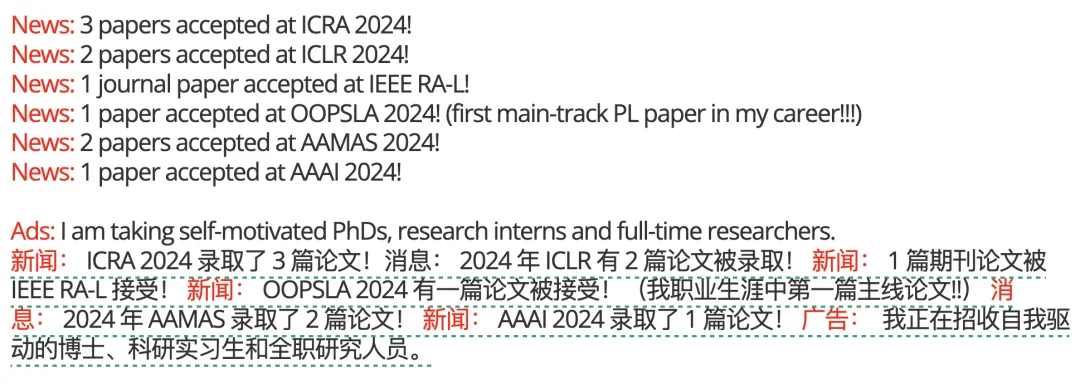
His published papers show academic output primarily in machine learning and reinforcement learning, with multiple publications at premier conferences like NeurIPS and ICML. Some of his research involves multi-agent learning, decision optimization, and learning frameworks integrated with real-world systems.
To date, Wu Yi has published over 40 papers at conferences including ICML, NeurIPS, and ICLR.
He led the development of multi-agent reinforcement learning algorithms like MADDPG and MAPPO, which have become significant contributions to the field.
During his PhD, he also interned at ByteDance and Facebook AI Research (FAIR).
Wu Yi completed his PhD at UC Berkeley in 2019.
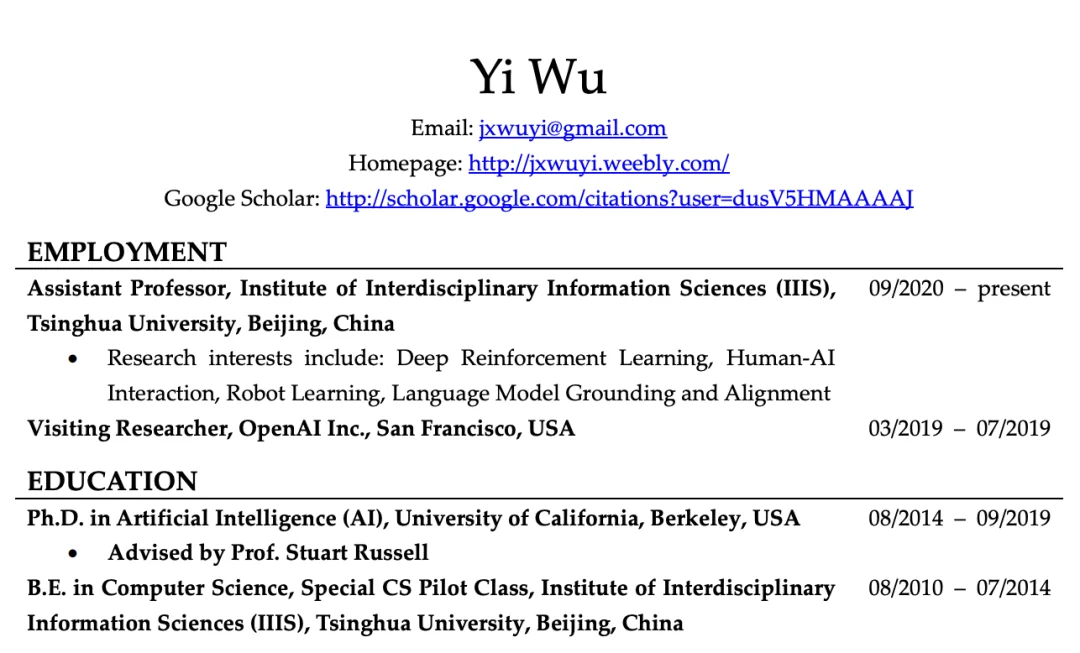
His resume shows that from March to July of that year, he served as a visiting researcher at OpenAI.
At that time, OpenAI wasn't yet a household name thanks to ChatGPT, but it was already considered a promised land by many AI researchers.
His time at OpenAI didn't last long.
In September 2020, Wu Yi returned to China to begin his academic career, adopting a "dual-appointment" model: serving as an assistant professor at Tsinghua's Institute for Interdisciplinary Information Sciences while also acting as chief researcher at the Shanghai Qi Zhi Institute, continuing his work on reinforcement learning and embodied intelligence.
In 2023, he ventured into entrepreneurship, founding Frontier Technology with a focus on AI.
In late November 2024, Ant Group officially acquired Frontier Technology, with the team integrated into Ant's ecosystem while maintaining independent operations, company structure, team, and business—not merging into Ant's organizational structure.
Wu Yi served simultaneously as chief scientist of Ant Group's Reinforcement Intelligence Lab and head of Frontier Technology, while still maintaining his positions at Tsinghua and the Shanghai Qi Zhi Institute.
Earlier this month, news broke that Wu Yi had officially joined Meta MSL.
The Institute Does Allow Industry-Academia Dual Roles
Tsinghua's Institute for Interdisciplinary Information Sciences doesn't prohibit faculty from holding industry positions simultaneously, as some currently listed faculty members remain active in industry.
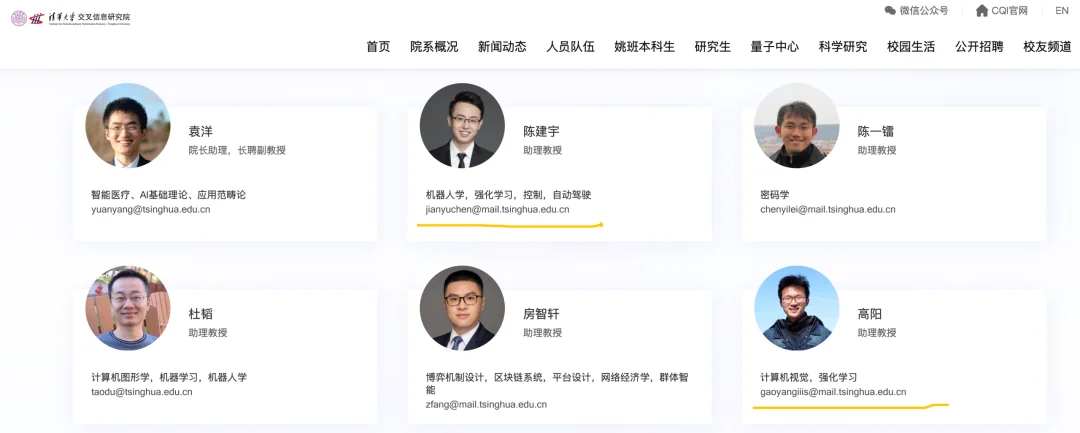
For example, the other three members of what's been called the "Berkeley Returnee Quartet"—Xu Huazhe, Chen Jianyu, and Gao Yang—are still listed as assistant professors on the institute's website.
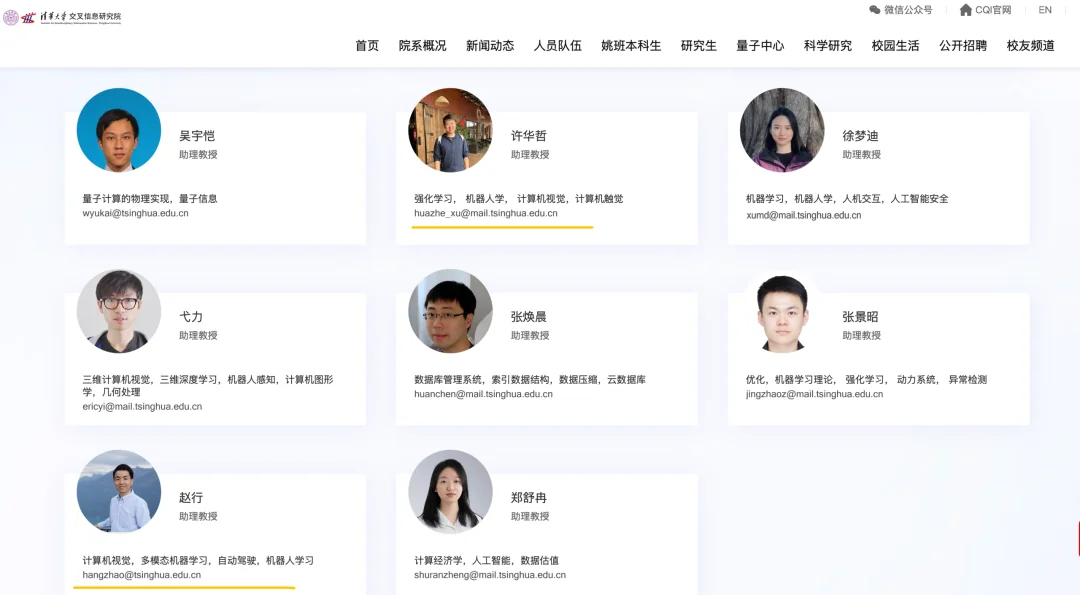
Among them, Xu Huazhe founded Poko Robotics, Chen Jianyu founded Xingdong Jiyuan, and Gao Yang founded Qianxun Intelligence, making them notable figures in Tsinghua's embodied intelligence sector.
Among full-time faculty, assistant professor Zhao Hang has also ventured into embodied intelligence entrepreneurship as co-founder and chief scientist of Xinghai Tu.
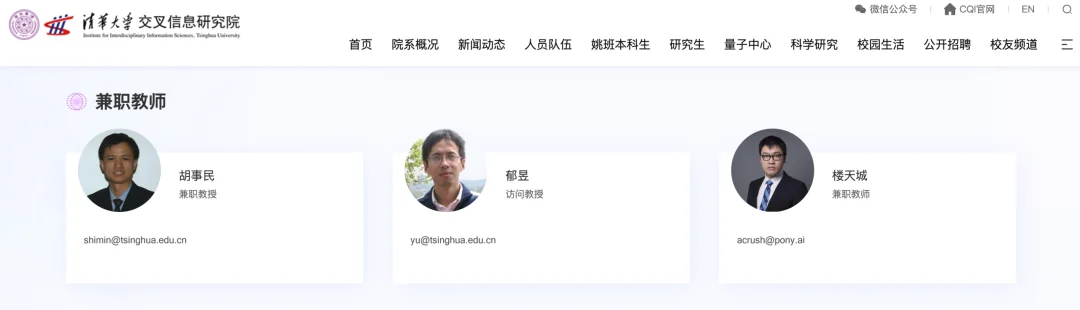
Additionally, Lou Tiancheng—the first doctoral student of Turing Award winner Andrew Yao—serves as both co-founder and CTO of autonomous driving company Pony.ai and as one of three adjunct faculty members at Tsinghua's Institute for Interdisciplinary Information Sciences.
These examples demonstrate how Tsinghua's institute has adapted to the unique characteristics of AI research that bridges academia and industry, continually cultivating versatile talent.
But Meta, it seems, doesn't fit within this flexible framework.
Reference links:
[1]https://iiis.tsinghua.edu.cn/rydw.htm#sz1
[2]https://jxwuyi.weebly.com/
[3]https://jxwuyi.weebly.com/uploads/2/5/1/1/25111124/cv\_faculty\_2023su.pdf