
Claude's most powerful "Mythos" model might be built on technology from ByteDance?
That speculation shot to the top of the trending charts on X (formerly Twitter).
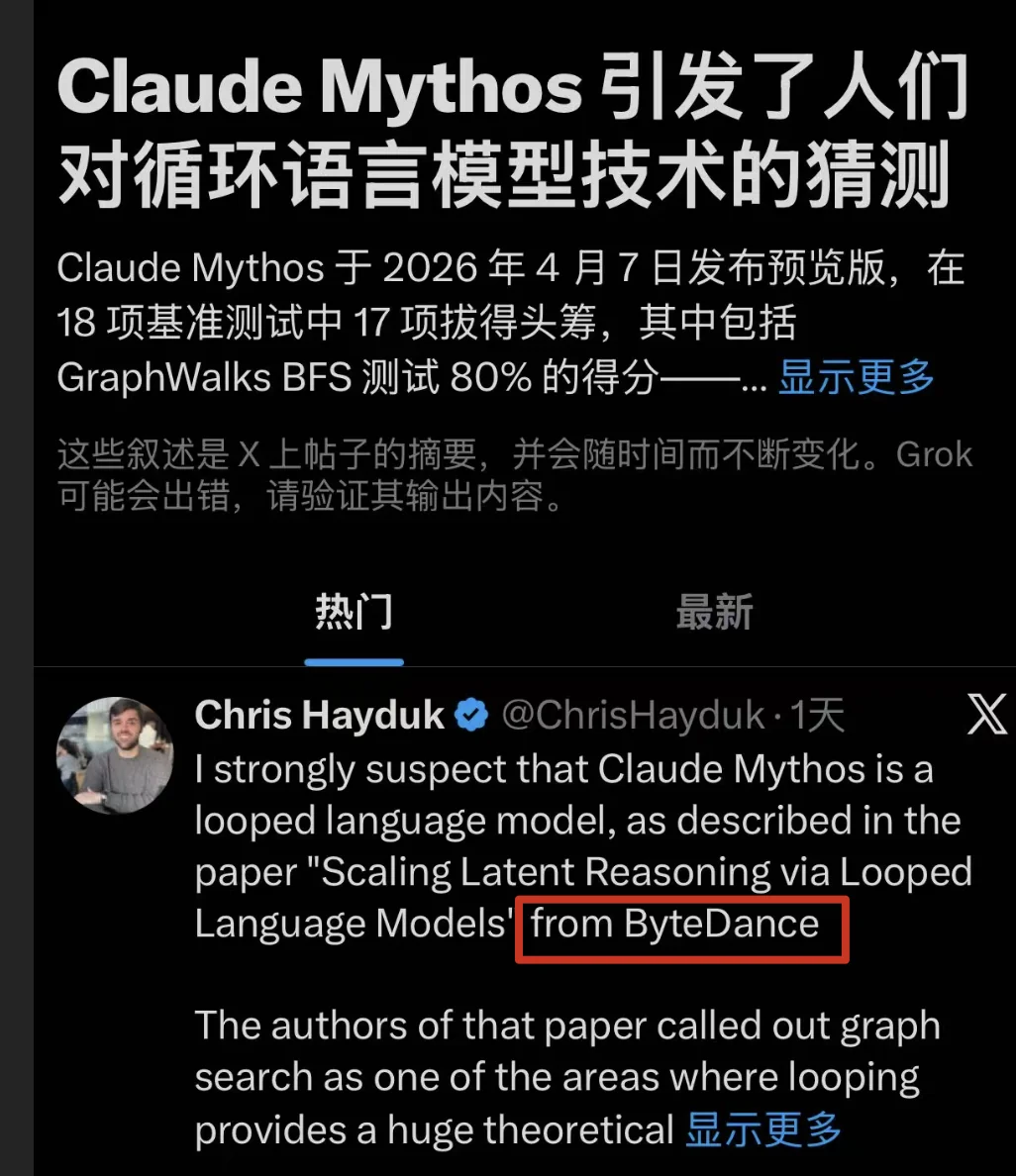
This "too powerful to release publicly" Mythos model has certainly sparked imaginations about the next generation of large language model (LLM) architectures.
The community is buzzing with debate over whether it employs a Looped Language Model (LoopLM) architecture.
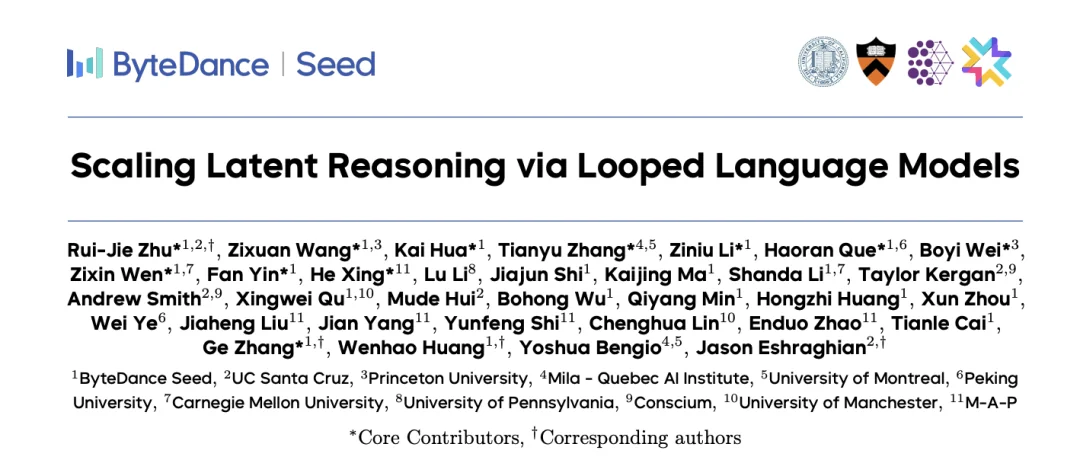
That concept comes from a research paper by ByteDance's Seed team in collaboration with several universities, with Yoshua Bengio also involved.
The key clue lies in a set of test data released by Anthropic.
The ByteDance paper notes that graph search is one area where looped algorithms hold a significant theoretical advantage over standard RLVR (Reinforcement Learning with Value-based Rewards).
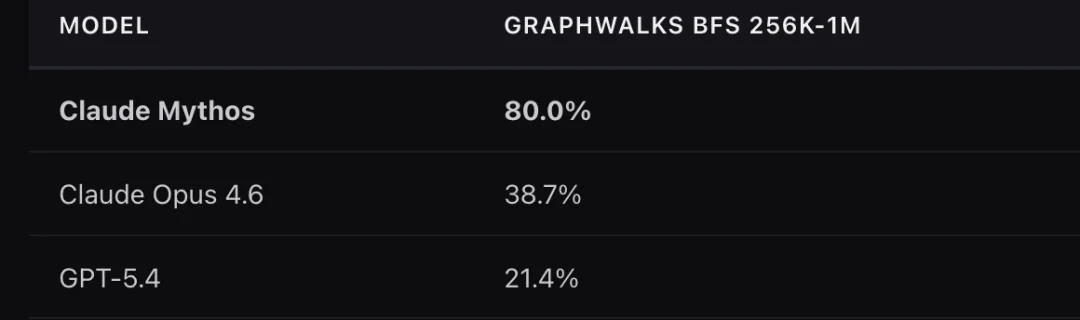
Looking at Mythos, it outperforms competitors like GPT-5.4 most dramatically in the breadth-first graph search test called GraphWalks BFS.
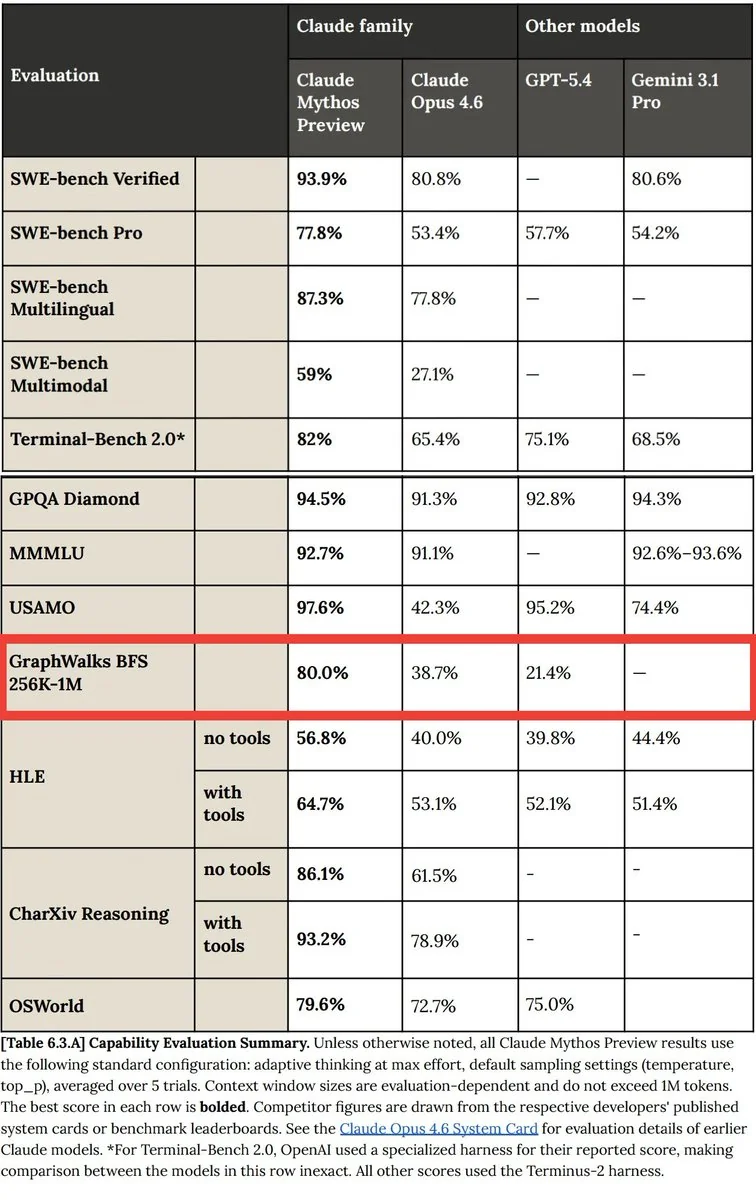
80% versus 21.4%—a gap of nearly four times.
On other types of tasks, such an abnormal performance difference doesn't appear.
This suggests the leap likely isn't from general scaling laws but from architectural innovation.
Looped Language Models: "Looping" Within a Layer to Outperform Larger Models
The GraphWalks BFS test gives a model a complex graph structure and asks it to perform a breadth-first search, visiting all adjacent nodes layer by layer from a starting point.
A standard Transformer handles this with a single forward pass, processing from start to finish without any concept of "iteration."
Mythos scoring 80% on graph traversal indicates it's likely "recomputing" internally, processing the same set of information multiple times.
So what architecture enables "repeated computation"?
ByteDance's Seed team proposed the LoopLM (Looped Language Model) in their paper.
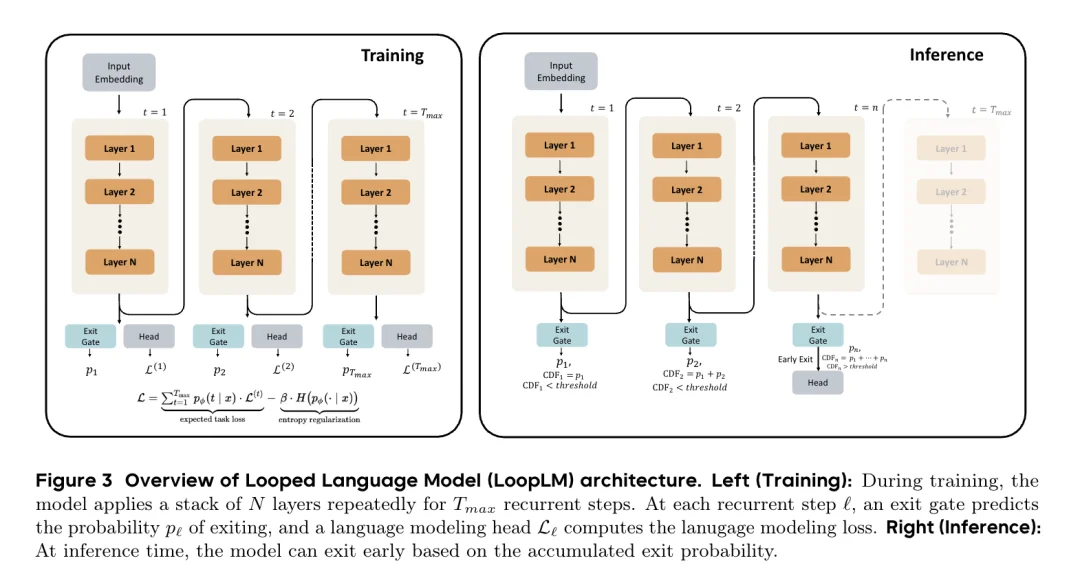
In short, LoopLM has three key features.
It doesn't generate long chains of thought text; instead, it iterates within the model's latent space without outputting extra tokens.
It automatically adjusts: simpler problems require fewer steps, harder ones get more loops.
During pre-training, it learns "how to think in latent space" rather than just "how to predict the next token."
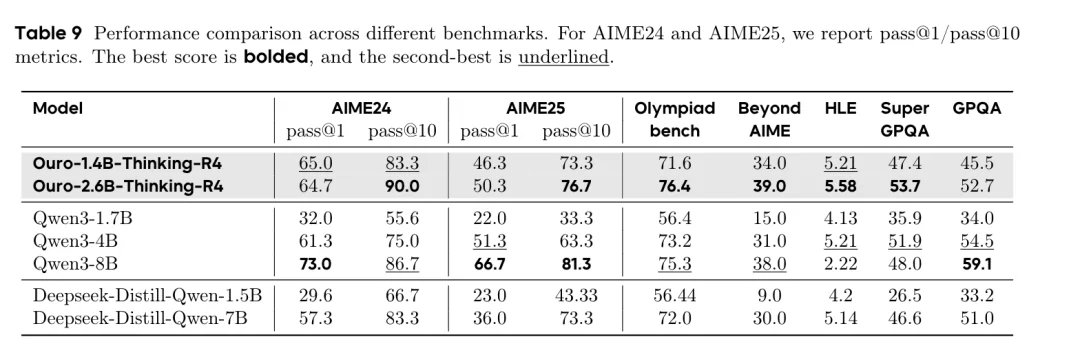
In experiments, the team trained the Ouro series of looped language models, which have built-in iterative reasoning.
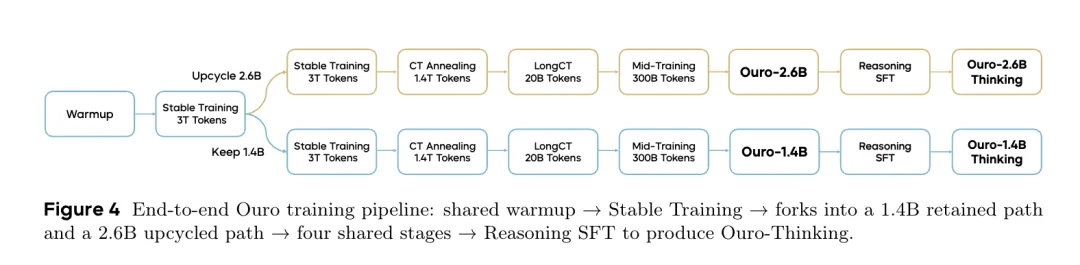
Test results show a 1.4B-parameter Ouro model performs on par with a traditional ~4B model. A 2.8B Ouro model matches the capabilities of traditional 8B–12B models.
As for where the performance gains come from, the paper details the distinction between knowledge storage and knowledge manipulation.
Knowledge storage capacity is limited—roughly 2 bits per parameter—and remains largely constant regardless of architecture.
Looping doesn't let the model "remember" more.
But knowledge manipulation is different: combining known facts for multi-hop reasoning, executing programs, or searching graph structures. These abilities grow exponentially with loop steps and training tokens.
In other words, looped models don't give AI a bigger knowledge base; they supercharge its ability to search and combine within that base.
Beyond GraphWalks, more clues point to whether Mythos uses a looped architecture.
Three Clues Pointing to a Looped Model Architecture
First clue: the breadth-first graph search test results.
Mythos not only scores four times higher than GPT-5.4 but also shows an unusually large improvement over its predecessor, Opus.
Second clue: Anthropic's report states Mythos uses one-fifth the tokens per task compared to Opus 4.6, yet it's slower.
(And it costs five times more!)
This is hard to explain with a standard Transformer framework: fewer tokens mean fewer generation steps, so it should be faster.
But a looped model neatly resolves this contradiction: reasoning happens in latent space, with computation spent in unseen layers.
Third clue: Mythos excels in cybersecurity.
Mythos scores 83.1% on the CyberGym test, compared to Opus 4.6's 66.6%—a lead of nearly 17 percentage points.
It also discovered thousands of zero-day vulnerabilities, affecting all major operating systems and browsers.
Vulnerability discovery essentially involves traversing control flow graphs—finding a path from input to a dangerous function, which is a graph reachability problem.
Again, graph traversal. Again, a natural strength of looped architectures.
All this remains speculation for now. Anthropic hasn't disclosed any details about Mythos's architecture and likely never will.
But one observation is worth pondering:
Scaling laws improve everything relatively evenly, while architectural innovation creates sharp, abnormal peaks on tasks that match its inductive bias.
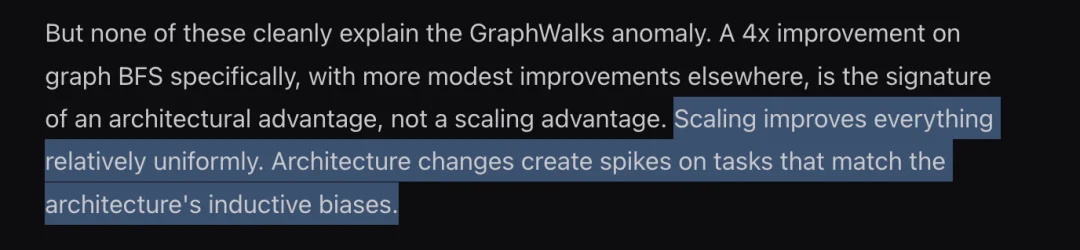
The inductive bias of looped Transformers is iterative graph algorithms. Mythos's abnormal peak happens to appear on graph traversal tasks.
Anthropic isn't talking, but the test data is speaking for it.
ByteDance paper:
https://arxiv.org/abs/2510.25741
Reference links:
[1]https://x.com/ChrisHayduk/status/2042711699413926262
[2]https://aiia.ro/blog/claude-mythos-looped-language-model-theory