

OpenAI's Chief Revenue Officer Denise Dresser sent a confidential internal memo to employees over the weekend—and it ended up published by The Verge.
The letter outlines OpenAI's enterprise strategy for the second quarter, but what really caught attention was its extensive takedown of rival Anthropic. Dresser criticized their computing power, revenue figures, and business philosophy point by point.
Dresser directly claimed Anthropic's $30 billion annualized revenue is inflated, saying that after removing $8 billion, it's actually $22 billion—below OpenAI's $24 billion.
That set off a firestorm. Some believe the memo was intentionally leaked.
Others think OpenAI is showing signs of panic. After all, how will they explain it when Anthropic's annual recurring revenue surpasses OpenAI's by $10 billion?
https://twitter.com/_alyxya/status/2043764615147073651
Additionally, the internal memo revealed several of OpenAI's future plans:
- OpenAI's biggest bottleneck isn't demand—it's production capacity. Multi-year, nine-figure enterprise deals are increasing.
- The new model "Spud" is coming soon and will make all core products "significantly better."
- The partnership with Amazon will reach AWS-native enterprise customers, filling gaps left by the Microsoft collaboration.
- Anthropic has insufficient computing power, leading to product throttling and availability issues.
- Anthropic is overly focused on coding, and in the platform wars, "a single product is a liability."
Here's the full text of the internal memo:
The System That Will Win Enterprise AI
As we enter Q2, I want to start where we always should—with our customers. I've been speaking with leaders at our largest enterprise customers, most influential startups, and major venture capital firms.
The message is clear: People are excited about what we're building. They want deeper insight into our product roadmap so they can plan with confidence and stay ahead of the market.
Enterprise AI is entering a more mature phase. Raw capability still matters, but it's no longer enough. Customers want fit—how well AI integrates into their workflows, knowledge systems, control mechanisms, and daily operations, and how effectively it can be deployed, trusted, and continuously improved. They want a system they can rely on and build upon.
We're building that system: models best suited for work, an agent platform, deep integration with business context, and the ability to deploy and improve at scale. Customers are validating this direction in the most direct way possible.
Multi-year, multi-product, nine-figure deals are increasing, and existing customers continue to expand as they standardize our capabilities across more departments within their organizations.
I'm incredibly proud of this team's performance. We earn trust through depth, quality, and care in our work. The opportunity ahead is enormous, and our biggest bottleneck right now isn't demand—it's production capacity.
That's why talent remains the highest priority in Q2. We'll continue to recruit selectively, maintaining high standards and building a team that matches both our customers' expectations and our own.
Extending our lead from here, we have everything we need. We have computing power, we have products, we have customer demand pulling us forward. Now is the time to go out and make it clear, confidently, that OpenAI is the platform enterprises should trust.
Here are five customer-validated priorities I want us to focus on.
Winning the Model Layer for Work
Enterprises buy business outcomes. They pay for models that help employees write faster, analyze better, code more efficiently, serve customers more effectively, and make higher-quality decisions.
They pay for higher revenue per employee, faster business cycles, lower support costs, and better execution.
Spud is a major step forward for the next generation of work intelligence. Early customer feedback has been very positive.
Spud isn't just our smartest model yet—it delivers across all dimensions that truly matter for high-value professional work: stronger reasoning, better understanding of intent and dependencies, improved execution follow-through, and more reliable output in production environments.
Better model performance lifts the entire technology stack. Spud will make all our core products significantly better, expand the workflows we can cover, and give customers a stronger reason to consolidate with us.
This is what our iterative deployment strategy looks like in practice: advancing the frontier, deploying to real products, learning from real usage, compounding those experiences into better systems, moving toward a super-app.
Our computing power advantage lets us consistently achieve leapfrog improvements in capability. Customers already feel this at the product level: higher token limits, lower latency, more reliable execution of complex workflows.
Every step forward in computing power lets us train stronger models, serve more demand, and lower the cost per unit of intelligence. This is durable business leverage.
Winning the Agent Platform Layer
The market has shifted from prompts to agents. This transition is a huge opportunity for us.
Customers want systems that can reason, use tools, operate across workflows, and run reliably in real business environments. That means orchestration, control, observability, security, integration, and governance.
Frontier gives us mastery of the platform layer. We need to position Frontier as the default platform for enterprise agents—the core intelligence layer enterprises use to build, deploy, manage, and scale systems.
This is where our advantages compound. Frontier directly links model intelligence with agent performance.
As our models improve, the platform's value increases. As the platform embeds more deeply, switching costs rise. As customers run more workflows through the system, OpenAI becomes harder to replace and more central to how work gets done.
This is our path from product vendor to operational infrastructure.
Expanding Market Reach Through Amazon
Our partnership with Microsoft is foundational to our success, but it has also limited our ability to meet enterprises where they are—and for many, that place is Bedrock.
Since we announced this partnership in late February, inbound customer interest has been frankly staggering. We're going all-in to build this channel into a scaled distribution path.
The Amazon Stateful Runtime Environment matters because it expands both reach and product interface. By enabling memory, context, and continuity across interactions, we move from stateless model access to systems that can run reliably over time in complex business processes.
This expands our market in three ways: reducing adoption friction for AWS-native customers, strengthening our position with regulated and security-sensitive buyers by operating within their AWS environments and existing governance models, and further integrating our platform from model access to production-grade runtime for long-running, multi-step agents.
Selling the Complete AI-Native Technology Stack
Customers want a platform, not fragmented point solutions. And that's exactly what we have. ChatGPT for Work is the entry point for knowledge work.
Codex is the system for software and agent development. The API is the embedded intelligence engine for customer products and workflows. Frontier is the agent platform. The Amazon runtime extends our reach to production-grade, stateful execution.
This breadth is a major strategic advantage because customers enter from different starting points.
Some start with employees, some with developers, some with internal systems, some with external products. Our job is to meet them wherever they enter, then expand them across the entire stack.
This is the flywheel we should build around: better models drive more usage, more usage drives deeper integration, deeper integration drives multi-product adoption, multi-product adoption makes us harder to replace.
We should stop thinking like a company with separate product lines and start thinking like a platform company with multiple entry points and one unified enterprise product.
Mastering Deployment
The biggest bottleneck in enterprise AI is no longer whether the technology works—it's whether enterprises can successfully deploy it at scale.
DeployCo gives us the chance to turn product demand into repeatable enterprise digital transformation. It will become a deployment engine that helps enterprises validate value faster, reduce risk, and scale AI adoption across their organizations.
This can be a force multiplier for everything we're building. It helps customers move faster, sharpens our feedback loops, surfaces repeatable deployment patterns, and improves product, sales, and customer success alike.
And, together with our Frontier alliance partners, it gives us a serious path to scaled execution across the entire market.
The company that wins enterprise AI won't just have the best models—it will have the strongest ability to deploy those models into real workflows, real organizations, and generate real, measurable value. We should become the best in the world at doing this.
A Note on the Competitive Landscape
This is the most competitive market I've ever seen. I believe that's ultimately a good thing—it means the opportunity is huge and important.
But make no mistake, it can be noisy, volatile, and distracting at times. Competition motivates us, will make all of us better, and most importantly, our customers will benefit.
With that said, as you rarely hear me say, the first priority should be spending time with our customers. When we spend time with customers, listening to their problems and aspirations, focusing on how to invest and help, everything else quiets down and becomes clear.
That said, a few things are worth keeping in mind, especially about Anthropic.
- Their story is built on fear, restriction, and the idea that a small elite should control AI. Our positive narrative will ultimately win: building powerful systems, setting the right safeguards, expanding access, helping people do more.
- Their strategic mistake of not securing enough computing power is showing up in their products. Customers are feeling it through throttling, declining availability, and unstable experiences. We saw the exponential growth curve in computing power earlier, moved faster, and now have real structural advantages.
- Their focus on coding gave them an early edge, but in platform wars, you don't want to be a single-product company. As AI expands from developers to every team, every workflow, every industry, that narrow focus could become a real liability.
- Their annualized revenue numbers are inflated. They use an accounting treatment that makes revenue appear larger than it actually is, including booking revenue shares with Amazon and Google on a gross basis. Our analysis shows this overstates their annualized revenue by approximately $8 billion (based on the currently claimed $30 billion). We book Microsoft revenue shares on a net basis, which better aligns with the standards we'd be required to follow as a public company.
Let's Build
Finally, one of the best things about the work we do is getting to do it with this group of people.
I'm incredibly proud of this company and our team. Working with all of you, living at the epicenter of the future at this moment, is a privilege. Let's stay focused, operate as one team at the highest level of excellence, and row in the same direction.
This market is ours. Go win it.
One More Thing
In other news, another completed acquisition has come to light.
OpenAI quietly acquired an AI personal finance startup called Roi last October.
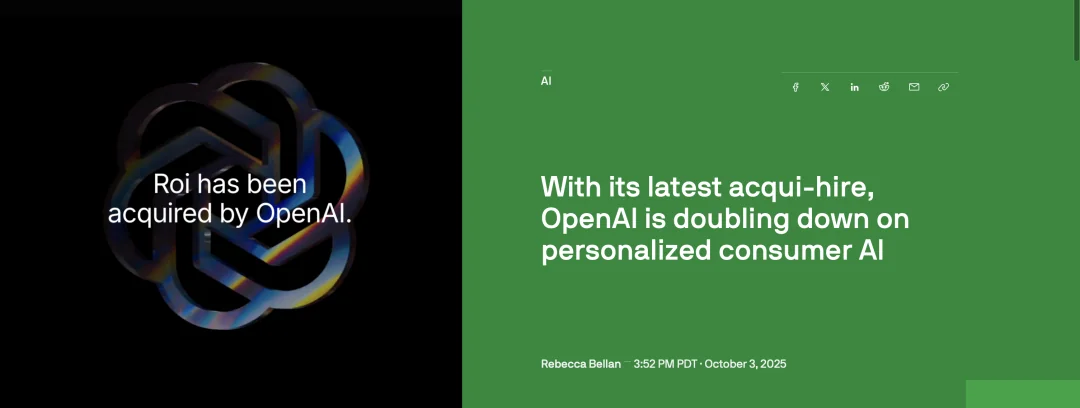
Roi was founded in 2022 by two former Airbnb engineers and focused on AI-driven personal finance management, including portfolio tracking, trading features, and a personalized financial assistant called Roi AI.
The company had raised $3.6 million from investors including Spark Capital and Balaji Srinivasan.
After the acquisition, only CEO Sujith Vishwajith from the four-person team joined OpenAI.
It's unclear whether CEO Sam Altman is trying to replicate the "Liang Wenfeng model"—referring to a pattern where Chinese tech companies acquire startups primarily for their talent—or simply has so much funding he needs help managing it.