
Google researchers, including Kaiming He and Saining Xie, have published a paper introducing Vision Banana. It's a clever trick: they took their own image generation model, Nano Banana Pro (also known as Gemini 3 Pro Image), gave it a light instruction fine-tuning, and turned it into a general-purpose visual understanding model. The core idea is to parameterize the output of all visual tasks as an RGB image. That means tasks like segmentation, depth estimation, and surface normal estimation are all performed through image generation, eliminating the need for specialized architectures or custom loss functions for each job.
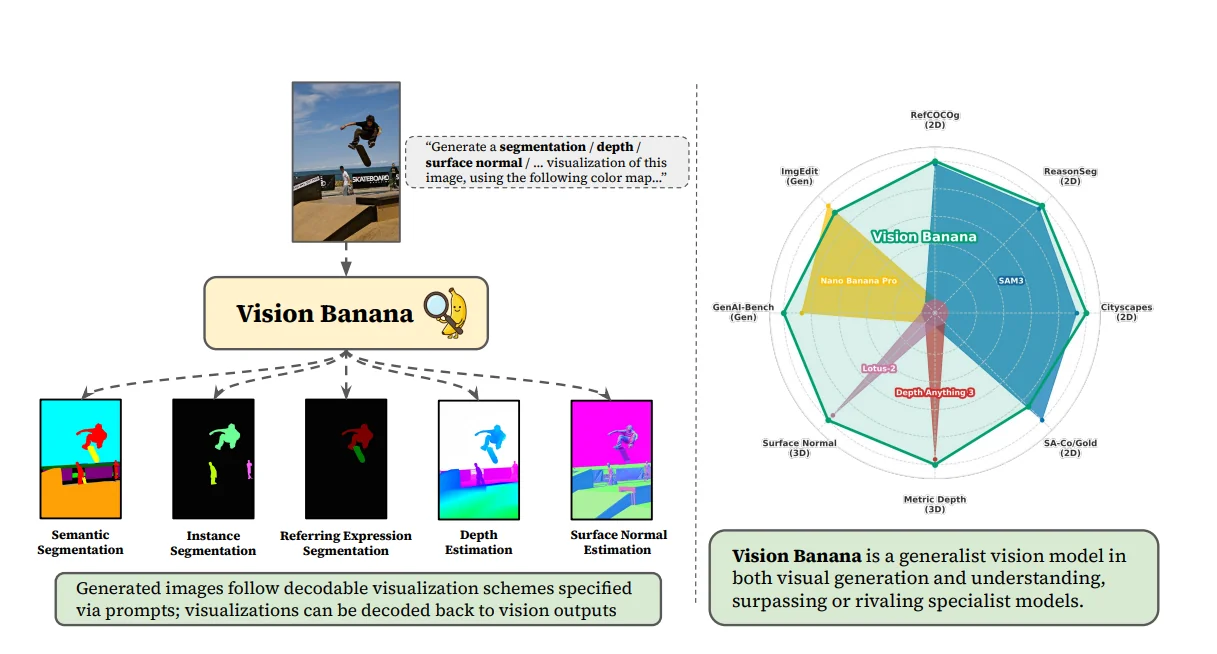
The evaluation covered two major categories: image segmentation and 3D geometric inference. For segmentation, Vision Banana beat the specialized segmentation model SAM 3 by 4.7 percentage points on semantic segmentation (labeling each pixel in an image with a category like 'road,' 'pedestrian,' or 'vehicle') on the Cityscapes dataset. It also outperformed SAM 3 Agent on referring expression segmentation (finding and segmenting an object based on a natural language description like 'the dog with the hat on the left'). However, it still lags behind SAM 3 on instance segmentation (distinguishing between different individual objects of the same class, like identifying five separate dogs in a picture).
On the 3D front, metric depth estimation (calculating the actual physical distance from the camera for each pixel in a single photo) achieved an average accuracy of 0.929 across four standard datasets, beating the specialized model Depth Anything V3's score of 0.918. Impressively, it was trained entirely on synthetic data, used no real-world depth data, and doesn't require camera parameters during inference. Surface normal estimation (inferring the orientation of object surfaces) achieved top results on three indoor benchmarks.
The fine-tuning process simply mixed a small amount of visual task data into the original image generation training data. The model's core image generation capability remained virtually untouched, matching the original Nano Banana Pro in quality evaluations. The paper argues that image generation pre-training plays a role in vision similar to text generation pre-training in language: the model learns the internal representations needed to understand images simply by learning how to generate them. Instruction fine-tuning just unlocks that latent capability. This approach arrives as the competition heats up, with OpenAI reportedly readying a new image model to counter Google's Nano Banana.