
Exa has launched a new high-end search interface for AI agents called Deep Max. It's designed to be fast—really fast. How does it work? A single query triggers dozens of concurrent Exa searches, each approaching the question from a different angle, and then merges the results into a final answer.
This is what's known as "agentic search," where a large language model autonomously plans and executes multiple search rounds before synthesizing a response. It's become the primary product focus over the last year for search API companies like Perplexity, You.com, and Parallel.
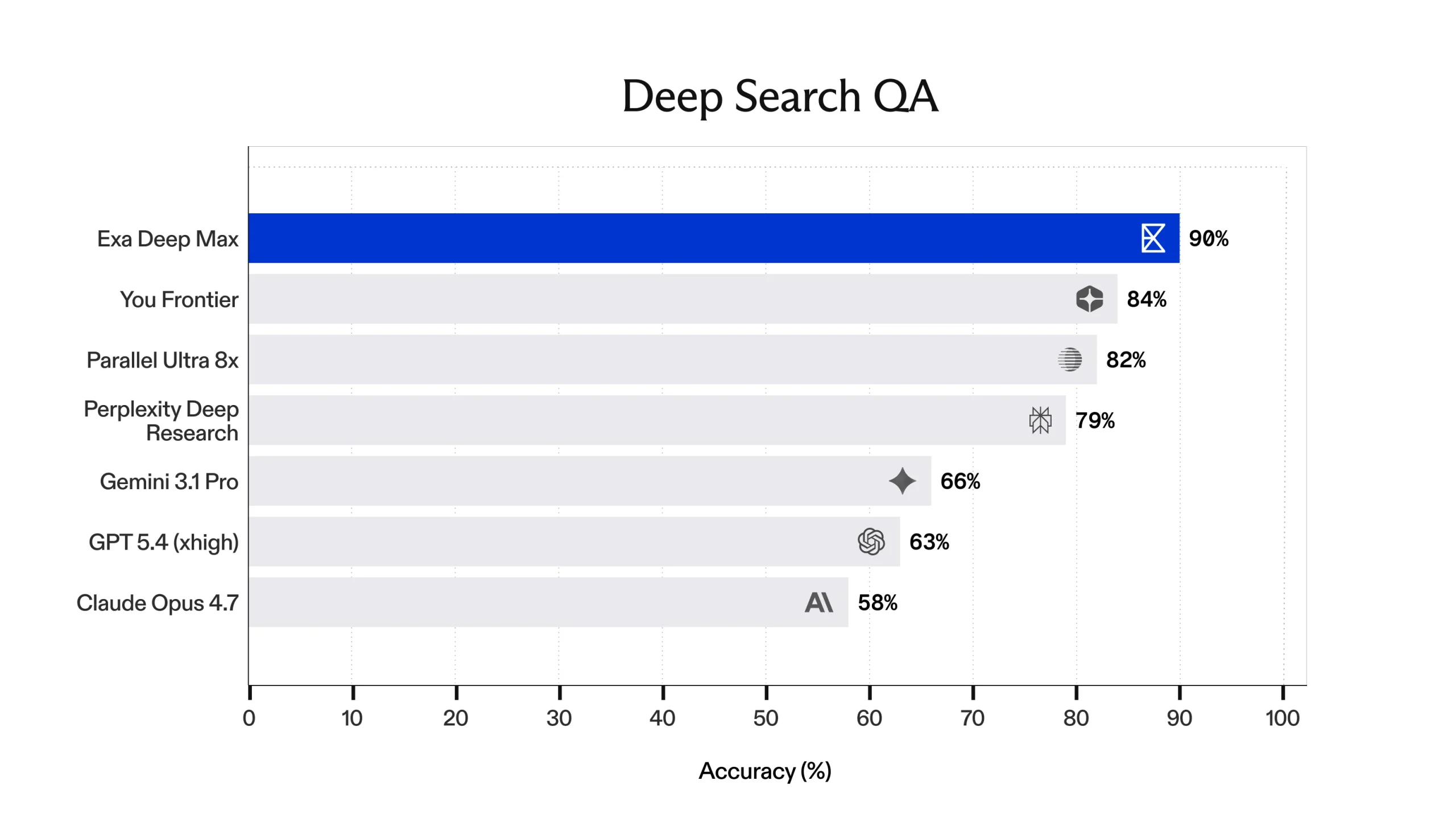
The performance claims are based on Exa's own internal benchmarking against competitors. In the Deep Search QA test, Deep Max scored 90% accuracy in 64 seconds, compared to You.com Frontier's 84% in 5908 seconds and Parallel Ultra 8x's 82% in 1703 seconds. On the FRAMES benchmark, Deep Max hit 94% in 11 seconds, while Parallel Ultra took 1457 seconds for 88%. For HLE-Search, Deep Max achieved 80% accuracy in 25 seconds, matching GPT 5.4's accuracy but cutting the time in half. The comparison also included native search tools like Gemini 3.1 Pro and Claude Opus 4.7. Exa says Deep Max is "up to 20 times faster than the closest competitor."
That speed is attributed to parallel tool calls, compressed web page content, and Exa's proprietary search stack, which returns a single call in under a second. Deep Max is currently only available to customers in direct sales discussions; a public release date and pricing haven't been announced. This launch comes as the AI search space heats up, with models like Moonshot AI's Kimi K2.6 also making waves by matching GPT-5.4 on coding benchmarks and Anthropic's Claude Opus 4.7 arriving with smarter coding and better vision.