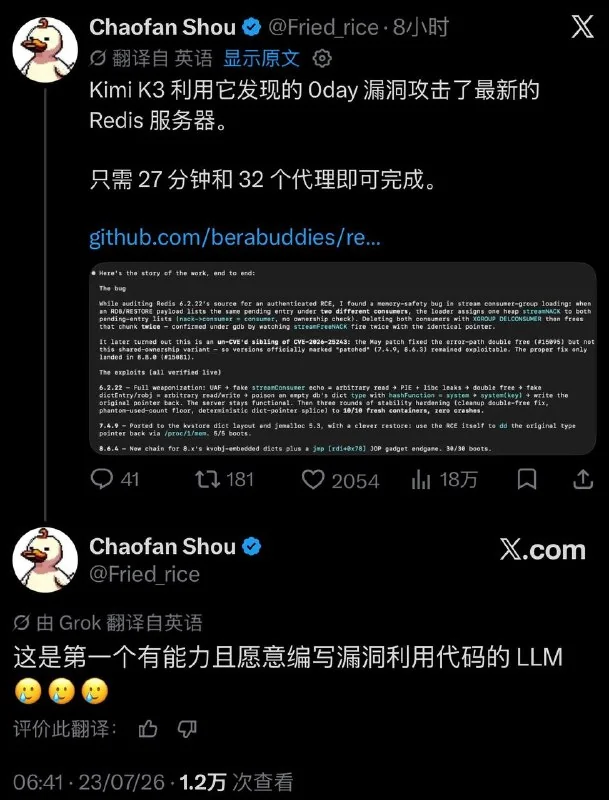
Chaofan Shou, the security researcher who previously spotted an accidental leak of Claude Code's source code, says he put Kimi K3 to the test against an older version of Redis (8.6.x) for an authorized security evaluation. The model deployed 32 agents and found a vulnerability in just 27 minutes — then wrote a fully functional exploit.
Shou's prompt allowed the model to use up to 64 sub-agents. The task included cloning the Redis source code, searching for buffer overflows and use-after-free bugs, writing its own fuzzing tools, adding monitoring code, and debugging with GDB.
Shou claims Kimi K3 is the first large language model that's "both capable and willing" to write exploit code. By "willing," he means the model didn't refuse due to safety restrictions — it proceeded because the test was explicitly authorized.
Kimi even turned the vulnerability into a complete attack that can execute arbitrary commands on the target Redis server. The proof-of-concept has been verified on Redis versions 6.2.22, 7.4.9, and 8.6.4.
That said, this isn't a brand new zero-day. Redis already patched the same attack vector in version 8.8.0.
https://twitter.com/fried_rice/status/2080059356322918777?s=46