
On April 13, Stanford University's Institute for Human-Centered Artificial Intelligence (Stanford HAI) released its 2026 AI Index Report, a comprehensive 423-page document.
Published annually since 2017, this report has become the most thorough yearly snapshot of the artificial intelligence industry, tracking everything from model releases and funding flows to workforce shifts, energy consumption, environmental impact, and public sentiment.
The 2026 edition reveals an industry racing toward breakthroughs while raising urgent questions about environmental costs, technological transparency, and who truly benefits from these advances.
Here are the key takeaways from the latest report:
The 2.7% Gap: China Narrows the AI Performance Divide
Silicon Valley has long been seen as the undisputed global hub for AI, but Stanford's latest data shows that monopoly is crumbling.
According to research firm Epoch AI, as of March 2026, the most advanced model from U.S. AI leader Anthropic—led by CEO Dario Amodei—holds just a 2.7 percentage point lead over China's top competitor.
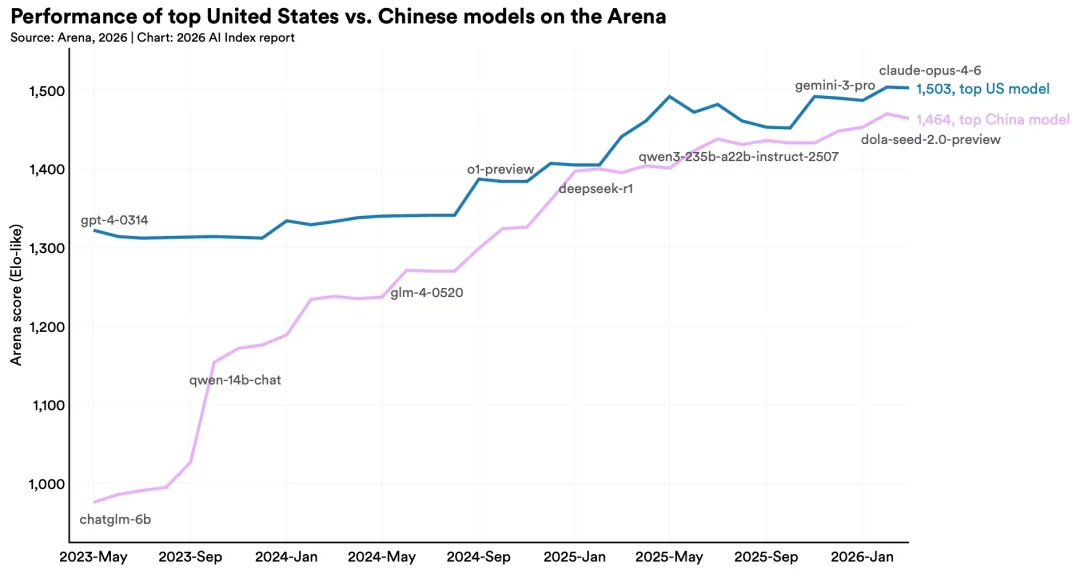
Performance gap between top U.S. and Chinese AI models
The turning point came in February 2025, when DeepSeek's R1 model briefly matched U.S. performance, kicking off a rapid back-and-forth of incremental gains. Nestor Maslej, the report's editor-in-chief, notes that this seesawing lead signals a new era of "technological parity" at the highest levels of global AI development.
In terms of output, the U.S. released 50 notable top-tier models in 2025, while China followed with 30.
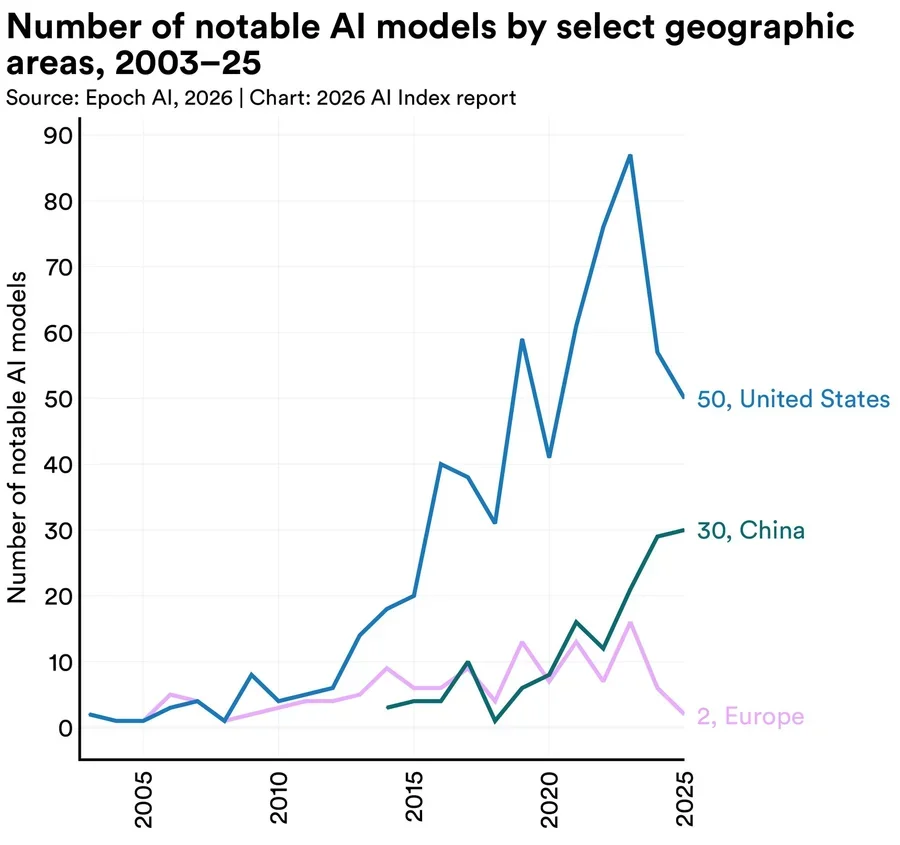
AI model counts from the U.S., China, and Europe, 2003–2025
While the U.S. still leads in total model count and private investment—$285.9 billion versus China's $12.4 billion—the report cautions policymakers that these figures vastly underestimate China's actual spending.
Since 2000, Chinese government-guided funds have funneled approximately $184 billion into AI companies. This state-backed, enterprise-driven model has already made China the global leader in AI publications, paper citations, and patent grants.
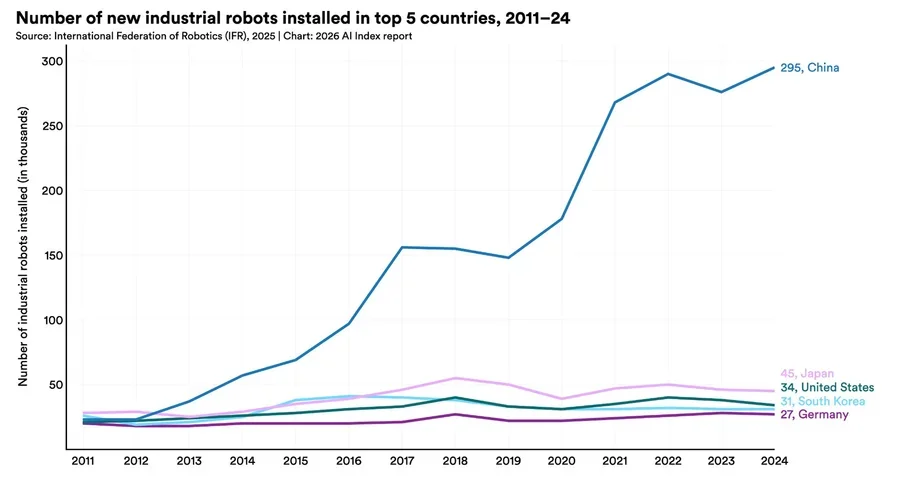
Industrial robot installations in 2024: China 295,000, Japan 44,500, U.S. 34,200
More tangible evidence: China now leads the world in industrial robot installations, suggesting it may have a stronger engineering foundation for deploying AI in the physical world.
Some U.S. tech executives attribute China's catch-up to its efficient use of open-source code and engineering execution. But as performance gaps shrink to single digits, future competition won't just be about whose model scores a few percentage points higher—it will hinge on who can turn expensive computing power into real-world productivity gains.
So far, the U.S. still employs far more AI researchers and developers than any other country, but the influx of experts is slowing dramatically. Since 2017, the number of AI scholars moving to the U.S. has dropped 89%, with an 80% decline in the past year alone.
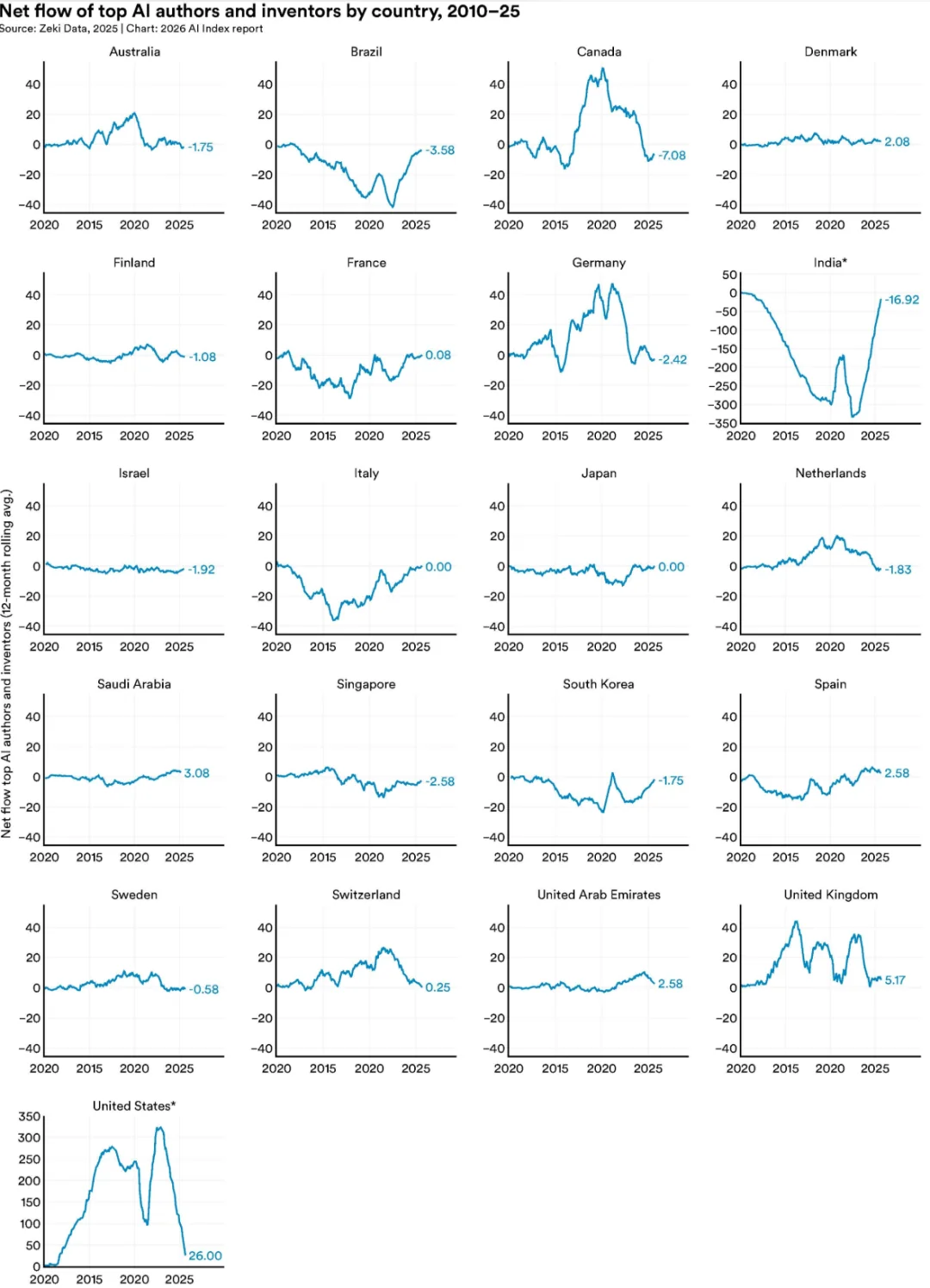
Sharp decline in AI talent migrating to the U.S.
U.S. Holds Computing Lead, But Strains the Grid
The U.S. maintains a clear lead in data center infrastructure.
Stanford HAI data shows the U.S. operates 5,427 data centers, compared to China's 449, with Germany and the U.K. each around 525. By the end of 2025, AI data centers' total power capacity reached 29.6 gigawatts—roughly equal to New York State's peak electricity demand.
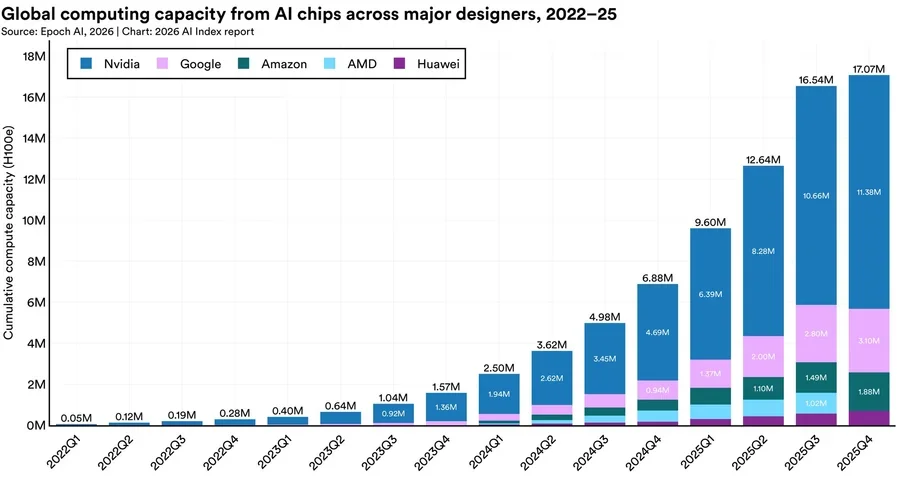
Nvidia GPUs account for over 60% of global AI computing capacity, followed by Google and Amazon
Data center expansion comes with significant environmental costs. The Stanford HAI report estimates that training xAI's Grok 4 model produced about 72,816 metric tons of CO₂ equivalent—more than the lifetime emissions of about 1,000 average cars.
Ray Perrault, co-chair of the AI Index Steering Committee, notes this estimate relies on unverified public reports and xAI statements and should be interpreted cautiously. He adds that Epoch AI independently estimated Grok 4 emissions at around 140,000 metric tons of CO₂.
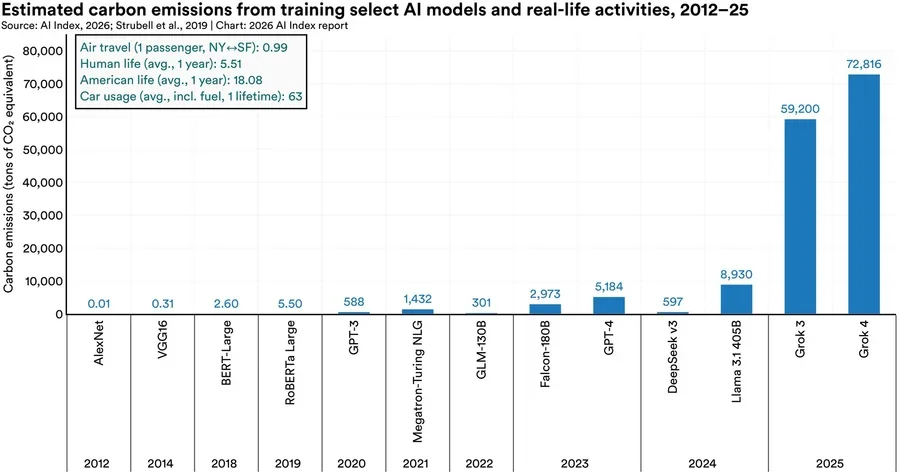
Estimated AI training emissions, 2012–2025, with sharp spikes from Grok 3 and Grok 4
Model inference also carries an environmental burden. The report estimates that GPT-4o's annual water consumption for inference exceeds the drinking water needs of 12 million people. The least efficient models emit over 10 times more carbon than the most efficient. DeepSeek's V3 model uses about 23 watts for a medium-length prompt, while Claude 4 Opus uses about 5 watts.
Local communities are increasingly pushing back against data center projects. Over the past two years, $64 billion worth of U.S. data center projects have been stalled or delayed due to local opposition, with at least 142 activist groups across 24 states organizing resistance.
Among elected officials who publicly opposed data centers, 55% were Republicans and 45% Democrats. In Warrenton, Virginia, every town council member who voted for an Amazon data center project lost their next election.
Some opposition has turned violent. An Indianapolis city councilor who supported rezoning for a data center in his district reported that someone fired shots at his home in early April, leaving a handwritten note on his doorstep that read, "No data center." The councilor and his eight-year-old son were unharmed.
AI Performance Soars, But Weak Spots Remain
Over the past decade, AI model performance has improved rapidly, with acceleration in recent years.
Multimodal large language models are now solving new benchmarks almost as fast as they're released. AI agents show the steepest improvement curves, particularly on the OSWorld benchmark (testing autonomous computer use) and SWE-Bench Verified (testing autonomous coding).
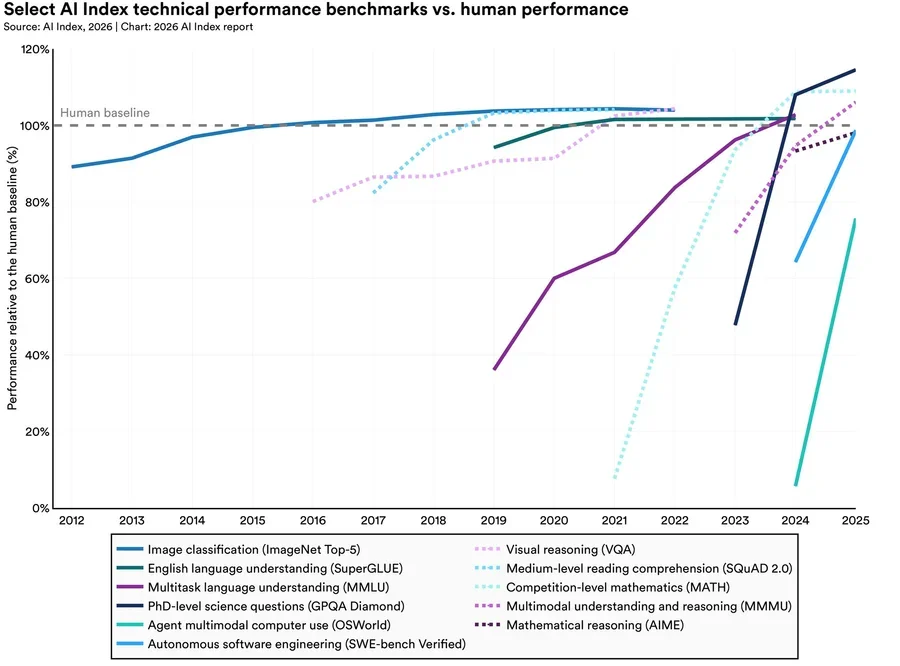
AI performance vs. human baselines across tasks, 2012–2025
The "Human Ultimate Exam" benchmark includes expert-contributed questions across fields. In the 2025 report, OpenAI's top-performing o1 model answered only 8.8% correctly, later improving to 38.3%. By April 2026, the highest-scoring models—Anthropic's Claude Opus 4.6 and Google's Gemini 3.1 Pro—topped 50%.
Perrault cautions that benchmarks don't always reflect real-world performance: "Knowing a model scores 75% on a legal reasoning benchmark doesn't tell us how well it would perform in a law firm."
AI is making strides in medicine. Publications on AI for drug discovery more than doubled in the past two years, while multimodal biomedical AI publications grew 2.7 times.
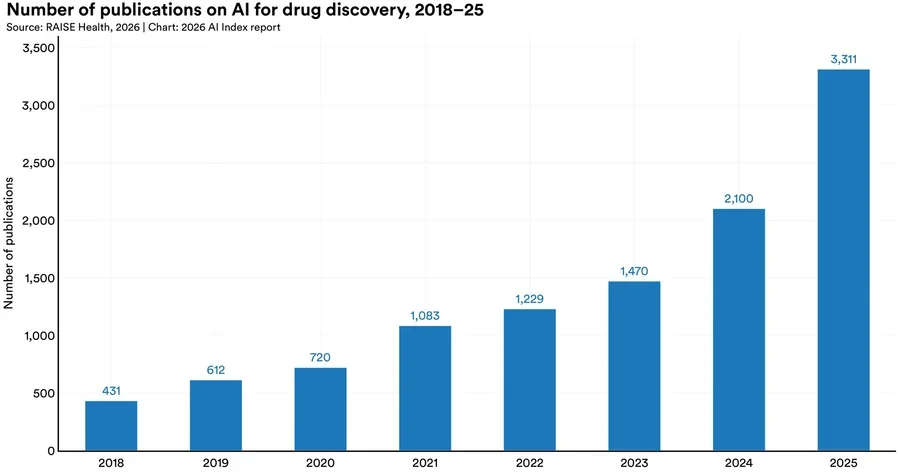
Publications on AI for drug discovery, 2018–2025
Yet AI models struggle with some common tasks.
The ClockBench test measures multimodal LLMs' ability to read analog clocks. The top performer, OpenAI's GPT-5.4, achieved just 50% accuracy. Most models scored much lower. Anthropic's Claude Opus 4.6—a high scorer on other benchmarks—managed only 8.9%.
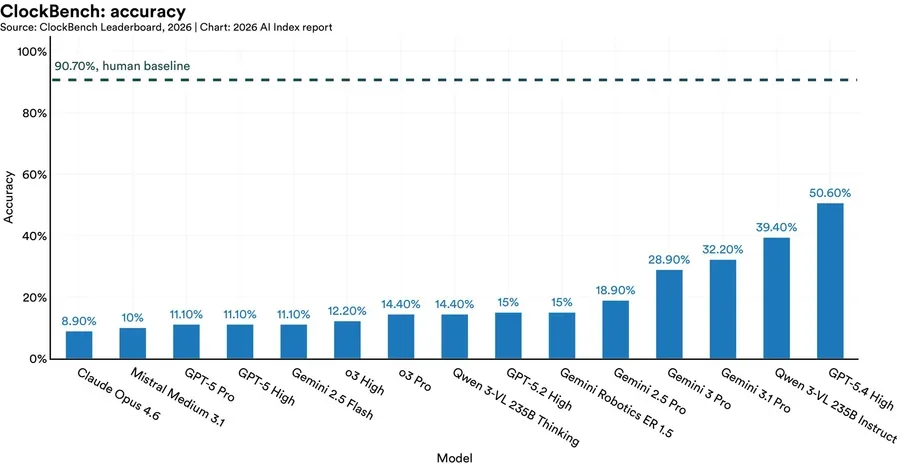
ClockBench accuracy rates for various LLMs
Perrault says this reflects a broader issue: "Research suggests that when systems are asked questions combining language with other modalities like images or audio tone, the language part carries almost the entire burden, to the point of ignoring non-linguistic information entirely."
Robots also lag in household chores, succeeding only 12% of the time at tasks like folding laundry or washing dishes.
AI Accelerates in Medical Research
Medical AI applications are advancing quickly. Publications on AI for drug discovery more than doubled over two years, while multimodal biomedical AI publications grew 2.7-fold.
Notable 2025 projects included the first end-to-end AI weather forecasting system, which ingests raw meteorological data and outputs final forecasts, and astronomy's first foundation model for automated telescope observations.
In clinics, tools that automatically generate clinical notes from patient visits saw widespread adoption in 2025. Doctors reported cutting note-writing time by up to 83% and significantly reducing burnout.
But the report notes that, aside from certain tools, clinical AI's value remains speculative. A review of over 500 clinical AI studies found nearly half relied on exam-style questions rather than real patient data, and only 5% used actual clinical data.
Another growing area is digital twins—dynamic, data-linked computational models of individual patients that update over time and support prediction, simulation, and treatment optimization. Publications on the topic rose from near zero in 2015 to 372 in 2025.
Worker Efficiency Rises, But Companies Don't Benefit
On specific tasks, AI delivers measurable efficiency gains.
Customer support agents solve nearly 15% more issues per hour, developers using GitHub Copilot complete 26% more pull requests, and marketing teams using AI for ad creation see per-person output jump 50%.
At the U.S. economy level, 2025 productivity growth hit 2.7%—about double the prior decade's average. But the Wharton Budget Model cited in the report estimates AI's actual contribution to total factor productivity at just 0.01 percentage points, effectively zero.
The report also notes that for deeper reasoning tasks, AI tools can reduce human efficiency. Open-source developers using AI assistance were 19% slower. Engineers relying on AI for learning showed no speed gains and suffered what researchers call a "learning penalty," potentially slowing their professional development over time.
Workforce data shows clear generational splits. By September 2025, employment of U.S. software developers aged 22–25 fell nearly 20% from its 2022 peak, while older developers kept growing. Customer support shows similar trends.
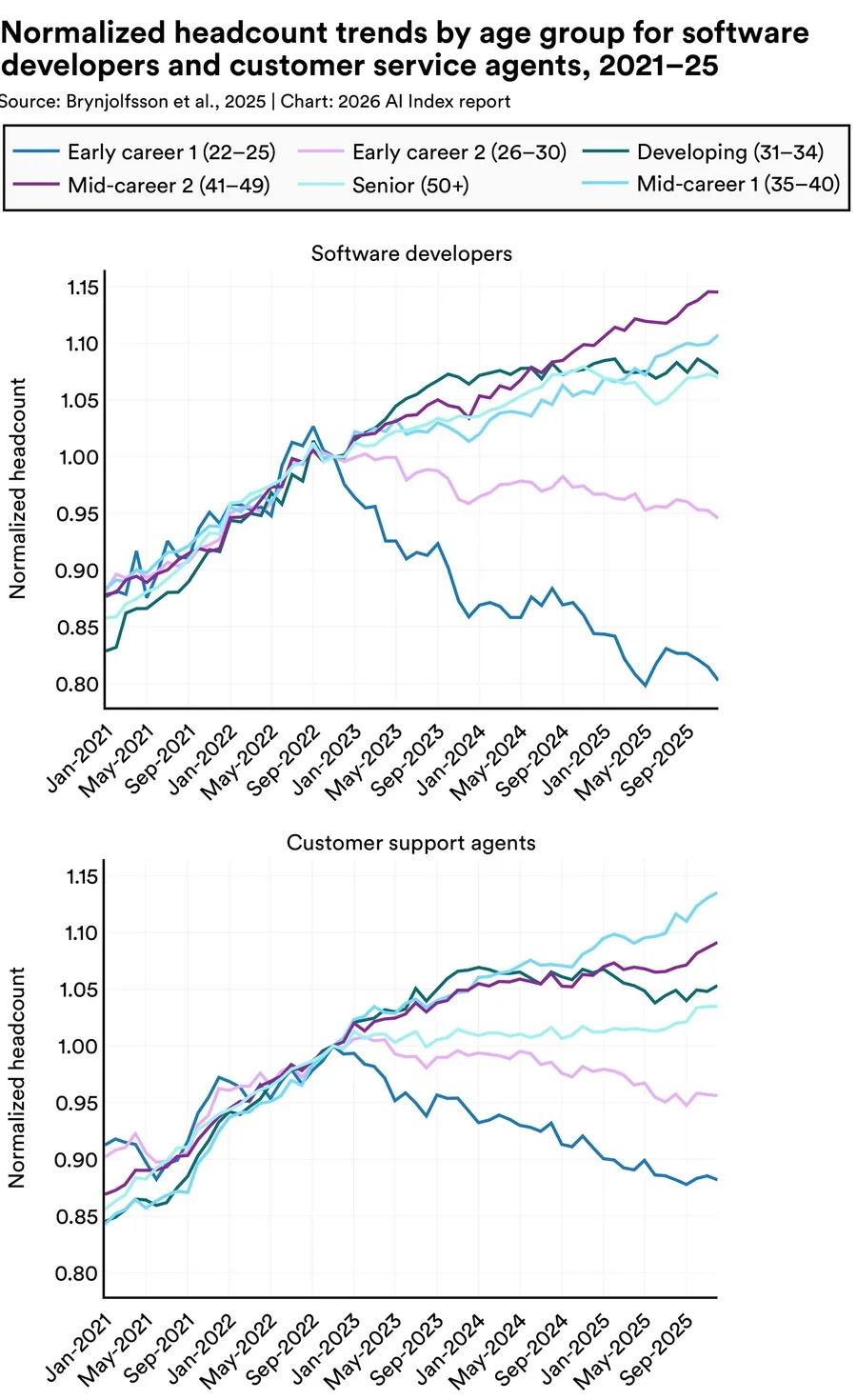
U.S. software developer and customer support staffing by age, 2021–2025
These shifts are hard to isolate from broader trends. Unemployment is rising across multiple occupations, and contrary to expectations, workers least exposed to AI saw larger unemployment increases than those most exposed. One-third of surveyed companies expect to reduce headcount due to AI in the coming year.
Separate MIT research found that 95% of companies saw zero return on roughly $35–40 billion in AI investments, with only 5% successfully deploying tools at scale.
Global AI Investment Soars, U.S. Leads But China Underestimated
According to AI analytics firm Quid, global AI investment hit a record $581 billion in 2025—more than double 2024's $253 billion and surpassing 2021's $360 billion peak.
Unlike 2021's merger-driven surge, 2025's record was fueled by private investment. Most funding went to the U.S., which attracted over $344 billion.
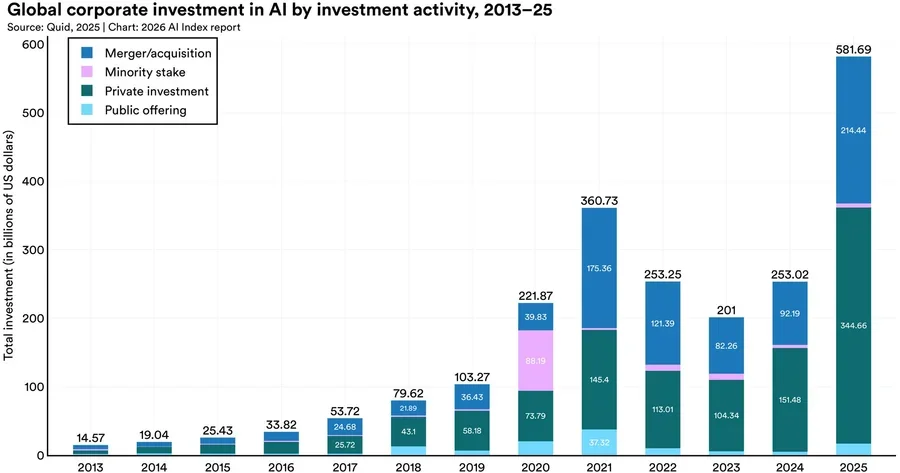
Global corporate AI investment by activity type, 2013–2025
But the report reiterates that comparing only private investment underestimates China's AI spending. It estimates that from 2000 to 2023, $912 billion in government-guided funds was deployed across sectors including AI.
In computing capacity, Nvidia GPUs account for over 60% of global AI compute, with Google and Amazon following. Global AI compute has grown 3.3 times annually since 2022 and 30 times since 2021.
AI Adoption Outpaces Internet, But U.S. Lags
Generative AI adoption continues to accelerate. The report notes it reached 53% population penetration in three years—faster than personal computers or the internet. Adoption varies by country and closely tracks per capita GDP.
Some nations exceed expectations: Singapore hit 61%, the UAE 54%. The U.S. ranks 24th at 28.3%. By early 2026, generative AI tools' estimated annual value to U.S. consumers reached $172 billion, with per-user value tripling from 2025 to 2026.
In education, four out of five U.S. high school and college students use AI for schoolwork. But only half of middle and high schools have AI policies, and just 6% of teachers say those policies are clear. Formal education is lagging far behind AI use.
On GitHub, AI-related projects climbed to 5.58 million in 2025—about five times 2020's count and up 23.7% from 2024. Projects with at least 10 stars and total stars awarded grew at similar rates. The open-source agent software OpenClaw has garnered 352,000 stars.
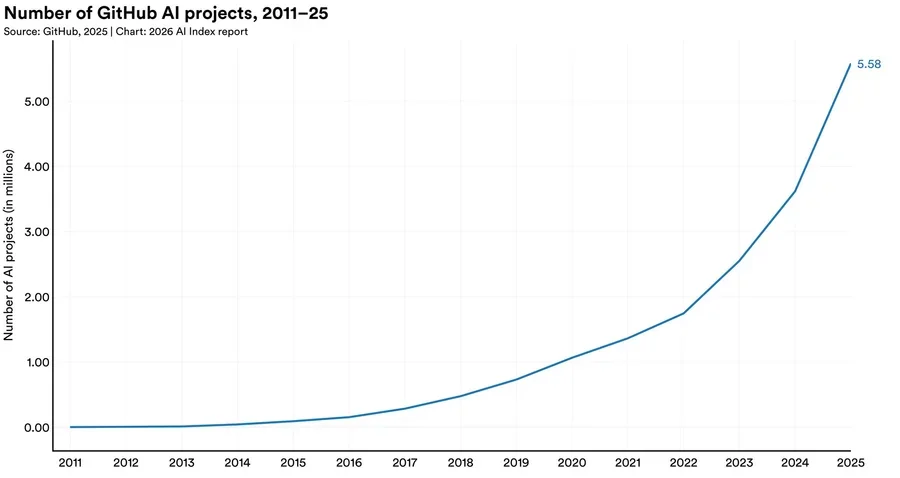
GitHub AI project count, 2011–2025
Perrault says, "GitHub activity likely correlates strongly with AI usage intensity." But according to the tracking site Agents in the Wild, most GitHub activity is still human-driven.
Over the past decade, AI-related computer science publications more than doubled from 102,000 to 258,000. As of 2024, over 68% came from academia, with government and industry contributing about 11.5% and 12.5%, respectively. Growth is driven by machine learning, computer vision, and generative AI.
Americans Are Most Wary of AI
Ipsos survey data shows the share of respondents who believe AI's benefits outweigh its risks rose from 55% in 2024 to 59%. Those claiming a "good understanding" of AI edged up from 67% to 68%. Yet 52% said using AI products and services makes them "nervous."
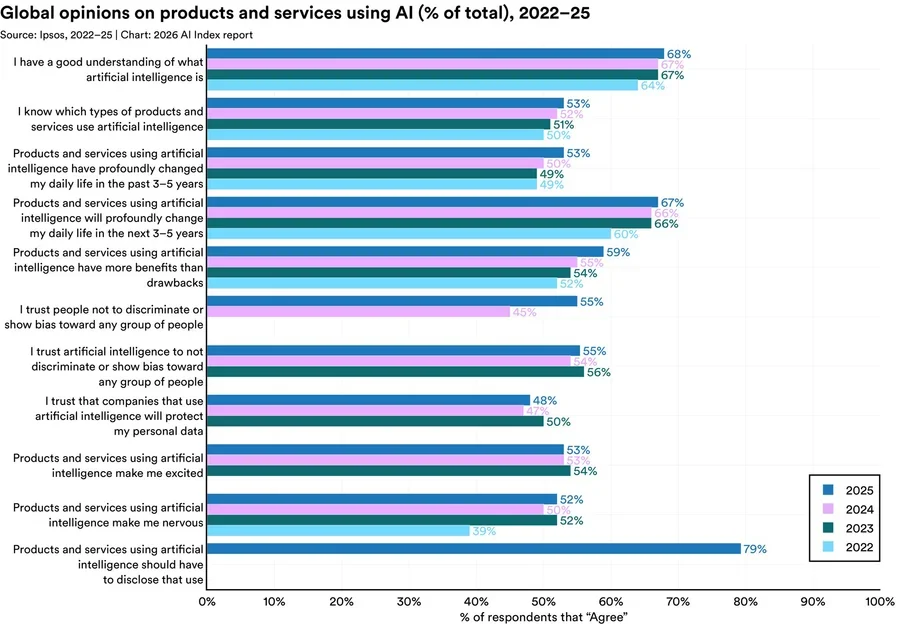
Public sentiment on AI statements, 2022–2025
Attitudes vary widely by country. China, Malaysia, Thailand, Indonesia, Singapore, and other Southeast Asian nations lean positive. The biggest annual positive shifts were in Germany (+12%), France (+10%), and the Netherlands (+10%). Colombia saw the largest negative shift (-6%), reversing prior trends.
Americans are more cautious than most. Only 33% expect AI to improve their jobs, versus 40% globally. The U.S. also has the highest share expecting AI to eliminate rather than create jobs.
Trust in government AI regulation varies even more. In Singapore, 81% trust regulators; in the U.S., just 31%—the lowest among surveyed countries. Several European nations and Japan also show low trust, while Asian and South American countries generally report higher confidence.
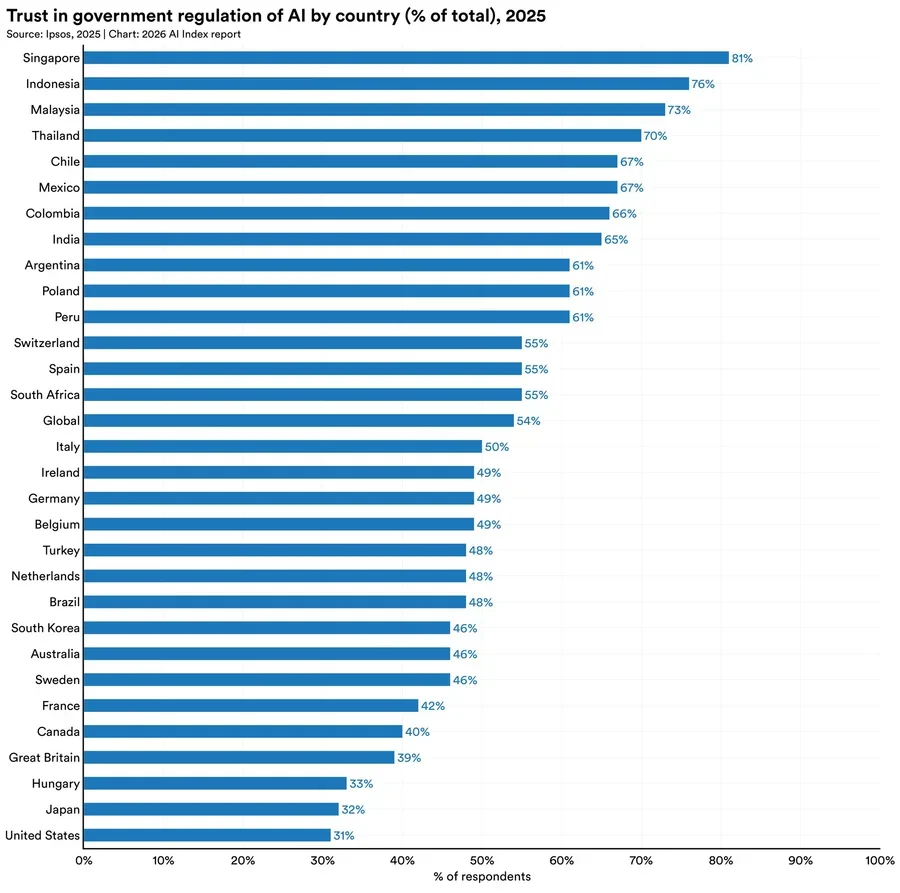
Public trust in government AI regulation by country
Pew Research finds a sharp divide between experts and the public. While 73% of experts believe AI will positively impact work, only 23% of Americans agree. Experts are also more optimistic about AI in education and healthcare, though both groups expect negative effects on elections and personal relationships.
The report highlights another concerning trend: today's most capable models are also the least transparent. Powerful models are increasingly concentrated in the largest AI companies, which are keeping training code, dataset sizes, and parameter counts secret.
The Foundation Model Transparency Index, which measures how openly companies disclose model details, fell from an average score of 58 in 2024 to 40 this year. The index notes that the most capable models often disclose the least.
Report co-author Yolanda Gil, a computer scientist at the University of Southern California, says, "There's a lot we don't know about predicting model behavior." This lack of transparency, she adds, makes it harder for independent researchers to study how to make AI models safer.
Conclusion
Stanford's AI Index Report is, in essence, a survival manual co-authored by humans and machines. Its 423 pages make clear that AI has moved past its storytelling childhood into adulthood—facing grown-up challenges like commercial returns, energy constraints, and global sovereignty competition.
For China, closing the 2.7% gap means the catch-up phase is over. The next task is leveraging its patent and industrial robot scale to harvest AI's benefits in the real economy.
For the U.S., maintaining private investment's innovative energy while solving high costs and energy demands will determine whether it leads the next decade.
The $405 billion gamble has just entered its second half. The ultimate winner may not be the one with the most computing power, but the one best adapted to physical reality and commercial value.