
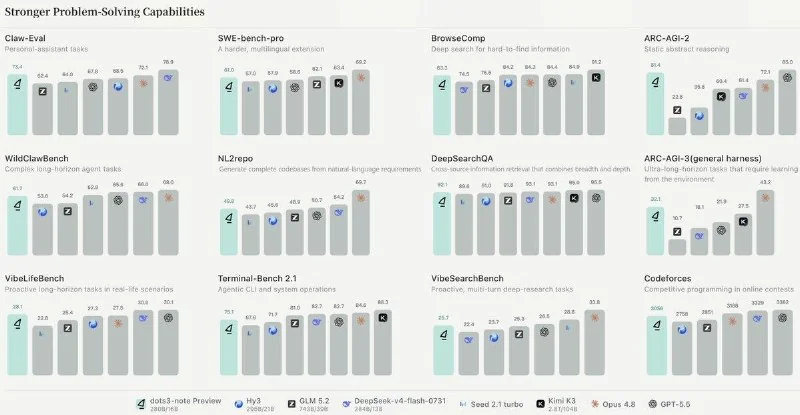
RedNote's dots lab has open-sourced dots3-note preview, the first open-weight model in the dots3 series. It packs 280B total parameters with 16B active at a time, a 512K context window, and support for text, images, video, and audio.
It's built for long-horizon agents. The model can explore the rules of unfamiliar environments, call tools, write code, save important information to memory, and adjust its actions as new situations arise.
The training method TEMPO specifically tackles the problem of feedback arriving too late in long tasks. It breaks down a task that might run for a dozen or more hours into multiple stages, letting the model evaluate itself midway, then continuing with reinforcement learning. In official experiments, plain GRPO tends to plateau in later stages, while TEMPO keeps improving.
The team also open-sourced VibeSearchBench and VibeLifeBench. The latter includes 200 tasks, 22 simulated services, and 288 tool interfaces. Even the strongest current model manages just 32.5 avg@3. Long-horizon agents still have a long way to go before they can truly see long-term tasks through to the end.
https://twitter.com/dotsstudioai/status/2088083314855018521