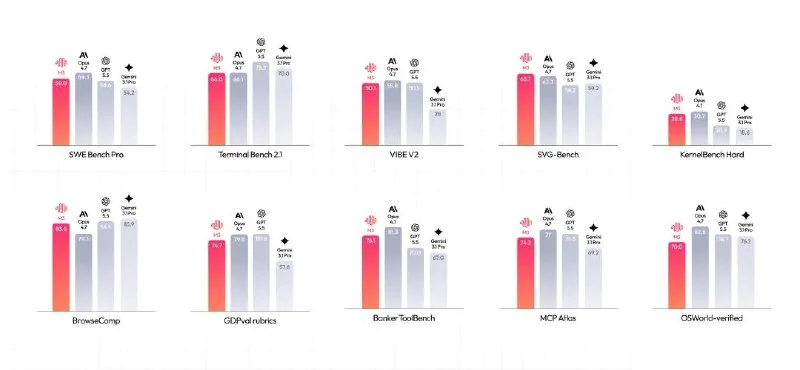
MiniMax today released its M3 large language model, and it's making some bold claims. The company says M3 is the first open-source model to combine top-tier coding, ultra-long context, and native multimodal capabilities — with weights planned for release in 10 days. It already beats GPT-5.5 and Gemini 3.1 Pro on the SWE-Bench Pro coding benchmark, scoring 59.0%, and hits 66.0% on Terminal Bench 2.1. That puts it close to Opus 4.7.
For long-context tasks, M3 introduces a new sparse attention architecture called MSA. It uses KV block aggregation to hit queries, achieving 4x faster memory access than Flash-Sparse-Attention. At 1 million tokens of context, it reduces per-token computation to 1/20th of the previous generation, with 9x faster prefilling and 15x faster decoding.
In autonomous tests, M3 ran for 12 hours to reproduce an ICLR 2025 paper and observed the direct preference optimization (DPO) effect. On a Hopper-based FP8 operator optimization task, it autonomously called tools 1,959 times over 24 hours, pushing hardware utilization from 7.6% to 71.3% — a 9.4x speedup. On the PostTrainBench, it scored 0.37, slightly behind Opus 4.7 and GPT-5.5 but well ahead of other models.
MiniMax Code has also been updated with computer use desktop control. The Plus subscription costs 49 yuan per month for 600 million tokens — roughly five times the capacity of Claude Pro. The API is live with thinking (reasoning) and non-thinking (fast) modes, and the model weights are scheduled to be open-sourced within 10 days.