
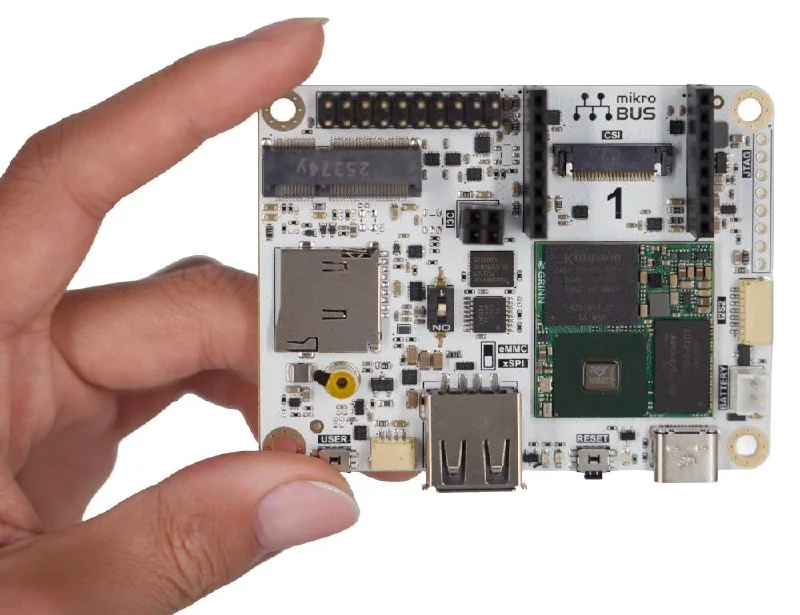
Google Research and chipmaker Synaptics have teamed up on a limited-edition Coral Dev Board that signals a major shift in Google's edge AI hardware strategy: instead of selling proprietary chips, the company is now giving away the designs for free. The move effectively ends Google's run of closed-source Edge TPU hardware (like the USB Accelerator) and pivots the company into a pure architecture and standards play. Google won't sell physical chips anymore — it's open-sourcing the whole NPU design, built on the open RISC-V instruction set.
This new board is the first commercial product to come from that open-source chip blueprint. Inside is Synaptics' Astra SL2610, a chip that integrates Google's open-source NPU. With 1 TOPS of hardware acceleration, the board is optimized out of the box and can run Google's latest lightweight Gemma 3 270M model entirely on-device — no cloud, no API fees, no network needed. Developers get private, local generative AI at incredibly low power.
On the hardware side, the board includes CSI/DSI video interfaces, USB, microphone input, and an M.2 expansion slot for wireless connectivity. That makes it cheap to slap into smart home gadgets, wearables, or robots. Software-wise, it runs the Torq open-source toolchain based on MLIR and IREE compilers, which can compile and quantize models from PyTorch, JAX, and TensorFlow into a unified format. Because the chip architecture is fully open and standardized, developers can "write once, run on any compatible chip" — no more being locked into a single vendor's ecosystem.