

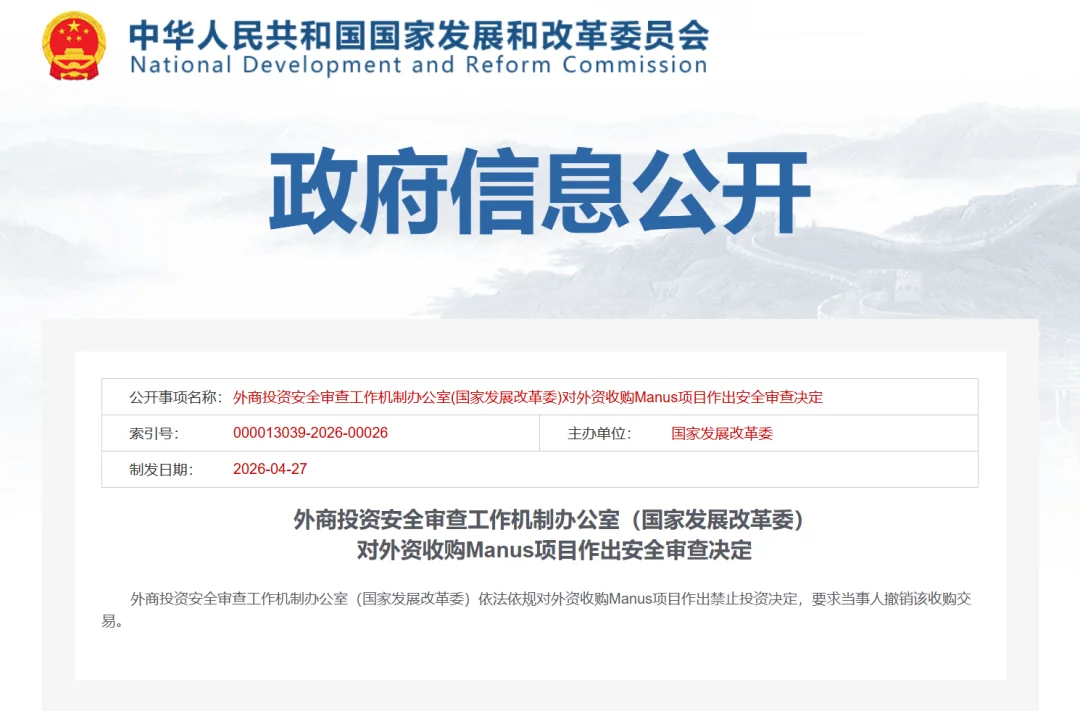
On April 27, China's National Development and Reform Commission (NDRC) Foreign Investment Security Review Office formally banned Meta's acquisition of AI agent startup Manus, ordering the deal unwound.
The deal, once touted as Meta's third-largest acquisition, lasted just four months from its December 2025 announcement to its April 2026 demise.
Manus acquisition key timeline
Last March, Manus officially launched. The Monica.im team released what they called the world's first general-purpose AI agent. It was an instant hit — invite codes were scalped for high prices, and annualized revenue quickly surpassed $125 million.
On December 30, Meta announced it would acquire Manus parent company Butterfly Effect for $3–5 billion. Negotiations took just over ten days, and founder Xiao Hong was set to become a Meta VP.
On January 8, regulators launched an investigation. The Ministry of Commerce and other agencies assessed compliance on tech exports, cross-border data, and foreign investment reporting.
In March, the NDRC summoned executives from both sides, flagged technology transfer and data security risks, and ordered a halt.
On April 27, the Foreign Investment Security Review Office formally prohibited the transaction, requiring its unwinding and restoration to the pre-investment state.
Unwinding the deal:
Full restoration from equity to data
Under Article 12 of China's Foreign Investment Security Review Measures, the core requirement is to restore the state before the investment within a deadline and eliminate national security risks. This breaks down into three modules:
(1) Equity and transaction entities
All parties sign a written termination agreement, cancel the acquisition, and terminate all ancillary documents (shareholder agreements, technology transfer agreements, etc.).
If Meta has already completed equity transfer, it must return all Manus shares to the original shareholders/domestic entities and complete business registration changes.
Regulators will monitor to ensure no "de facto control" through agreements or nominee holdings.
(2) Funds and consideration return
Meta must fully return the approximately $2 billion already paid (including deposits, advance payments, etc.) to transaction accounts.
Original shareholders, upon receiving funds, must complete foreign exchange return and report to foreign exchange authorities.
Both parties must handle intermediary fees and penalties; disguised consideration payments via "compensation" or "consulting fees" are prohibited.
Foreign exchange authorities will audit the entire fund flow to prevent capital flight disguised as deal termination.
(3) Data and technology security
Data isolation and deletion:
Meta must delete all acquired Manus user data, training data, and business data within China, provide proof of deletion, and submit to audits. Manus must restore localized data storage and shut down all cross-border data channels.
Technology and code restoration:
Terminate all technology licenses and code transfers to Meta, reclaim control of core AI technologies and algorithm models, and prohibit Meta from using any Manus technology. Already transferred technical documents and code copies must be destroyed.
Personnel and management isolation:
All Meta-assigned management and technical personnel must withdraw. All control-related management agreements must be terminated to ensure full autonomous management by the domestic entity.
Core reasons:
Three red lines crossed
- Technology and data security
Manus's core technology was developed in China by a Chinese team. During the deal, the entity structure was moved to Singapore — regulators focused on whether this was "tech washing" to evade China's technology export controls. Core algorithms, training data, and user data could have flowed abroad via the acquisition, directly threatening data sovereignty and tech security.
- Foreign investment compliance loopholes
This "American company buying a Singaporean entity" transaction was essentially a Chinese-developed AI technology being acquired by a foreign firm through an offshore entity change, without undergoing China's foreign investment security review. Regulators labeled it a textbook case of "cross-border M&A circumventing review."
- Restructuring to evade regulation
China's Foreign Investment Security Review Measures explicitly require security review filings for foreign acquisitions involving key technologies or data. Manus attempted a path of "domestic R&D + offshore shell + foreign acquisition" to transfer control. The unreported transaction was deemed invalid.
Regulatory oversight and follow-up constraints
The parties must complete all the above operations within a deadline set by regulators. The review office, along with NDRC, commerce, cyberspace, and foreign exchange authorities, will conduct on-site inspections to confirm the deal is fully unwound.
Failure to comply can result in fines, restrictions on domestic operations, a ban on foreign investment activities, and personal legal liability for responsible individuals.
More importantly, any future cross-border cooperation or fundraising by Manus and its original shareholders must go through statutory procedures including foreign investment security review and cross-border data security assessment. They cannot again transfer control, data, or technology abroad through regulatory evasion.
AI cross-border M&A: no more gray areas
This prohibition isn't just about one case — it draws a clear boundary for the AI industry:
It explicitly bans the "domestic R&D + offshore shell + foreign acquisition" transfer path. AI cross-border M&A must undergo full security review and data assessment. Control of AI technology developed in China cannot be transferred abroad without review.
For Meta, losing the acquisition means missing out on key AI agent technology assets and having to return all payments. For the Manus team, they must restore domestic entity control, terminate all cooperation with Meta, and return to compliant operations in China.