Perplexity's open-source search agent beats GPT-5.4 on accuracy and cost


Perplexity's research team just published the recipe for its secret sauce: a detailed technical paper outlining how it trains its web search agents. The process starts with open-source models from Alibaba's Qwen series—specifically the Qwen3.5-122B-A10B and Qwen3.5-397B-A17B—and refines them in two distinct phases.
First, supervised fine-tuning (SFT) teaches the model the basics: following instructions, maintaining consistent language, and other behaviors needed for real-world deployment. Then, the real magic happens with online policy reinforcement learning (RL), which optimizes for search accuracy and how efficiently the agent uses its tools.
For the RL stage, Perplexity uses the GRPO algorithm and feeds it two types of training data. One is a custom-built, multi-hop question-answering dataset. The team starts with internal seed queries, constructs chains of entities to create questions that require two to four logical steps to answer, and then verifies each answer's uniqueness using multiple independent solvers. The other dataset is general conversation data built around a scoring rubric. This turns deployment requirements—like sticking to a format or following instructions—into objective, checkable conditions, preventing the model from backsliding on what it learned during SFT.
The reward system has a clever gatekeeping mechanism. A preference score only factors into the final reward if a baseline is met first—like getting the answer right or satisfying all the rubric's conditions. This prevents a model from getting a high reward for a pleasing but factually wrong response. To keep things efficient, Perplexity uses a "group-anchored" penalty. It compares an agent's performance to correct answers from its peer group, then applies a smooth penalty for any extra tool calls or unnecessarily long text generation.
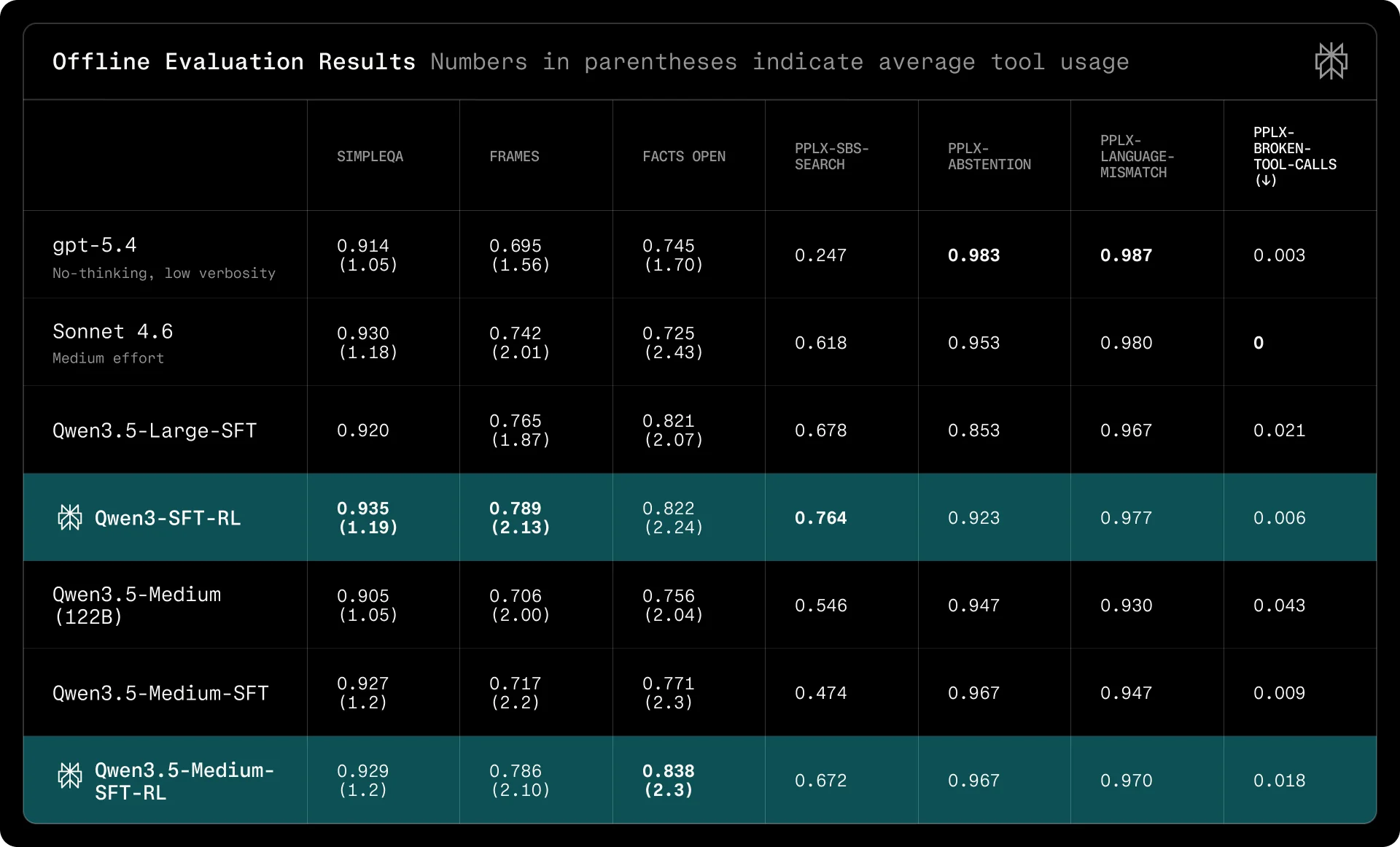
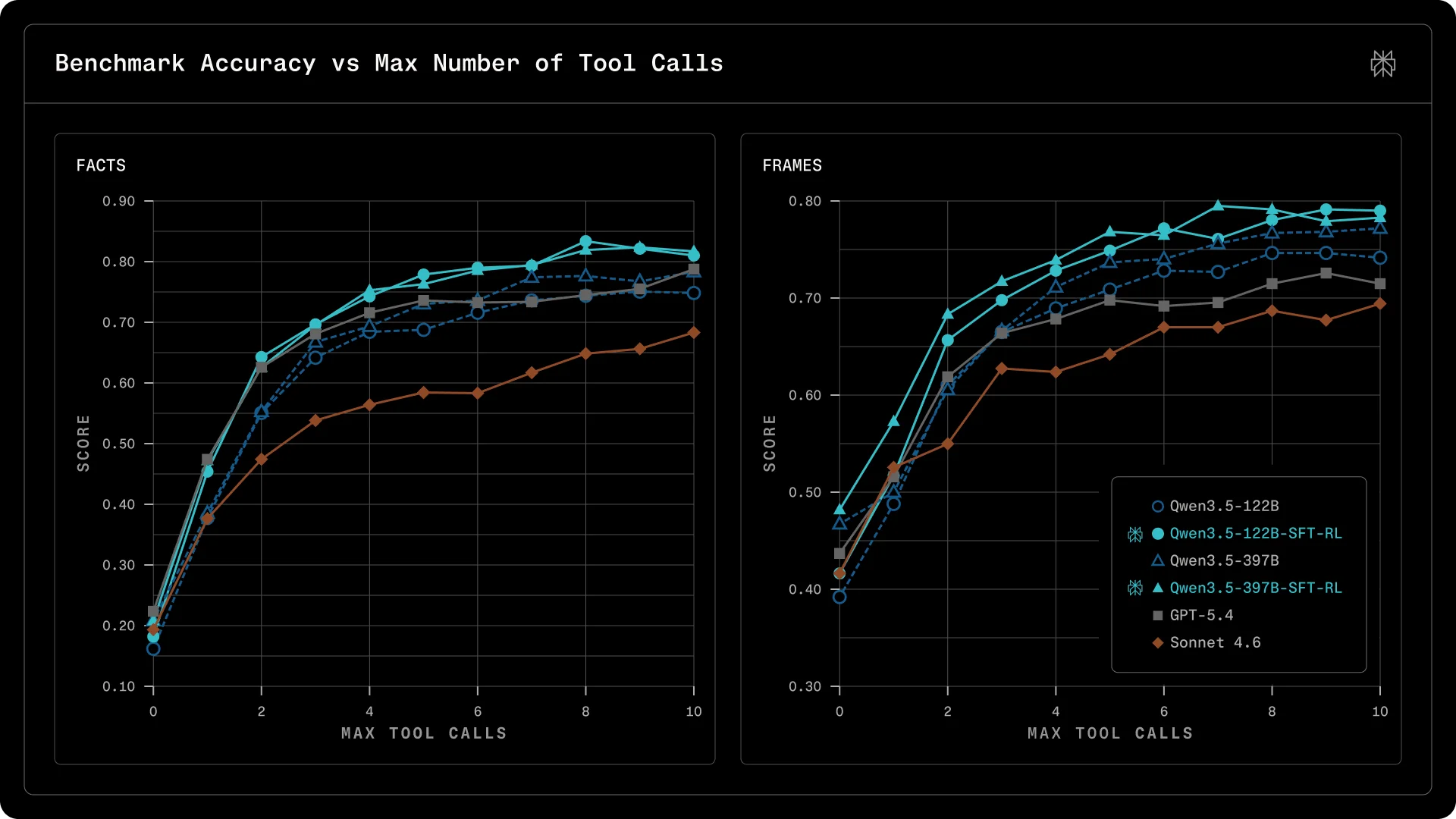
The results? The fully trained model, dubbed Qwen3.5-397B-SFT-RL, topped several search benchmarks. On the FRAMES test, it hit 57.3% accuracy with just a single tool call—that's 5.7 percentage points higher than GPT-5.4 and 4.7 points above Anthropic's Claude Sonnet 4.6. With a medium budget of four tool calls, accuracy jumped to 73.9% at a cost of just 2.0 cents per query. Under the same conditions, GPT-5.4 scored 67.8% for 8.5 cents, and Sonnet 4.6 managed 62.4% for a hefty 15.3 cents. These cost figures are based on each company's public API pricing and don't include any potential caching optimizations.
This open-source approach is part of a broader trend, as seen when Moonshot AI open-sourced its Kimi K2.6 model, which also claims to rival GPT-5.4 on coding tasks. Meanwhile, infrastructure for running these agents is getting more accessible, with projects like Tencent Cloud's Cube Sandbox providing a fast, open-source environment for AI agents to operate safely.