
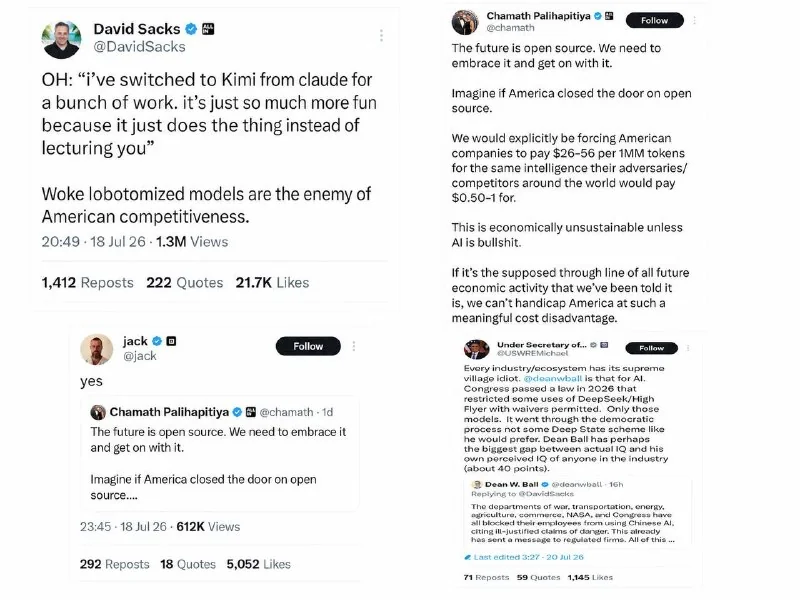
China's open-source AI strategy is paying off in ways that go beyond matching model performance: it's fracturing the US tech establishment. American tech leaders and officials are now siding with the Chinese approach, questioning their own closed-source giants.
Kimi K3 has dragged this split into the open.
David Sacks says people have already shifted significant workloads from Claude to Kimi because Kimi is more direct and willing to complete tasks. Investor Chamath Palihapitiya warns that if US companies have to pay ten times more for equivalent intelligence, the closed-source model simply can't compete long-term. Jack Dorsey has also publicly endorsed open source.
On the other side, there's concern that China's open models will drive down prices and reduce the incentive for US firms to keep investing in frontier models. This camp argues for using regulation and national security to restrict Chinese models.
So the US AI community is now split: one side started using Chinese models and is calling for the US to follow suit on open source; the other, realizing it can't compete on price, is debating how to blockade China.
China hasn't just closed the model gap — it's changed the rules of the game, forcing the US to choose between following suit and building a wall.
The irony is that without the chip export controls, China might never have bet so hard on open source. The US could have kept selling massive computing power to China. Instead, it missed out on the revenue and failed to stop the spread of Chinese models.