
It happened fast. xAI is gone.
Elon Musk just announced that xAI is being disbanded and folded into SpaceXAI, where it will live on as a product. Just one sentence, and a company vanishes.
https://twitter.com/WatcherGuru/status/2052107006966657497
https://twitter.com/elonmusk/status/2052105373621121284
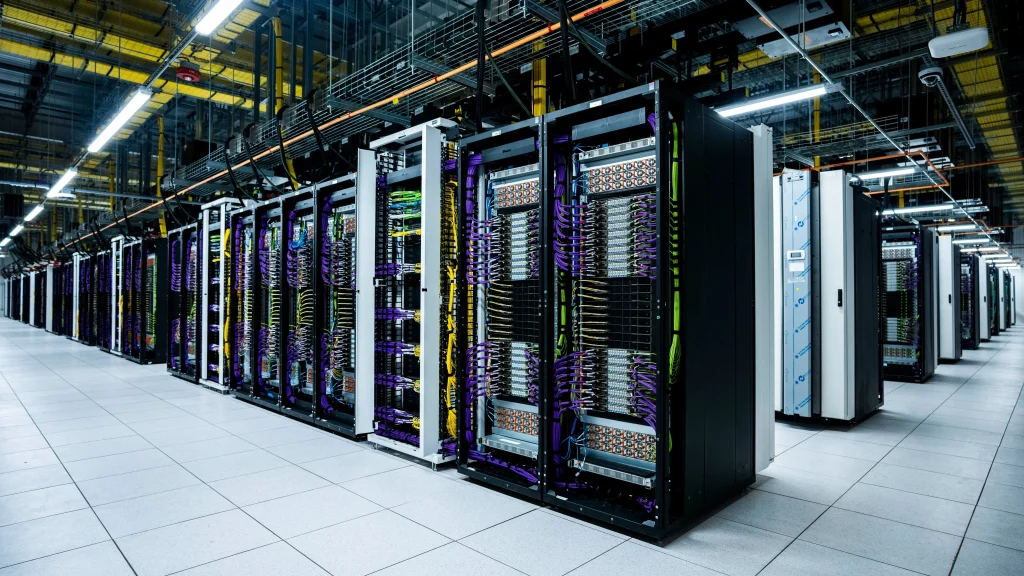
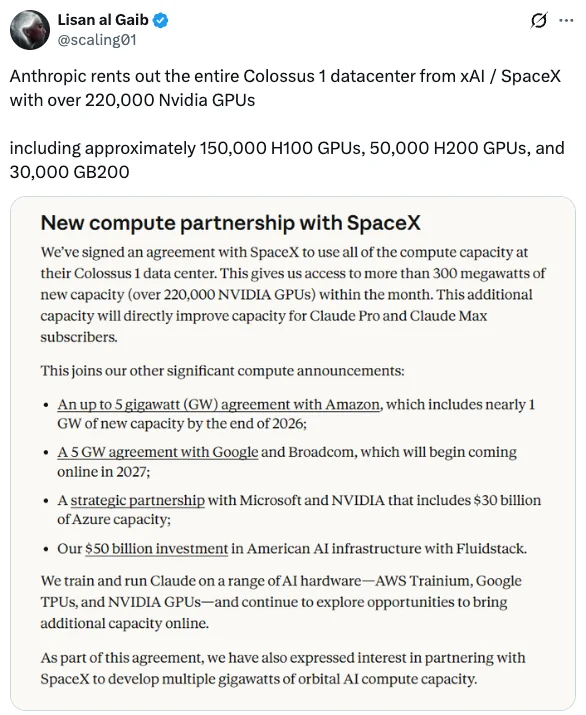
At almost the same moment, SpaceX and Anthropic jointly announced a deal: Anthropic is leasing the entire compute output of Colossus 1 — 220,000 GPUs, over 300 megawatts of compute — and will spin up Claude inference in a matter of days.
Just one week earlier, Musk was sitting in an Oakland federal courtroom, locked in a landmark lawsuit against Sam Altman that could reshape the AI industry. One minute he's demanding Altman be removed from OpenAI's board; the next, he's renting his supercomputer to Altman's biggest rival.
It's almost too absurd to process.
xAI is gone
On the surface, this looks like a branding exercise. Back in February, SpaceX completed its acquisition of xAI at a combined valuation of $1.25 trillion ($1 trillion for SpaceX, $250 billion for xAI).
https://twitter.com/SpaceX/status/2018440335140024383
Now the independent company shell is being tossed away, unified under SpaceX.
But look closer at the timeline, and the death of the brand means a lot more than that.
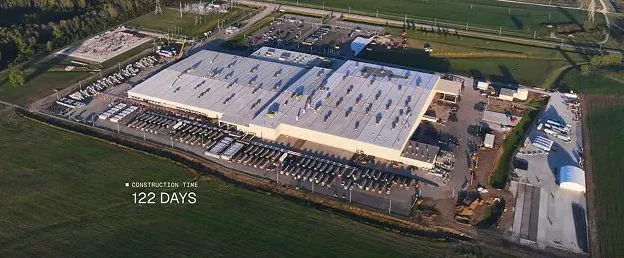
xAI was founded in 2023. Musk's ambition was to take on OpenAI head-on: build Grok, an AI that "maximizes truth-seeking," and prove it could beat Altman's ChatGPT. In 2024, he built Colossus 1 from scratch in Memphis in just 122 days — the world's largest supercomputer cluster, with 220,000 GPUs.
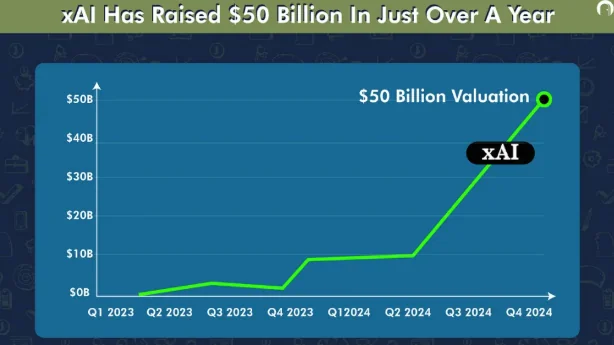
xAI's valuation went from zero to $5 billion in a year, and now sits at $250 billion. It even landed a $200 million military AI contract from the Pentagon.
Everything seemed to be going according to Musk's script. Except that Grok never won the model war.
In the latest AI model rankings from May 2026, Claude Opus dominates the developer tool ecosystem with a commanding lead: an 80.8% SWE-bench score, powering the three mainstream coding tools — Cursor, Windsurf, and Claude Code.
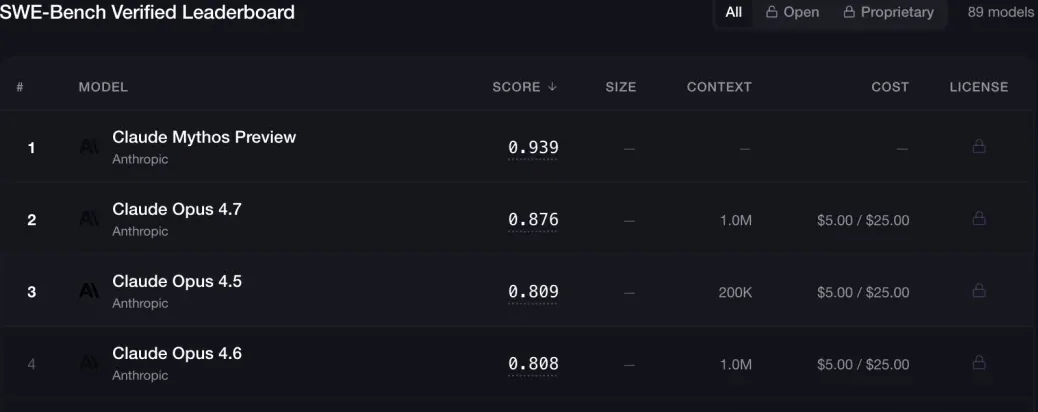
GPT-5.5 keeps evolving in general tasks and agent workflows. Gemini 3.1 Pro scores 94.3% GPQA in scientific reasoning.
And Grok? Its benchmark numbers are okay, but in the real developer ecosystem, it's virtually invisible. Its most powerful features are locked behind the $300/month SuperGrok Heavy plan. Its core selling point is real-time access to X data — and recent integrations with Gmail, GitHub, and Google Drive don't change the fact that it feels more like a social media add-on than a world-changing AI platform.
Then there are the numbers that really sting: xAI burned roughly $10 billion a month in 2025, consumed $80 billion in cash over the first nine months, posted a net loss of $14.6 billion in Q3 alone, and is on track to lose about $130 billion for the full year. It's surviving on a $20 billion funding round at a $230 billion valuation.
Let's be blunt: the model war is lost. Musk is a businessman, not a gambler. When you can't win, you change the game.
Copying Google's playbook: if you can't beat them, invest in compute
The same day xAI was dissolved, Musk leased the entirety of Colossus 1 to Claude.
https://twitter.com/xai/status/2052060350770515978
This strategy isn't exactly new. Google already walked this path two weeks ago, when it announced an additional investment of up to $40 billion in Anthropic ($10 billion cash upfront, $30 billion tied to milestones) along with 5 gigawatts of TPU compute. Google has DeepMind and Gemini — its models are competitive — yet it still chose to bet heavily on Claude.
Why? Google realized something: in a three-way AI showdown, if you can't be sure your model will be the only winner, make sure your biggest rival's rival is also funded by you. Whether Claude or Gemini wins, Google wins. It's classic Silicon Valley hedging: don't bet on winners, bet on the whole track.
Now Musk is copying that homework. He's trading compute for leverage. The monthly lease revenue from Colossus 1 can partially offset the black hole of xAI's losses. More importantly, every GPU rented to Claude adds firepower to OpenAI's strongest competitor.
Today, Anthropic's compute alliance roster is nothing short of insane:
- Amazon: 5 GW capacity deal (nearly 1 GW online by end of 2026) + $25 billion investment
- Google + Broadcom: 5 GW TPU capacity (starting 2027) + $40 billion investment
- Microsoft + Nvidia: $30 billion Azure capacity
- Fluidstack: $50 billion infrastructure
- SpaceX: 220,000 GPUs, 300 MW, available right now
The last bullet is the one that matters most. Every other compute partnership won't come online until late 2026 or even 2027. Claude's capacity crunch is a today problem. Anthropic announced immediate changes: Claude Code rate limits doubled, peak-hour throttling eliminated, and Opus API restrictions relaxed. The capacity boost, as we covered, directly stems from the SpaceX GPU deal.
https://twitter.com/ClaudeDevs/status/2052064938840228237
https://twitter.com/claudeai/status/2052060691893227611
For Musk, this deal is a perfect trifecta: make money, fund OpenAI's rival, and turn Colossus 1 from a stranded asset into a revenue generator.
Courtroom hunt: Musk vs. Altman
But Musk's chessboard has more than just Anthropic. The same week as the SpaceX-Anthropic announcement, the trial of the century — Musk v. OpenAI — is under way in federal court.
At the heart of the lawsuit: Musk wants Altman and Greg Brockman removed from OpenAI's board. His claim is that they betrayed OpenAI's nonprofit mission by using his $38 million donation for unauthorized commercial purposes.
The courtroom drama is pure Silicon Valley. Two days before the trial started, Musk texted Brockman to test the waters on a settlement. Brockman suggested both sides drop their cases. Musk's reply is already a candidate for quote of the year: "By the end of this week, you and Sam will be the most hated people in America. If you insist, so be it."
https://twitter.com/FT/status/2051351782521995646
Now overlay the two threads. In court, Musk is asking the judge to remove Altman, arguing that OpenAI's pivot from nonprofit to for-profit betrays its founding principles. If he wins, OpenAI's $850 billion valuation empire faces a leadership earthquake. Outside the courtroom, Musk is handing 220,000 GPUs to Claude, directly strengthening OpenAI's biggest competitor. Claude Code capacity doubles, API limits are lifted — that means more developers, more enterprise customers migrating from OpenAI to Anthropic.
Musk is hunting Altman in court while starving him of compute. He has effectively blocked OpenAI's path.
The ultimate game
Compare this to the two inflection points that defined the last decade of AI. The first was OpenAI's founding in 2015, when Musk and Altman were on the same side. The second was Microsoft's $1 billion investment in OpenAI in 2019, when Musk left the board. This is the third: in 2026, Musk is back at the table, but he's sitting on Anthropic's side.
The list of players for the final ASI showdown is now essentially set:
- OpenAI + Microsoft + Stargate
- Anthropic + Google + Amazon + and now SpaceX
The model maker landscape is locked. What comes next hinges on a few things: the mid-May ruling in Musk vs. Altman, the pricing of Anthropic's June IPO, and how OpenAI responds to Musk's latest move.
Musk is waiting for Altman's reply.
The rules of AI's second half are being rewritten
When Google, Amazon, and Musk all pile their compute onto the same horse, the competitive focus has already shifted from "whose model is best" to "who controls the infrastructure behind the models."
Musk isn't conceding defeat. He's standing up from the chessboard and moving to a deeper level — to control the board itself.
Colossus is still Colossus. 220,000 GPUs, 300 MW, the lights in the Memphis data center stay on all night.
The only thing that changed is the name beating in its heart. Not Grok anymore. Claude.