
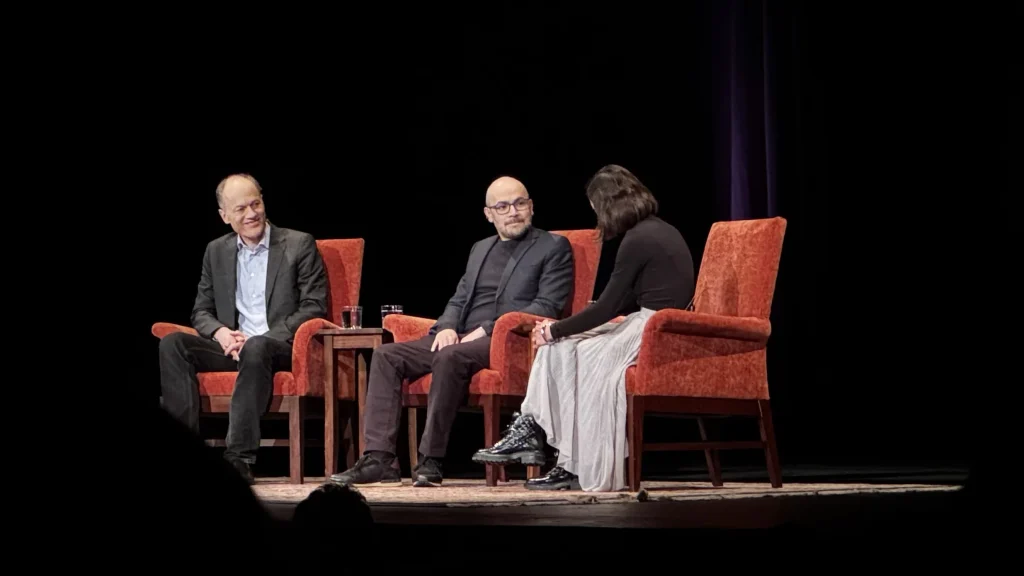
Demis Hassabis, co-founder of DeepMind, and Sebastian Mallaby, author of The Power Law, took the stage in San Francisco today. Here are the nine most provocative things they said.
1. OpenAI's precarious position
"There is a 50% chance that OpenAI goes bankrupt in the next 18 months," Mallaby said bluntly.
2. Praise for a rival
"Dario is the best of all the other lab leaders," Demis offered, referring to Dario Amodei, CEO of Anthropic.
3. The geopolitics of AI safety
On the topic of Anthropic's 'Claude Mythos' safety framework, Mallaby raised a red flag: "It's not really tenable for a private company to decide who gets access to the frontier of cyber defense tech. What happens when China can do this in 6-12 months?"
4. Global optimism
"Not all countries are pessimistic about AI," Hassabis countered. "I was just in India for the AI summit Prime Minister Modi had, and they're quite optimistic there."
5. The next frontier: biology
"The most exciting current prospect in AI is our work at Isomorphic Labs," Hassabis declared. "AlphaFold is just one of the many problems we need to solve. We need six 'AlphaFold' moments to compress the drug delivery timeline from 10 years to a few months."
6. On existential risk
"I don't think of p(doom) as probabilities to throw out there. I just know it's non-zero," Hassabis said. "Some people like Marc Andreessen and Yann LeCun think it's 0%, and I think that's crazy."
7. Imagining a post-scarcity world
On the topic of AGI (Artificial General Intelligence), Hassabis painted a picture: "I think of a post-scarcity world where, on the bright side, we will have an unbelievable amount of science, but we will have to think of economic problems of sharing proceeds equitably. We will also have philosophical questions to answer and need great new philosophers."
8. Career advice for the AI age
"Immerse yourself in AI tools," Hassabis advised. "Everyone has access to tools 3-6 months behind the frontier. Enormous opportunity lies in applying AI to unexplored areas."
9. A plea for thoughtful progress
Reflecting on the industry's trajectory, Hassabis shared a personal vision: "When I started building this technology, I pictured a future quite different from this. More like CERN researchers, where we discuss ideas and help each other out and stress-test each other's ideas."
He continued, "It's my job to help how I can to make sure we make more considered, more scientific, more rigorous, and more thoughtful decisions, and that will also involve social scientists and economists. I'm going to do all I can to try and influence the future in a more thoughtful manner. The decisions we make in the next 5-10 years are going to affect us for thousands of years. But I remain very optimistic."