

Anthropic just announced Claude Opus 4.7, the direct successor to Opus 4.6. The company says it's specifically tuned for advanced software development and complex tasks, with improvements to instruction-following and high-resolution image processing.
According to Anthropic, Opus 4.7 can handle complex, long-running tasks more precisely and consistently. It's better at reading instructions accurately and has enhanced behavior where it verifies its own outputs before responding. Early testers reportedly found they could trust it more with difficult coding work that previously required close human supervision.
There's a catch, though. The improved instruction-following means Opus 4.7 behaves differently with prompts. If you feed it prompts designed for older models, you might get unexpected results. Anthropic recommends re-tuning your prompts and execution environments.
Image recognition gets a major boost
One of the biggest changes is support for high-resolution images. Opus 4.7 can now accept images up to 2576 pixels on the long side—about 3.75 megapixels. That's over three times more information than previous Claude models could handle.
This should help with reading screenshots full of tiny text, extracting data from complex charts, and any task requiring pixel-perfect alignment.
Benchmarks show gains across the board
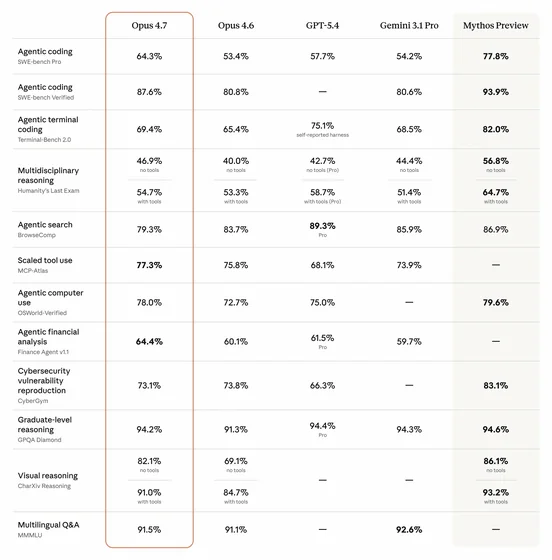
On the visual reasoning benchmark ChartX Reasoning, Opus 4.7 scored 82.1% without tools and 91.0% with tools—up from Opus 4.6's 69.1% and 84.7%.
Coding benchmarks also showed improvements:
- SWE-bench Pro: 64.3%
- SWE-bench Verified: 87.6%
- OSWorld-Verified: 78.0%
- Finance Agent: 64.4%
All these numbers beat Opus 4.6.
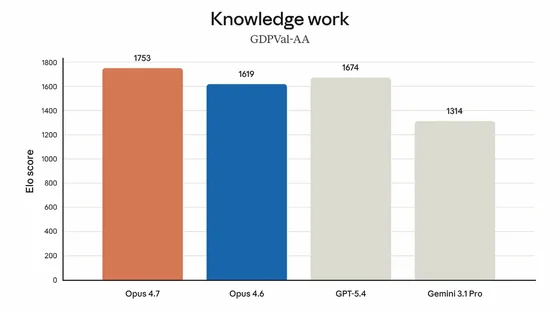
On the knowledge work benchmark GDPVal-AA, Opus 4.7 outperformed both GPT-5.4 and Gemini 3.1 Pro.
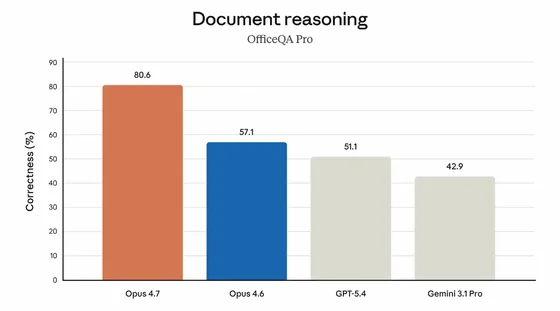
For document reasoning measured by OfficeQA Pro, Opus 4.7 achieved "significantly higher accuracy" than Opus 4.6, GPT-5.4, and Gemini 3.1 Pro.
But it's not their top model
Anthropic is careful to note that Opus 4.7 doesn't have the broad capabilities of their highest-tier model, Claude Mythos Preview. While Mythos Preview remains in limited release, Anthropic is using the more restrained Opus 4.7 to field-test new cybersecurity safeguards.
The company has introduced automated detection and blocking of requests that indicate dangerous cyber uses, plus a new Cyber Verification Program for legitimate vulnerability research and penetration testing by experts.
Safety profile
Overall safety is similar to Opus 4.6, with improvements in honesty and resistance to malicious prompt injection. However, there are slight weaknesses in some areas—like providing overly detailed harm reduction advice about regulated substances.
Anthropic's alignment evaluation places it as "generally appropriately aligned and trustworthy, but behavior is not yet ideal."
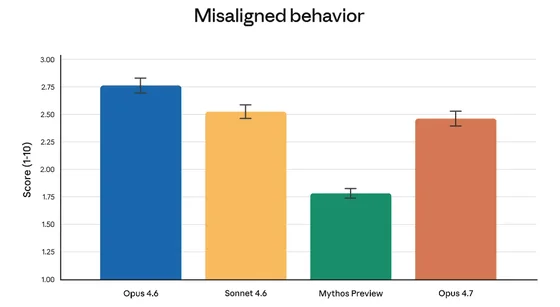
The bar chart below shows action mismatch rates from automated behavior audits—lower scores mean higher safety. Opus 4.7 shows slight improvement over Opus 4.6, but Mythos Preview has significantly lower mismatch rates.
Availability and pricing
Opus 4.7 is available across the Claude product line, plus Anthropic API, Amazon Bedrock, Google Cloud's Vertex AI, and Microsoft Foundry. Pricing stays the same as Opus 4.6: $5 per million input tokens and $25 per million output tokens.
One note: the updated tokenizer means the same input could use 1 to 1.35 times more tokens than with Opus 4.6, depending on content. At higher effort settings, especially in later turns of agent-like use, thinking volume increases and output tokens may grow.
Still, Anthropic says internal coding evaluations show overall efficiency has improved, and they recommend migrating while monitoring traffic differences in production.
Also announced
Claude Code gets a new xhigh setting for fine-tuning reasoning effort, a /ultrareview command for code reviews, and an auto mode extension for Max users.