
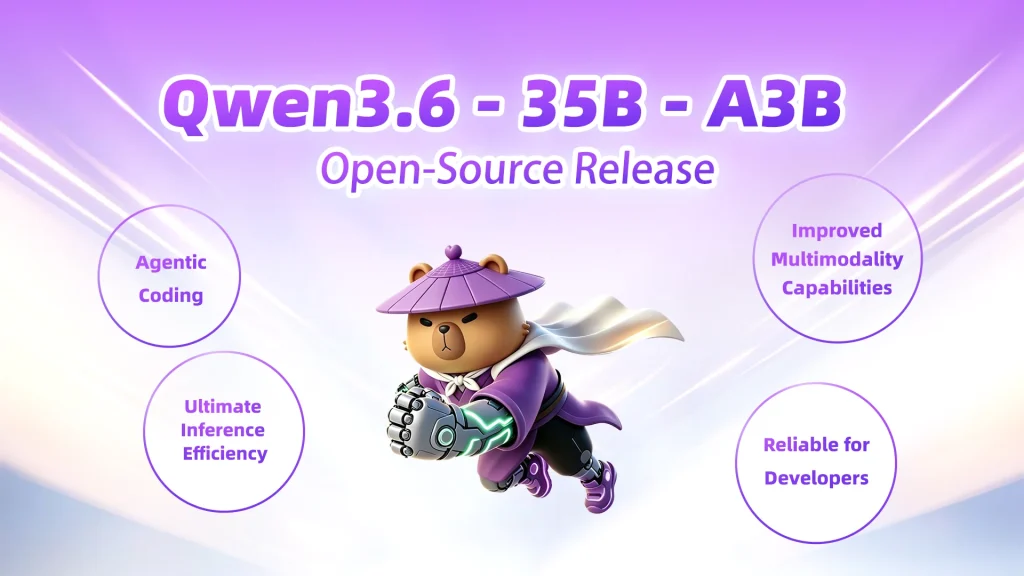
Alibaba's Tongyi Lab just dropped a new open-source AI model that's specifically designed to handle the messy reality of programming and complex task execution. The Qwen3.6-35B-A3B, announced on April 17th, uses a sparse mixture-of-experts (MoE) architecture to keep compute costs down while aiming for high performance.
https://twitter.com/Alibaba_Qwen/status/2044768734234243427
With 35 billion total parameters, the model only activates about 3 billion during a single inference run. That's the MoE trick: it's a big brain that only uses the relevant parts for any given task, making it cheaper to run than a dense model of similar capability.
Built for AI agents and real-world coding
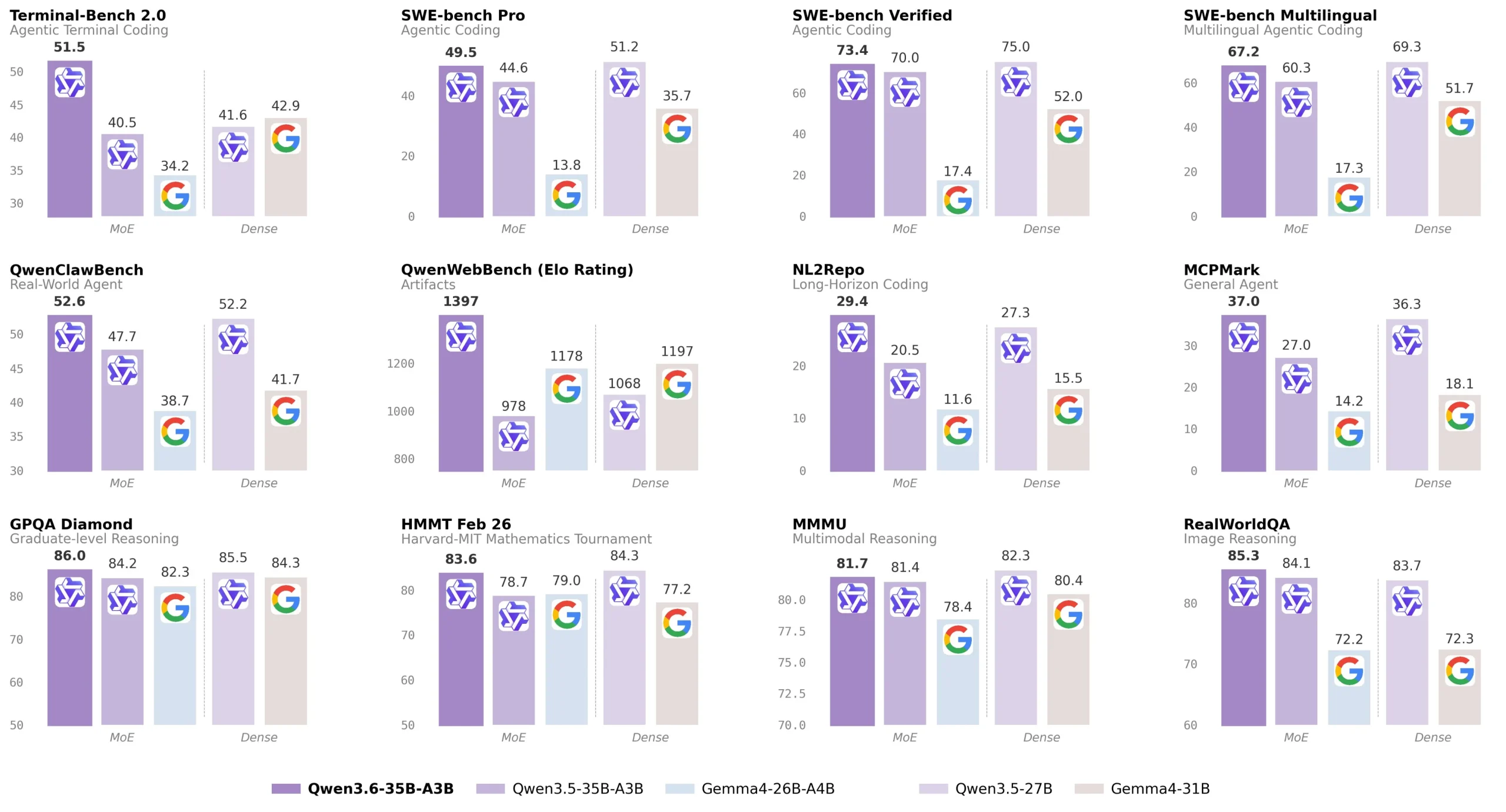
The model is squarely aimed at "agent programming"—the kind of AI that can plan multi-step tasks and actually use tools to get things done. Alibaba says it shows significant improvement over its predecessor, the Qwen3.5-35B-A3B, on programming benchmarks like SWE-bench and Terminal-Bench. In some tasks, it even competes with larger dense models in the 27B to 30B parameter range.
What does that mean in practice? Better code generation, more stable performance on terminal operations, and a stronger grasp of complex project structures. It also maintains context better across longer conversations, which is crucial for an AI agent that needs to stay on track through a lengthy task.
Multimodal and multi-mode
Qwen3.6-35B-A3B keeps the dual "thinking/non-thinking" mode from previous versions and adds native multimodal input support. It can handle images, documents, and even spatial understanding tasks.
On visual-language evaluations, it reportedly approaches or even surpasses some closed-source models on certain metrics. For spatial reasoning—tested on datasets like RefCOCO and ODInW—it scores highly, suggesting it can model three-dimensional relationships to some degree.
Ready for your workflow
The full model weights are available now on Hugging Face and ModelScope for local deployment. To make integration easier, its API is compatible with OpenAI and Anthropic's specifications. You can also plug it into various programming agent tools like OpenClaw, Claude Code, or Qwen Code to fit different development workflows.
One neat feature for complex tasks is the preserve_thinking mechanism, which lets the model retain its reasoning process information across multiple interactions. That should help it stay consistent when the job gets complicated.