
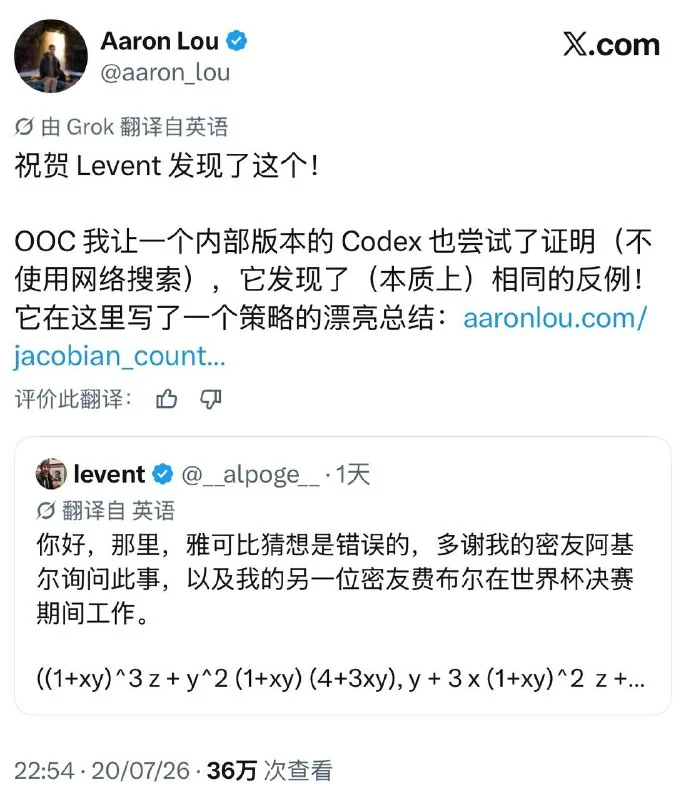
Anthropic mathematician Levent Alpöge used Claude Fable to find a three-dimensional counterexample to the Jacobian Conjecture. The problem has been open since 1939 and was even listed among important 21st-century mathematical problems.
Fable's polynomial mapping had a Jacobian determinant that was constant −2, yet it sent three different inputs to the same output. That means it's impossible to invert — disproving the conjecture in three dimensions and higher. (The two-dimensional version remains unsolved.)
OpenAI researcher Aaron Lou then had an internal version of Codex try independently. Without internet access, the model found essentially the same counterexample and wrote out the derivation.
Going forward, mathematicians might toss a pile of open problems at different models simultaneously. AI can iterate, find counterexamples, spot loopholes, and propose new approaches — then verify results with symbolic computation or formal proof tools. Many directions that no one had time to exhaustively explore could get swept through quickly, potentially accelerating scientific discovery.
But that doesn't mean problems automatically get easier. Models can also mass-produce seemingly rigorous but incorrect proofs. The field might shift from "can't find an answer" to "can't keep up with verifying answers."
The bigger risk comes from a genuine breakthrough. RSA security relies on the difficulty of factoring large integers; Diffie-Hellman and elliptic-curve cryptography rely on the hardness of discrete logarithms. If AI finds a fast enough new algorithm, parts of the public-key infrastructure used for website encryption, digital signatures, bank transactions, and blockchain could break — forcing an emergency global switch to new cryptographic standards.