
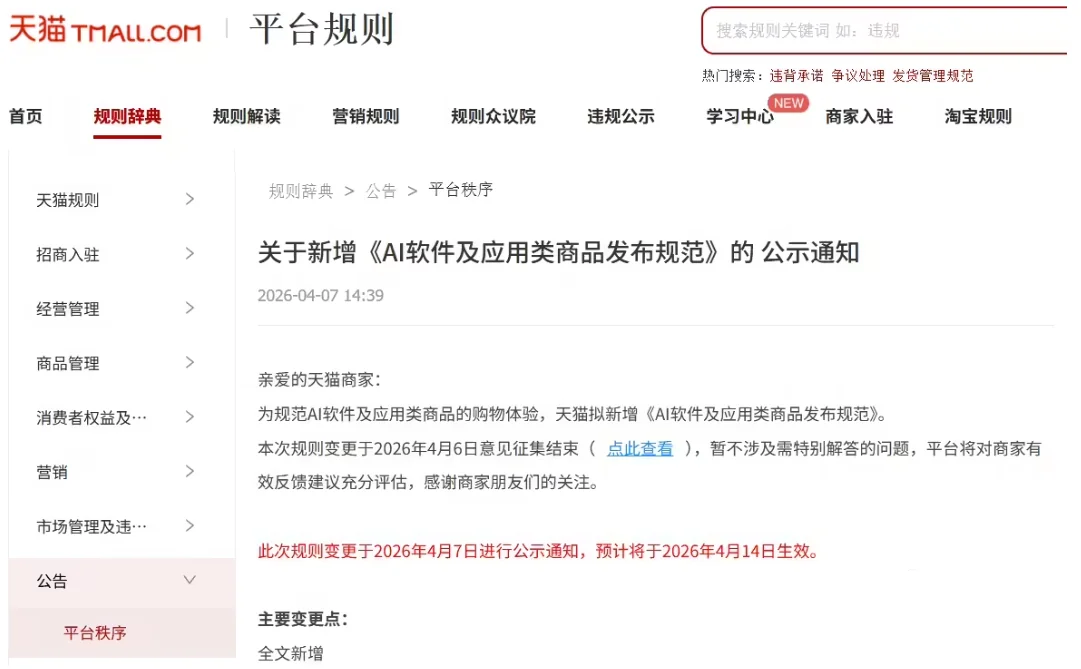
April 15 — China's major e-commerce platforms are rolling out specialized regulations for AI application products. Tmall, Alibaba's business-to-consumer marketplace, began enforcing its "AI Software and Application Product Listing Standards" on Monday, April 14. This marks the first systematic product management framework for AI software and applications in China's e-commerce sector.
Scope of the New Rules
The new regulations cover a wide range of areas, including service subscriptions and top-ups, licensing and integration, developer resource transactions, and deep synthesis applications.
Specific examples include:
- Recharging official model memberships
- Purchasing token consumption quotas
- Selling API-Key credentials
- Text generation and virtual human interaction applications built on large language models
Transparency Requirements
The standards impose strict requirements for product information transparency.
For products involving "token quotas" or "membership durations," sellers must clearly specify exact values on the detail page, such as "1 million tokens" or "12-month membership." For API-Key products, sellers must clearly indicate the validity period and the corresponding model name and version.
Prohibited Practices
To address market irregularities, the rules establish several red lines. They explicitly prohibit merchants from using absolute terms like "100% accurate," "completely replaces human labor," or "never gets banned" to exaggerate model capabilities. Token package prices must not significantly deviate from prevailing market levels; for instance, pricing below 30% of the official price without reasonable justification will be considered a violation.
Additionally, the rules strictly forbid any form of inducement for consumers to pre-deposit funds exceeding five times the product's listed price, or to guide users off the platform for private transfers or top-ups.
Earlier in March, Taobao, Alibaba's consumer-to-consumer marketplace, initiated a crackdown on AI-generated fake images, intercepting nearly 100,000 distorted product pictures through identification models and calling for industry-wide standards on AI-generated content usage.