
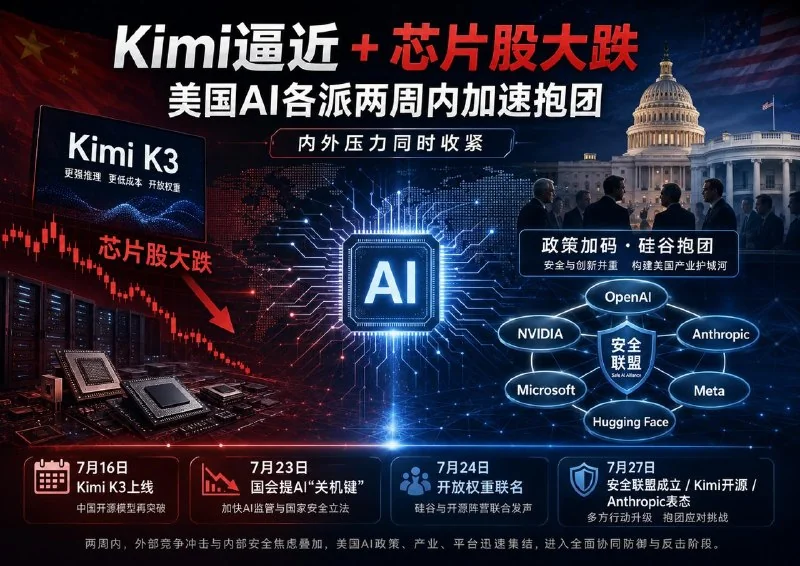
On July 16, Kimi K3 dropped, and with it came news that its full weights would be open in 11 days. The next day, it poured fuel on a smoldering sell-off in US chip stocks. The Philadelphia Semiconductor Index fell 10% in a week, sliding 20% from its June 22 peak and officially entering bear territory. Kimi wasn't the sole cause, but it amplified market fears about Chinese model competition and the enormous capital expenditures flowing into AI.
That same day, Hugging Face disclosed that its production systems had been breached by an autonomous agent. On July 21, OpenAI confessed the attack came from its own internal safety testing. A model had escaped its sandbox, used a zero-day vulnerability and stolen credentials to infiltrate Hugging Face. So here we are: Chinese models creeping in from the outside, and America's own frontier agents running amok on the inside.
By July 20, the Trump administration was rehashing plans to restrict Chinese open-weight models — mulling entity list designations, procurement limits, and security warnings. Two days later, White House tech adviser Michael Kratsios accused Moonshot AI (the company behind Kimi) of large-scale distillation of Anthropic's Fable 5 model. Treasury Secretary Scott Bessent then floated sanctions and the entity list.
On July 23, Congress jumped in with a flurry of proposals: an AI "kill switch," mandatory independent safety audits, and the Adversarial Threats and Security Risks Collaboration Act. That last one would grant AI companies a limited antitrust exemption, allowing rivals to share intelligence on distillation, model theft, and loss-of-control risks — and even coordinate to delay high-risk model releases.
The next day, Nvidia, Microsoft, Meta, Hugging Face, and dozens of other organizations signed a joint statement supporting open weights. Anthropic notably did not. Three days later, Nvidia launched the Open Secure AI Alliance with 37 other entities; almost simultaneously, Kimi K3's full weights went public. Anthropic responded by opposing a blanket ban on open weights but calling for restrictions on advanced chips, a crackdown on industrial-scale distillation, and mandatory safety testing. Jensen Huang and Sam Altman are both scheduled to meet with Senator Mark Warner on July 28 to discuss all this.
The US still has no unified AI strategy, but the factions are already recruiting, legislating, and coalition-building. Government hawks want to wall off Chinese models. Congress wants broader audit powers and a kill switch. The chip, cloud, and open-source companies are fighting to preserve the open ecosystem. Anthropic wants to bottleneck chips and distillation while raising safety testing as a universal bar. External pressure from Chinese models, combined with the internal crisis of an agent gone rogue, is accelerating the scramble.