
Microsoft quietly open-sourced a speech recognition model in January, and Simon Willison just put it through its paces on a Mac. His verdict: it's impressively capable, but don't expect to run it on a laptop with less than 64GB of RAM.
VibeVoice-ASR is a 9-billion-parameter speech-to-text model that Microsoft Research released on January 21st under the MIT license. The headline feature: it can handle up to 60 minutes of continuous audio in a single pass and outputs structured data that tells you who said what and when. No more stitching together OpenAI's Whisper with a speaker diarization tool like pyannote — this model does it all natively, supporting over 50 languages and mix of Chinese and English.
https://twitter.com/simonw/status/2048912086307377252
Simon ran a community-made 4-bit quantized version (5.71GB, down from the full 17.3GB) on a 128GB M5 Max MacBook Pro. Transcribing a one-hour podcast took 8 minutes and 45 seconds. One catch: you have to manually set the max-tokens parameter to 32768; the default of 8192 only covers about 25 minutes of audio. Activity Monitor showed memory usage spiking to 61.5GB during the prefill phase and settling around 18GB during generation. A typical 32GB laptop won't even be able to load the quantized model.
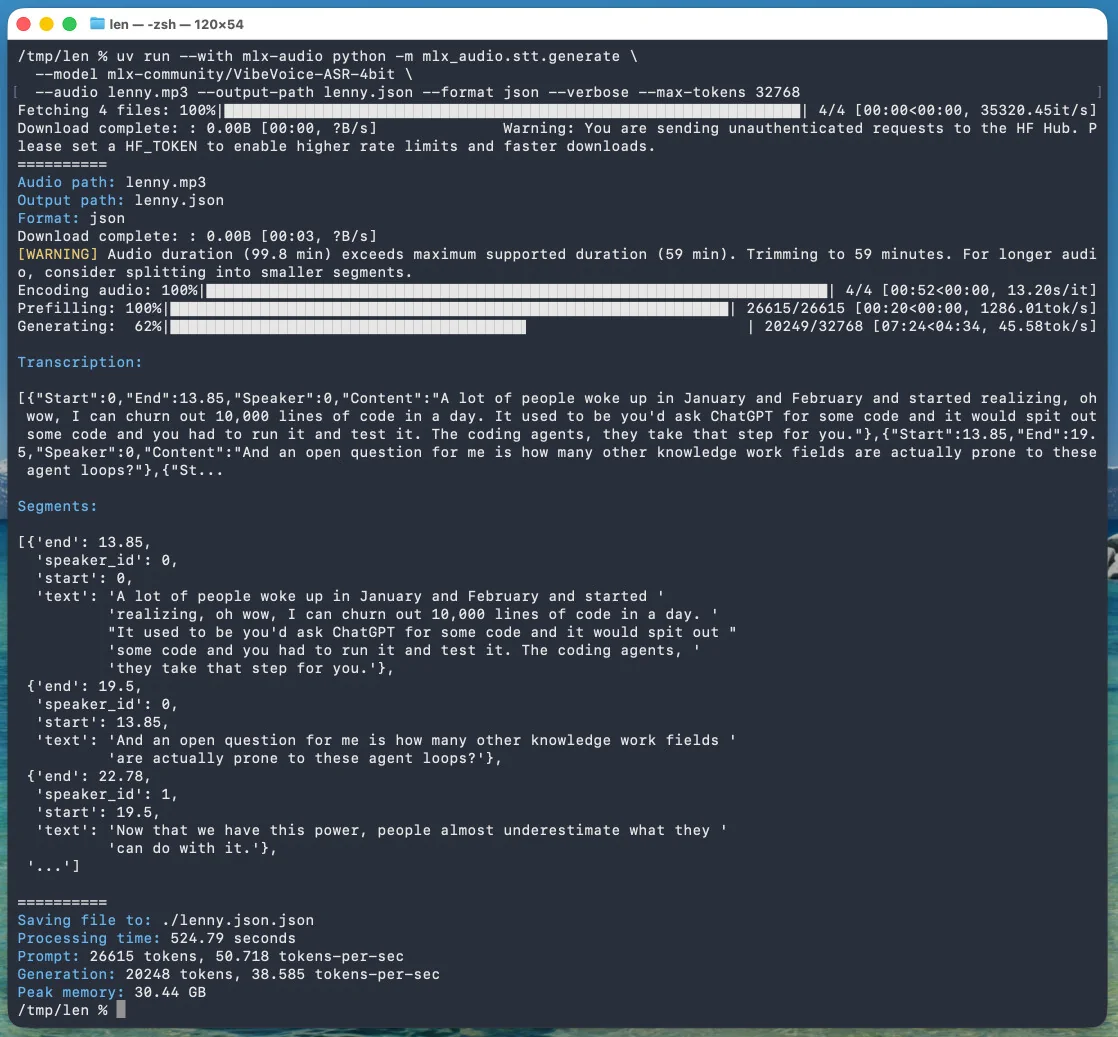
A curious detail: the model detected three speakers in the podcast, even though there were only two — Simon and host Lenny. The model got confused by Lenny's intro and ad reads, which were recorded in different acoustic environments, so it split those into a third voice.
The hard limits are real: you can't feed it more than 60 minutes at a time — longer files need to be chunked and you'll have to manually align speaker IDs across chunks. And to run the quantized version locally, you'll need at least 64GB of RAM. Still, for podcast transcription, meeting notes, and interview summaries, this collapses what used to be a multi-step pipeline into a single inference call.