
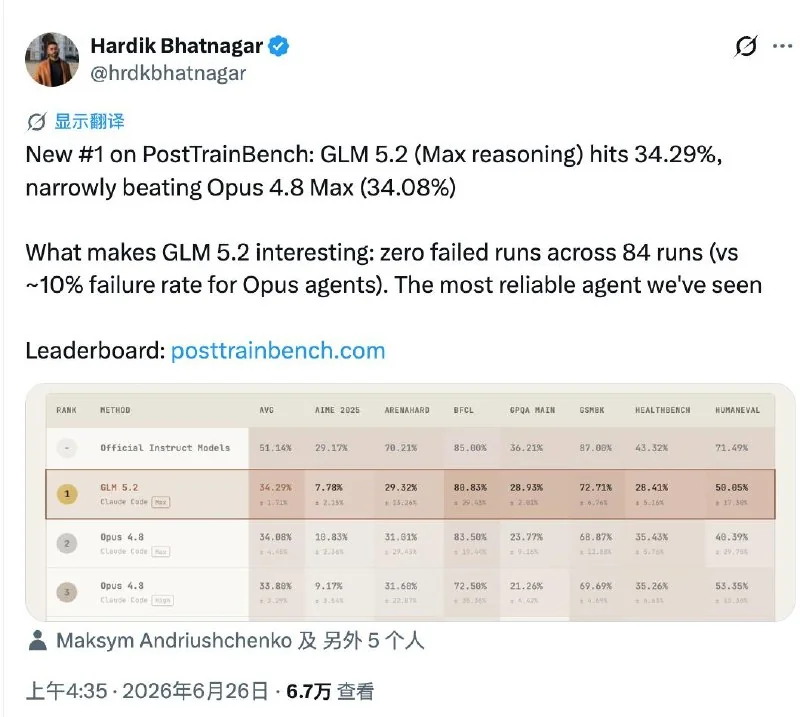
In the latest AI R&D automation benchmark, PostTrainBench, the reasoning model GLM 5.2 Max scored 34.29% to take first place, narrowly beating Claude Opus 4.8 Max's 34.08%.
https://twitter.com/hrdkbhatnagar/status/2070244540108423427
The benchmark simulates the full post-training fine-tuning workflow under the constraints of 10 hours and a single H100 GPU, including data cleaning, writing training scripts, and hyperparameter optimization. Across 84 complete runs, GLM 5.2 achieved a 0% crash rate, while the Claude Opus series of agents had roughly a 10% task freeze or crash rate.
Analysis shows that the new generation of reasoning models can more accurately parse terminal errors, self-heal environment and training script issues, and dynamically spin up larger local teacher models (like 14B to 72B Qwen) on the local GPU for synthetic data distillation, thereby avoiding the logic deadlocks that plague traditional agents on long-duration tasks.