
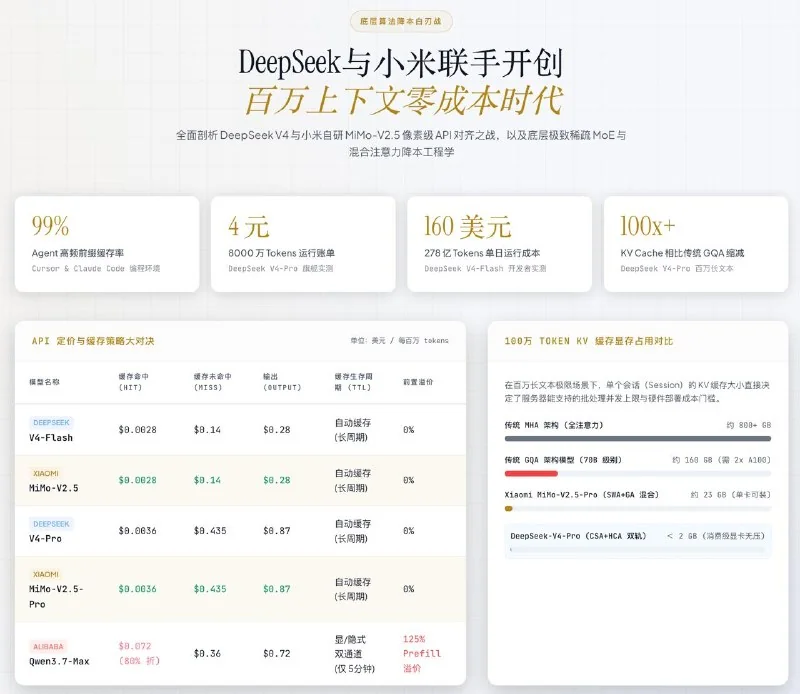
After Alibaba's Qwen team introduced implicit caching for Qwen3.7-Max that cuts input costs by up to 80%, Xiaomi has announced permanent price cuts for its in-house MiMo-V2.5 series APIs, matching DeepSeek V4's entire pricing lineup. For flagship models, the input cache hit price is now $0.0036 per million tokens, cache miss is $0.435, and output is $0.87. The alignment aims to capture global developer traffic and accelerate the adoption of agent-based applications.
Within a month of its April 24 launch, DeepSeek V4 Flash topped OpenRouter's monthly leaderboard with 7.99 trillion tokens consumed, while V4 Pro entered the top ten. In agent programming scenarios involving high-frequency codebase reads — such as Cursor and Claude Code — a 99% prefix cache hit rate means developers using the Pro model can burn through 80 million tokens for just 4 RMB (about $0.55), while Flash model users can consume 27.8 billion tokens in a single day for $160.
For comparison, Alibaba's Qwen3.7-Max auto-implicit caching offers only an 80% discount, and explicit caching comes with a 125% first-creation premium and a 5-minute lifespan. The high creation premium and short retention hint at high system caching overhead — per-token compute load and KV cache usage limit the room for discounts.
Xiaomi and DeepSeek can afford to cut prices thanks to algorithmic advantages. In inference over 1 million tokens, DeepSeek V4 uses Compressed Sparse Attention (CSA) and High Compression Attention (HCA) to reduce inference FLOPs to 27% of the previous generation and KV cache to 10%, a reduction of over 100x compared to traditional GQA models. Xiaomi's MiMo-V2.5-Pro activates only 4.1% (42B) of its 1.02 trillion total parameters, interleaving sliding window attention (SWA) and global attention (GA) to reduce long-context KV cache overhead by 7x, and uses multi-token prediction (MTP) to boost output throughput 3x. Both approaches squeeze resources at the algorithm level, signaling the arrival of a low-cost, high-context era.