
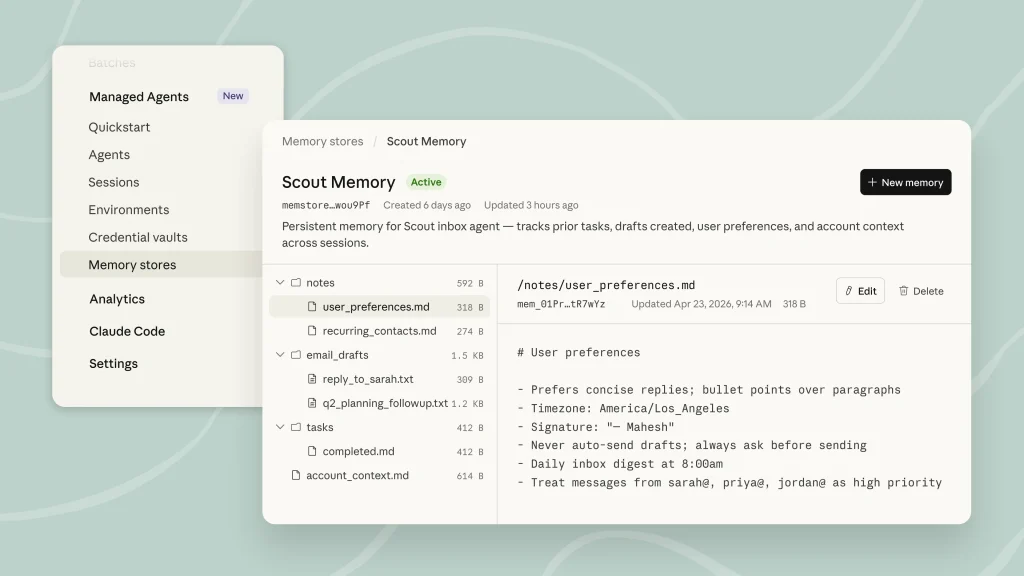
Anthropic just gave its Claude Managed Agents — the cloud-based agent hosting platform that entered public beta on April 8 — a built-in memory system. Agents can now learn and accumulate experience across sessions, so developers don't have to build their own memory infrastructure.
Memory is mounted as files on the agent's file system. Claude reads and writes to it using its native bash and code execution abilities, just like any other file. Multiple agents can share the same memory store, with permission levels: an organization-wide memory bank can be read-only, while personal memory banks allow read-write access. Concurrent operations from different agents won't overwrite each other. Memory can be exported and managed via API, and every change comes with an audit trail that traces back to the specific agent and session. Rollbacks and content deletion are supported.
Anthropic shared four customer case studies. Rakuten's long-running agents use cross-session learning to avoid repeating mistakes, cutting first-pass errors by 97%, costs by 27%, and latency by 34%. Wisedocs uses cross-session memory in its document validation pipeline to spot recurring document issues, boosting validation speed by 30%. Netflix's agents retain insights and human corrections across multiple rounds of conversation, eliminating the need to manually update prompts and skills. Ando uses memory to capture each organization's collaboration habits, saving the work of building memory infrastructure from scratch.