
Anthropic, the company behind the Claude AI models, just published the results of a survey of 81,000 Claude users. The poll asked about "people's outlook and anxieties regarding AI progress," and Anthropic even used Claude itself to help analyze respondents' attributes, emotions, and quantify their fears about job loss.
As part of the research, Anthropic created and measured a metric it calls "exposure." This measures how much Claude is used in a given job role—so a high-exposure job is one where AI is used extensively.
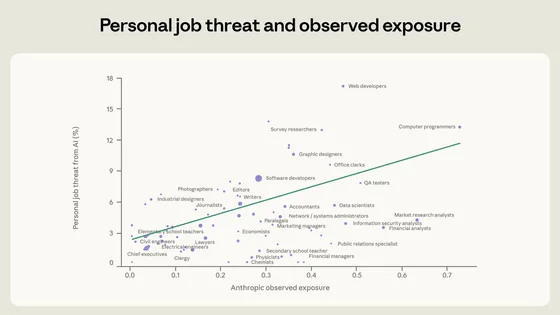
The chart below plots the percentage of people who answered "AI is already replacing my role, or is likely to replace it soon" (Y-axis) against that exposure metric (X-axis), broken down by profession. The takeaway? The more you use AI in your job, the more you worry about AI taking your job.
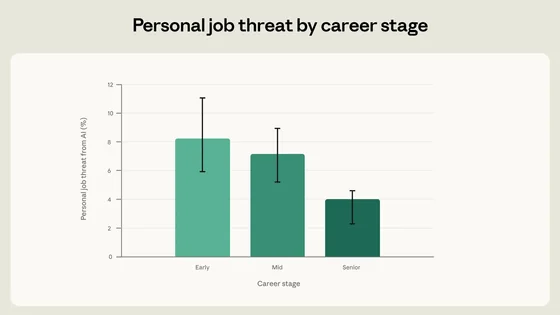
When responses were grouped by career stage, the results were clear: people in the earliest stages of their careers, on the left side of the chart, reported the highest levels of concern about losing their jobs.
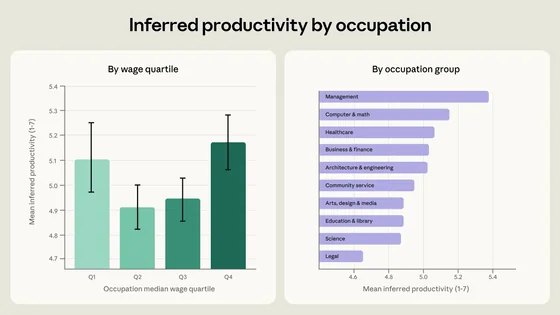
The survey also asked how much benefit people were getting from AI. Written responses were converted to a 1–7 score. The average score across all respondents was 5.1, which corresponds to "productivity has significantly improved." It also revealed that people in higher-paying jobs—like executives and software developers—reported greater productivity gains from AI.
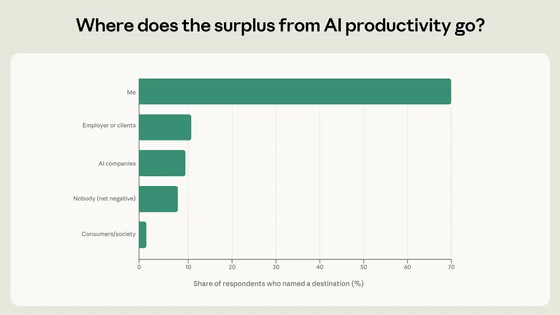
When asked, "Who do you think benefits from the advent of AI?" an overwhelming majority said "myself." About 10% of respondents said "my employer or client, who now demands more work."
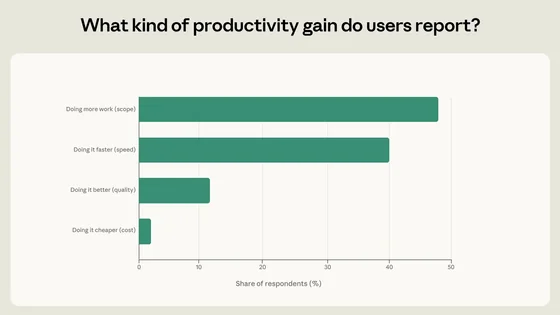
Anthropic dug deeper into what "productivity improvement" actually meant. They categorized respondents' descriptions across four aspects: "expanded scope of work," "increased speed," "improved quality," and "reduced cost." Expanding scope—like being able to write code outside one's expertise—was the most common benefit. Increased speed—like finishing a two-hour finance task in 15 minutes—came second. Together, these two categories accounted for nearly 90% of the responses.
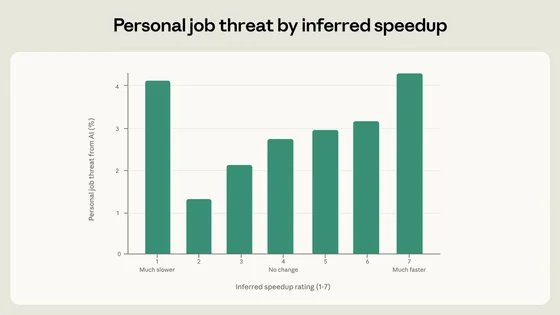
The relationship between fear of job loss and AI's impact on work speed produced a curious result. Anxiety was highest at both extremes: among those whose work speed decreased and those whose work speed increased dramatically. The analysis suggests that in creative fields, where AI can be inflexible and slow things down, the fear of being replaced was still notably high.
Anthropic added a caveat: the survey's respondents were all "individuals with a Claude personal account who opted to respond." This means, the company notes, there's a potential bias—these users "may be more likely to perceive benefits as accruing to themselves." This self-selected group is already deep in the AI ecosystem, a fact underscored by Anthropic's other projects, like its high-risk Mythos model designed for cybersecurity vulnerability discovery.