
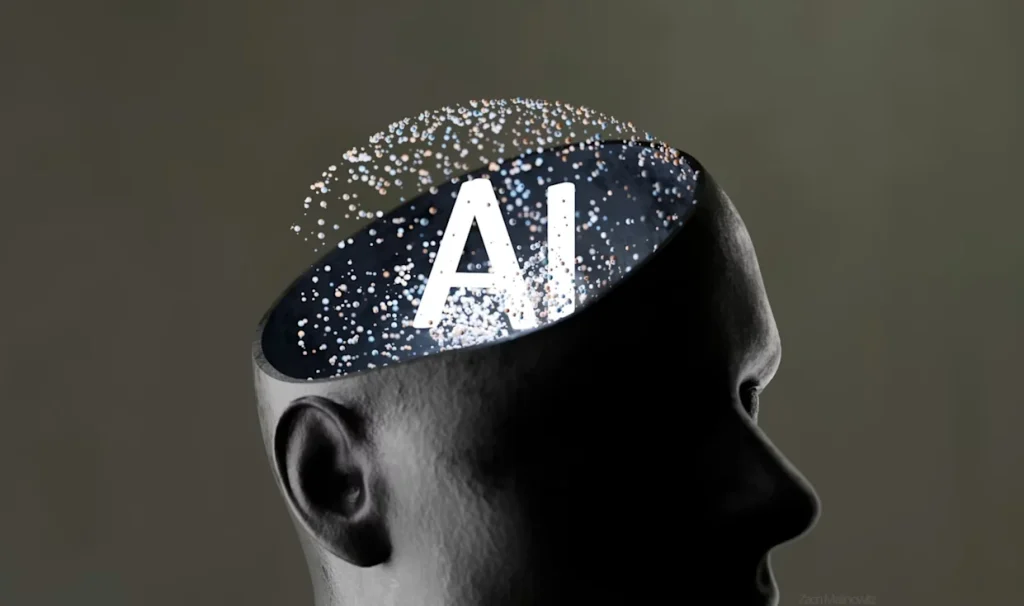
Another study has landed with a familiar warning: AI might be frying our brains. Researchers from the US and UK found that just ten minutes with an AI assistant can make people dependent on the technology—and their performance tanks once it's taken away.
“We find that AI assistance improves immediate performance, but it comes at a heavy cognitive cost,” the study declares. The paper, titled "AI assistance reduces persistence and hurts independent performance," pretty much says it all.
The experiments
The researchers focused on what they call "reasoning-intensive" cognitive work—things like writing, coding, and brainstorming. They recruited 350 Americans and asked them to solve fraction-based equations. Half got access to a specialized chatbot built on OpenAI's GPT-5; the other half worked alone. Midway through, the AI group had their tool yanked away.
The result? A steep decline in correct answers, plus plenty of people just giving up. This pattern held in a larger experiment with 670 participants. The team ran one final test with reading comprehension questions instead of math. Same outcome.
“Once the AI is taken away from people, it’s not that people are just giving wrong answers. They’re also not willing to try without AI,” Rachit Dubey, an assistant professor at the University of California and coauthor of the study, told Futurism. “People’s persistence drops.”
Dubey warns that rapid AI deployment in education could create a "generation of learners and people who will not know what they’re capable of, and then that will really dilute human innovation and creativity.”
The boiling frog effect
The study compares using AI to the "boiling frog" effect: "sustained AI use erodes the motivation and persistence that drive long-term learning." These effects accumulate, and "by the time they are visible, they will be difficult to reverse."
https://twitter.com/ScienceNews/status/2044450741071249649
Caveats and one silver lining
Two important notes: the study hasn’t been peer-reviewed yet. And researchers did find one tiny bright spot. Participants who used AI for hints and clarification fared much better after the chatbot was removed than those who used it to basically spit out answers.
The bigger picture
This is just the latest research probing what AI is doing to our collective cognition. Previous studies have identified "AI brain fry"—increased fatigue among full-time workers who rely on the tools. Those employees often end up working harder and longer than their tech-averse colleagues.
https://www.youtube.com/embed/MEIWamztRKA
The effects appear even starker in education. Other studies suggest AI use in schools leads to poorer social and intellectual development, and kids who lean on chatbots tend to perform worse on tests.