
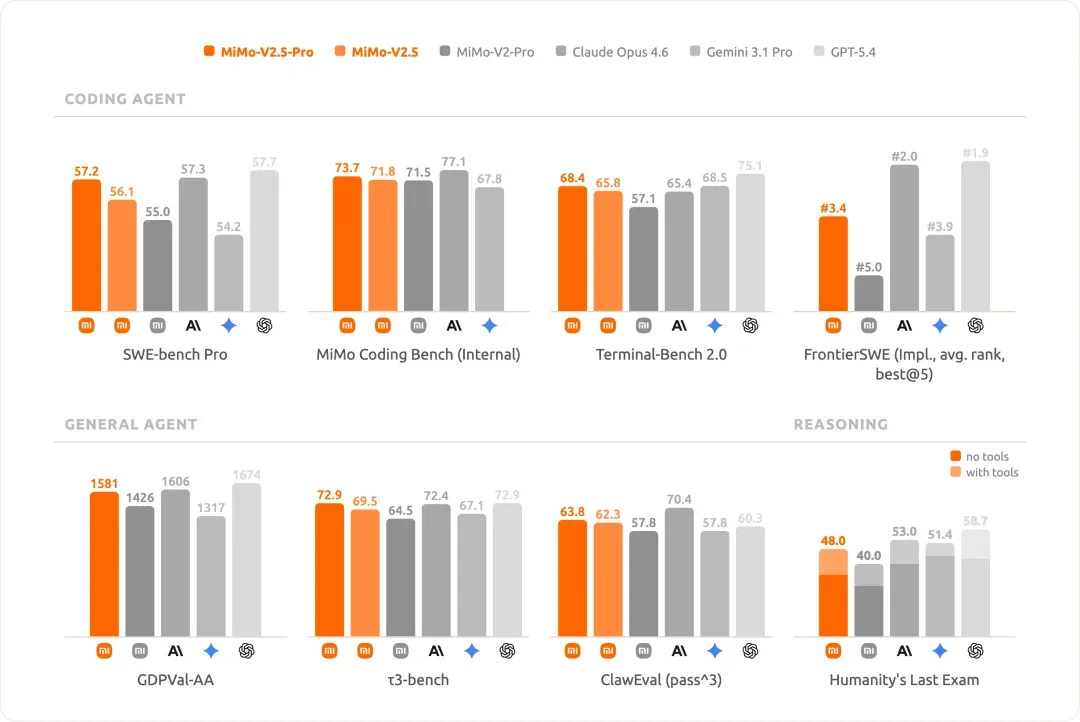
Xiaomi just opened public testing for its MiMo V2.5 series of large language models, with the flagship V2.5-Pro version aiming squarely at the performance tier of Anthropic's Claude Opus 4.6 and OpenAI's GPT-5.4.
https://twitter.com/XiaomiMiMo/status/2046988157888209365
The company demonstrated the model's capabilities with two long-form task examples. First, it tackled a classic computer science challenge: building a complete SysY compiler from scratch in Rust, a project from Peking University's "Compiler Principles" course. The model completed it in 4.3 hours with 672 tool calls, scoring a perfect 233/233 on the hidden test set.
Its second feat was more open-ended. Given only the instruction "build a video editor web app," the model delivered a functional application with a multi-track timeline, clip trimming, and audio mixing features in 11.5 hours. It made 1,868 tool calls and generated 8,192 lines of code.
On token efficiency, Xiaomi claims the V2.5-Pro uses 42% fewer tokens than Moonshot AI's Kimi K2.6 for the same score on the ClawEval benchmark. The standard V2.5 model is said to be 50% more efficient than Muse Spark. The new models' agent capabilities reportedly surpass the previous V2-Pro generation on ClawEval, while API costs have been cut by about half.
Pricing has been overhauled alongside the release. Xiaomi eliminated the previous credit multiplier distinction between 256K and 1M context windows, unifying the billing rate. A new nighttime discount offers 20% off for usage between midnight and 8 a.m. Beijing Time. The company also introduced discounts for monthly and annual subscriptions. Credits for existing Token Plan users will be fully reset.
In a significant move, Xiaomi announced that both the V2.5-Pro and V2.5 models will be open-sourced globally soon. This follows a trend of major Chinese AI releases going open source, like Moonshot AI's Kimi K2.6, which also claims to match top-tier closed models on coding tasks. The timing is interesting, as the AI cost conversation is heating up with news that Claude Opus 4.7's new tokenizer is burning through your budget for the same outputs.