
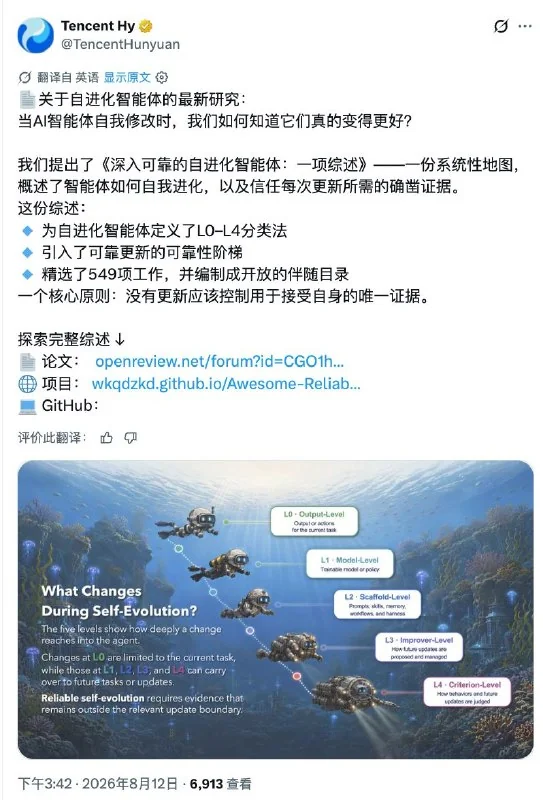
Getting AI to learn from experience and improve itself without a human manually tweaking it every step of the way is becoming a major thread in agent research. Tencent Hunyuan, working with Zhejiang University and other teams, combed through 549 papers on exactly that — self-reflection, self-training, memory evolution, skill evolution, recursive improvement — and organized them into a five-level roadmap, L0 through L4.
- L0 — Fix the answer. The AI reflects on mistakes, retries, and tries another approach. After the task is done, no lasting change remains.
- L1 — Fix the model. What it learns gets written into the model's parameters, carrying over to future tasks.
- L2 — Fix the agent. Now the changes move outside the model: prompts, memory, skills, tools, workflows, and the agent harness itself can all be modified.
- L3 — Fix the evolution method. The AI can now modify how it learns, how it proposes updates, and how it selects or rolls them back. The paper treats this as the starting point of recursive self-improvement.
- L4 — Fix what "progress" even means. Evaluation criteria, rewards, constraints, and testing methods all move into the self-modification zone.
The higher you go, the closer this gets to true AI-upgrading-AI — and the trickier the problems become. An AI that can modify both itself and its scoring rules could end up proving it "improved" by simply changing the test. It may not be getting genuinely stronger; it might just be getting better at passing its own exam.
That's why the paper includes a crucial guardrail: AI can evolve itself, but it can't hold the final acceptance authority. The tests, evidence, and release rules used to verify that it actually got better have to live somewhere the AI can't touch. Reject updates that don't pass, roll them back if something goes wrong, and escalate to a human when needed.
https://twitter.com/TencentHunyuan/status/2087444616832594022