Muon optimizer tricks models into overconfidence — and DeepSeek V4 uses it
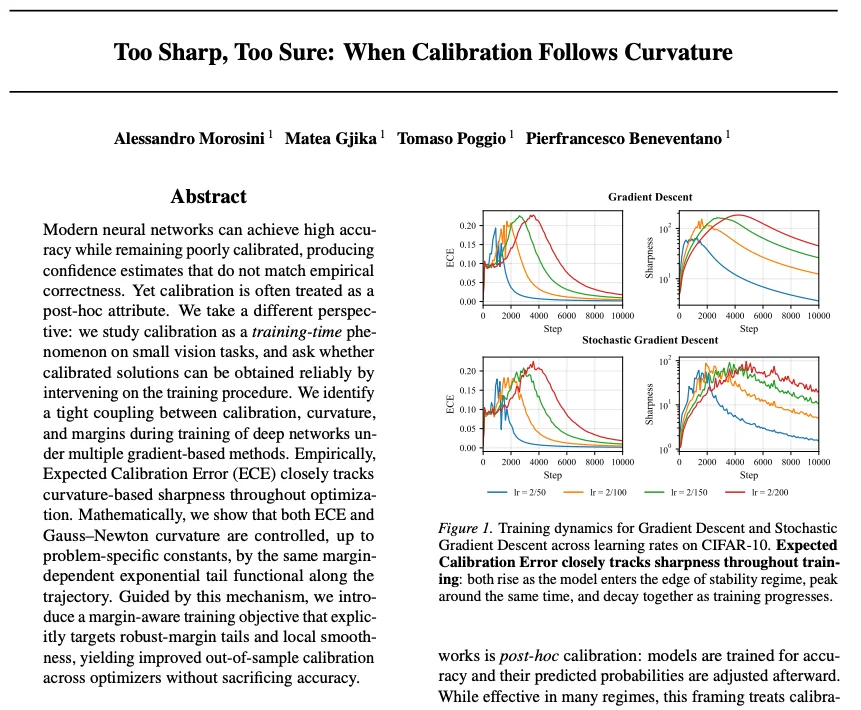
A new paper titled "Too Sharp, Too Sure: When Calibration Follows Curvature" has uncovered a strange behavior in the Muon optimizer: models trained with Muon become almost perfectly calibrated on their training data — they know exactly when they're right and when they're uncertain — but on unseen test data, their confidence shoots up, making them sound overly sure of shaky answers.
Think of it like a student who's memorized the practice exam cold. They can tell you exactly which questions they'll ace and which they'll bomb — as long as you're still asking from the practice set. Give them a slightly different test, and they're suddenly overconfident in the wrong answers.
The paper pins the problem on "margin instability." Muon pushes the model's decision boundaries wide apart on training samples, which looks stable — but even a tiny nudge in the input can collapse that distance. The model doesn't notice, and keeps outputting high confidence scores.
The team ran experiments on CIFAR-10 image classification with a ResNet-20. Under standard training, Muon's test Expected Calibration Error (ECE) was 0.065, compared to AdamW's 0.061, SGD's 0.081, and SAM's 0.020. (ECE measures the gap between a model's confidence and its actual accuracy — lower is better.) Muon isn't dramatically worse than AdamW on test data. What's striking is that its training ECE is nearly zero — meaning the calibration gap between training and test is much larger for Muon than for other optimizers. The paper proposes a fix called CalMO that brings Muon's test ECE down to 0.019.
But don't expect these findings to apply directly to large language models yet. The experiments only covered small image tasks like CIFAR-10 and CIFAR-100, and small models like MLPs and ResNet-20. No LLM validation was done.
That said, the Muon optimizer is already in production: DeepSeek's V4 technical report reveals that most of the model's modules were trained with Muon to speed convergence and improve stability, though some modules still use AdamW. Whether DeepSeek V4 suffers from the same calibration quirks will require more direct testing.