

Moondream just launched Lens, a commercial fine-tuning service that packages reinforcement learning and supervised fine-tuning into a pay-as-you-go API. You hand over a few dozen labeled images from your specific business scenario, and the backend automatically trains a custom visual language model (VLM) tailored to that task. The company claims you can see results with just a dozen or so sample images. Once trained, the model can be called via Moondream's cloud or deployed locally using its own inference engine, Photon.
This is a key piece of Moondream's strategy: build on open-source small models and add value with commercial services. Generic VLMs often struggle in niche domains like sports broadcasting, medical imaging, or factory quality inspection. Lens takes the messy work of setting up a reinforcement learning training pipeline off your plate, lowering the barrier to a few dozen labeled images and a training fee of a few dozen dollars.
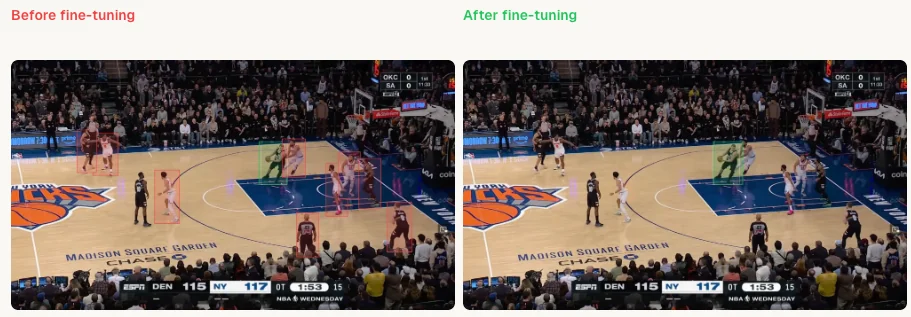
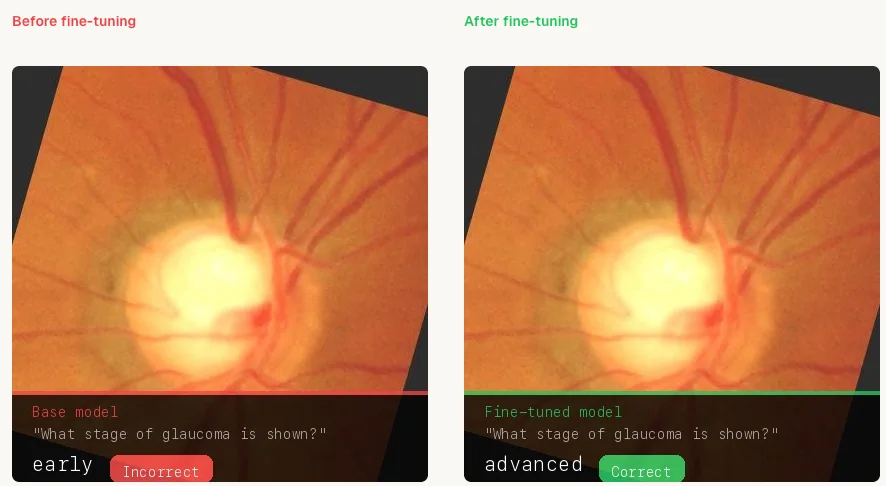
The company released three sets of comparative data. For detecting the ball-handler in NBA broadcast footage, the base model frequently produced a flood of false-positive bounding boxes. After RL fine-tuning, the F1 score jumped from 28% to 79%, false positives dropped from 61 to 2, and the training took 54 minutes and cost $16.89. In a task to identify a country from street-view photos, 25 fine-tuning samples per country achieved 71.1% accuracy, beating GPT-5.4's 69.8%. For medical imaging, the fine-tuned model was twice as accurate as GPT-5.4 at grading glaucoma severity, with training completed in 47 minutes for $15.68.
The first partner is PTZOptics, a maker of network-controlled pan-tilt-zoom cameras, which is using Moondream to track specific targets (like "the person in the red shirt"), inventory scene content, and flag anomalies. Moondream previously released its Photon inference engine, which it claims delivers 20-millisecond inference latency on an H100 GPU. With Lens focusing on accuracy, Photon on speed, and the locally-runnable open-source model core, Moondream has assembled the three key pieces for VLM deployment: speed, precision, and deployment flexibility. This push for specialized, affordable fine-tuning is part of a broader trend where companies like Moonshot AI are also challenging giants by open-sourcing models that match GPT-5.4 on coding benchmarks, while others grapple with the cost implications of new architectures, as seen with Claude Opus 4.7's more expensive tokenizer.