Baidu's AI research team has just open-sourced its text-to-image model, ERNIE-Image. Built on a single-stream Diffusion Transformer (DiT) architecture, the model packs 8 billion parameters and includes a lightweight "Prompt Enhancer" that can turn a short user input into a more detailed, structured description.
Baidu claims that at just 8B parameters, ERNIE-Image is already among the top-performing open-source text-to-image models available. The model has been specifically tuned for complex instruction following, text rendering, and structured image generation—making it suitable for scenarios that demand precise layout and text control, like posters, multi-panel comics, academic charts, and ad designs.
https://twitter.com/ErnieforDevs/status/2044076389251592395
According to the company, ERNIE-Image can generate clear glyphs and layouts in multiple languages, including Chinese, English, Japanese, and Korean. It's said to excel at handling complex multi-subject relationships, knowledge-intensive descriptions, and high-density text rendering. In several open-source model evaluations, its text rendering and complex instruction-following capabilities reportedly place it in the top tier.
Baidu also emphasizes that ERNIE-Image has modest hardware requirements: it can run on consumer-grade graphics cards with 24GB of VRAM and still produce images approaching the quality of commercial closed-source models. The company is positioning it as a "consumer-runnable" open-source model, aiming to lower the barrier to entry for high-quality text-to-image research and deployment.
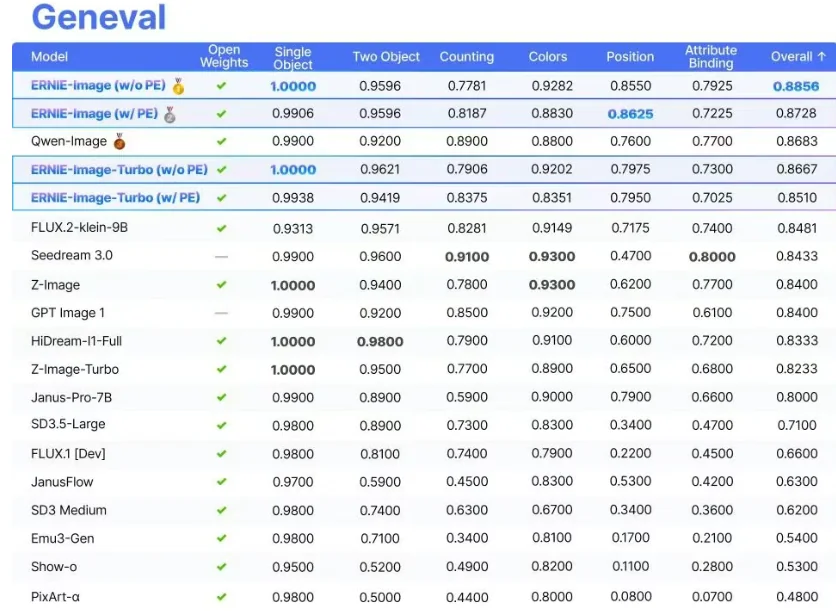
In international public benchmarks like GenEval, OneIG, and LongText-Bench, ERNIE-Image has achieved leading scores. Baidu states that its text rendering capability is now on par with commercial closed-source models like NanoBanana.