
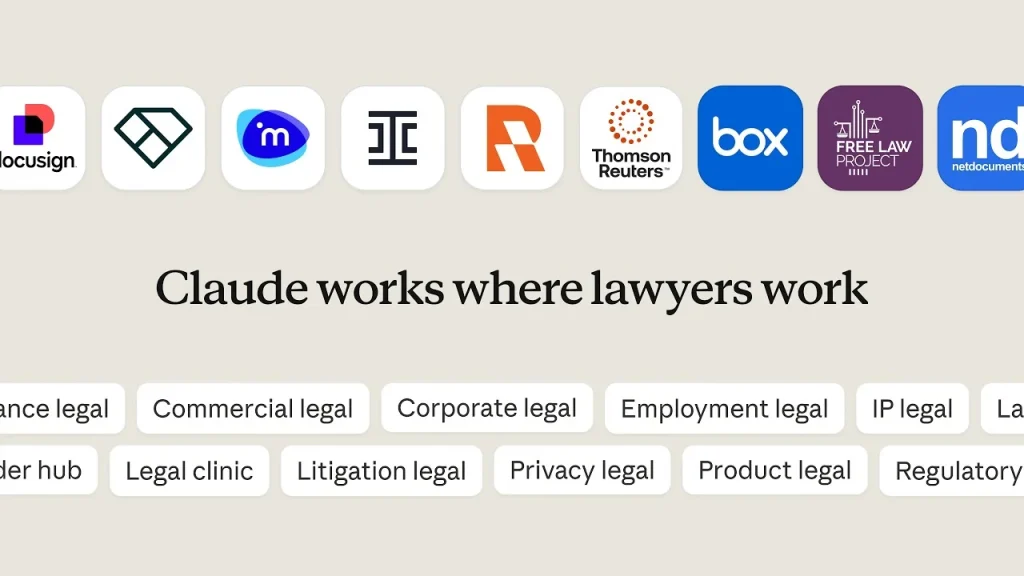
Anthropic today dropped a GitHub repository called "Claude for Legal," packing 12 plugins for specific legal roles and over 20 MCP connectors that link to industry-standard software.
Whether you're in-house counsel, a law firm grinding through M&A, a privacy and AI governance advisor, a litigation attorney burning the midnight oil, or a law student just trying to survive, this repo has an AI tool for you. And it's all open-source on GitHub:
These plugins aren't plug-and-play. Before using them, you'll spend 10 to 20 minutes doing a "cold start interview" with Claude, feeding your team's playbook, templates, and stylistic preferences into a local file called CLAUDE.md. After that, every plugin automatically works according to your firm's own style and standards.
Anthropic designed this to fix the most common complaint about AI legal tools: the output is too generic, and doesn't look like something your firm actually produced.
https://www.youtube.com/watch?v=7-1tNo8HAwk
Anthropic clearly understands law firms' pain points.
For example, the Vendor Agreement Reviewer plugin automatically modifies supplier agreements against your own contract templates, and helpfully spits out a redline memo. The NDA Triager sorts incoming NDA files into green, yellow, and red categories — green can pass, red goes straight to a lawyer. The Claim Chart Builder can generate a patent infringement comparison chart with one click. The Privilege Log Reviewer runs a first-pass review of privilege logs automatically. And the Docket Watcher plugin tirelessly monitors court dockets and pulls in the latest updates in real time.
In short, it turns the most tedious, mechanical, and wasteful tasks at a law firm into simple slash commands.
If the plugins solve internal efficiency, the deep integrations with industry systems reveal Anthropic's real ambition.
Now, almost every major platform you can name — Thomson Reuters' CoCounsel, Harvey, iManage, NetDocuments, Ironclad, DocuSign, Everlaw, Relativity, Box, Datasite — has an official MCP connector. Everyday office tools like Word, Excel, Outlook, and PowerPoint are also fully connected. After editing a contract, Claude can even output it directly in Word's track changes mode, so lawyers can accept or reject each change.
Anthropic isn't just targeting high-end law firms. They've also done something more down-to-earth: partnering with Free Law Project and the Justice Technology Association to offer special discounts for legal aid organizations, public defenders, and nonprofit legal groups. Even Courtroom5, a tool designed for pro se litigants, is integrated. That's notable, because roughly 80 percent of plaintiffs and defendants in US civil cases can't afford a lawyer.
Under the hood, Claude for Legal runs on the newly upgraded Claude Opus 4.7 model. Anthropic is careful to emphasize that all plugin output is "draft for attorney review only" and should never replace a lawyer's professional judgment.
The README repeatedly warns: track sources for citations, and default to conservative handling when privilege and subjective legal judgment are involved. After all, AI still can't fully replace a professional lawyer.