
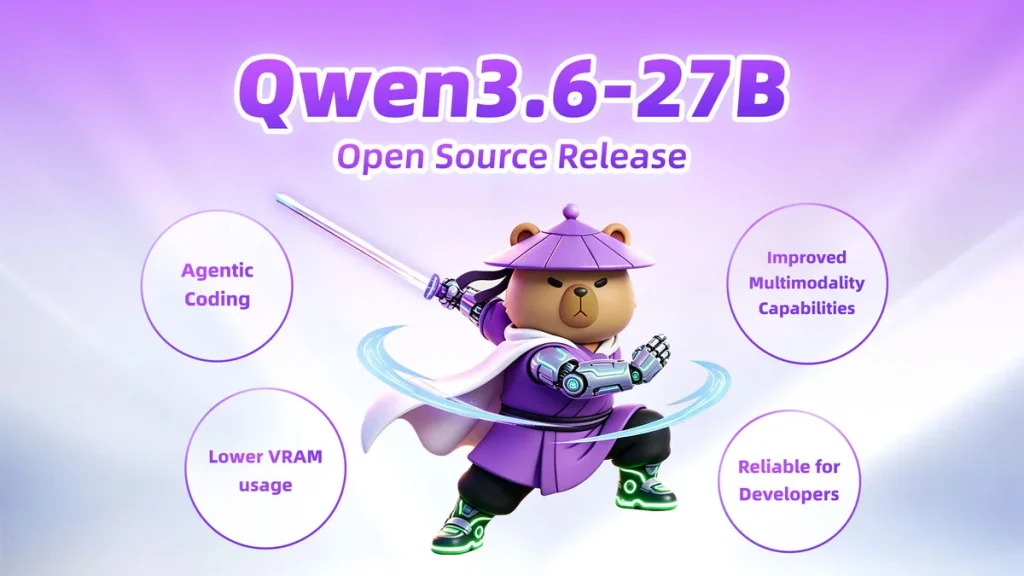
Alibaba's AI research team, Tongyi Lab (Qwen), just dropped a new open-source model that's making some bold claims. It's called Qwen3.6-27B, a 27-billion-parameter multimodal AI, and it's available for anyone to download and run on their own hardware under the permissive Apache License 2.0.
https://twitter.com/Ali_TongyiLab/status/2046939495497367863
The Qwen team first announced the Qwen3.6 series on April 2, 2026, with the flagship Qwen3.6-Plus. At the time, they promised a smaller, open-source version would follow. This 27B model is that scaled-down release.
This isn't the first smaller model from the Qwen3.6 line. They also released Qwen3.6-35B-A3B on April 15, a model that uses a sparse mixture-of-experts (MoE) architecture to activate only about 3 billion parameters at a time for faster, more efficient operation.
The new Qwen3.6-27B is a 27-billion-parameter dense model that supports both chain-of-thought and standard reasoning modes. Like the rest of the Qwen3.6 family, it's multimodal, handling images and video. The team pitches it as a practical, deployable-scale model with "top-tier agent coding capabilities."
And the benchmarks? They're the story here. According to Qwen's own charts, the model beats its predecessor, Qwen3.5-27B, and Google's recently released open model, Gemma4-31B, across all 12 benchmarks tested. More provocatively, it even scores higher than Anthropic's two-generations-old flagship, Claude 4.5 Opus, in some tests.

It also reportedly outperforms the massive 397-billion-parameter Qwen3.5-397B-A17B model on major coding benchmarks like SWE-bench Verified, SWE-bench Pro, Terminal-Bench 2.0, and SkillBench, underscoring its strength in agent-based coding tasks.

The model weights are available now on Hugging Face and ModalScope for self-hosting. An API version is planned for Alibaba Cloud Model Studio. Qwen says it integrates seamlessly with popular third-party coding assistants like OpenClaw, Claude Code, and Qwen Code to streamline developer workflows. An FP8 quantized version was released simultaneously.


In a statement, Qwen said, "Qwen3.6-27B surpasses the much larger 397B Qwen3.5-397B-A17B on critical developer tasks, yet is far easier to deploy and operate. Its release completes the Qwen3.6 series as a comprehensive model family, representing a generation where agent coding has achieved breakthroughs at every scale. We're excited to see what gets built with these models."
Separately, Simon Willison's Perplexity Benchmark on a 4-bit quantized version of Qwen3.6-27B also showed very strong results.
