

This is a story about ideals, power, and betrayal. It begins with a lavish dinner at a hotel in the heart of Silicon Valley and might end at the crossroads of human civilization's future. This is the decade of OpenAI — an epic that condenses all the ambition, conflict, and dreams of Silicon Valley.
Genesis: From Fear to Action
The real origin lies in a deep existential anxiety. In 2014, Google acquired the London-based AI research company DeepMind. For Elon Musk, this wasn't just a business deal — it was a warning sign. He had invested in DeepMind not for financial returns, but to monitor AI development up close.
Musk and Google co-founder Larry Page were once close friends, but they clashed violently over the fundamental philosophy of AI. Page was wildly optimistic about AI's future, while Musk was deeply worried. During one heated argument, Page even accused Musk of being a "speciesist" for insisting that human interests should outweigh those of future silicon-based intelligence. That rift ended their friendship and convinced Musk that a superintelligence controlled by a single for-profit giant would be the potential end of civilization.
That Summer Night at the Rosewood
To counter this growing "beast," Musk sought out the hottest figure in Silicon Valley at the time: Y Combinator president Sam Altman. One summer evening in 2015, at the Rosewood Hotel in Menlo Park, California, a birthday dinner for Altman brought together the Valley's elite to discuss the future of AI.
The atmosphere was both excited and tense. Musk laid out his concerns: Google already had the world's most powerful AI team, the largest datasets, and the most advanced compute. If nothing was done, humanity would hand its fate to a profit-maximizing corporation. Altman agreed wholeheartedly. As the head of Silicon Valley's most successful startup incubator, he understood the dangers of concentrated power.
A grand vision took shape that night: create a nonprofit AI lab dedicated to developing safe artificial general intelligence (AGI) and ensuring its benefits are shared by all of humanity. They called it OpenAI. Musk, the worried "Iron Man," wanted to counterbalance Google. Altman, the power broker, saw an opportunity to lead the next tech revolution. And the brilliant researcher Ilya Sutskever, who had been invited, was drawn to the pure scientific mission.
That night, they reached a consensus and loudly announced a $1 billion pledge, kicking off an unprecedented gamble. They believed they weren't just building a company — they were lighting a Promethean fire for humanity's future. No one expected that fire would eventually consume them, scorching ideals and reality into a wasteland.
Birth of the Dream Team
OpenAI's founding sent shockwaves through the AI world. But turning that grand vision into reality required the world's top AI talent. That daunting task fell to Greg Brockman.
Brockman had just resigned as CTO of Stripe — a coveted position at one of Silicon Valley's hottest fintech companies. But OpenAI's mission was irresistible. His first move was to fly to Montreal to visit Yoshua Bengio, one of the three godfathers of deep learning.

In Bengio's office, they spent an entire afternoon listing the world's best AI researchers on a whiteboard. Every name represented the cutting edge of AI. Brockman then embarked on a marathon recruiting tour, flying around the globe to convince these geniuses to join OpenAI.
The biggest breakthrough was poaching Ilya Sutskever. Ilya was the star student of deep learning godfather Geoffrey Hinton and co-inventor of AlexNet — the model that ignited the deep learning revolution in 2012. He was working at Google Brain on major projects like TensorFlow and AlphaGo. Musk later said that successfully poaching Ilya was the last straw that broke his relationship with Larry Page.

Beyond Ilya, Brockman also recruited nine other top researchers, including Wojciech Zaremba, John Schulman, and Andrej Karpathy. Many of them gave up huge salaries and stock at Google and Facebook to join this uncertain but noble endeavor. Zaremba later recalled turning down offers that "doubled his pay" just to follow the mission.
The assembly of this team was a miracle in itself. The talent war in Silicon Valley had never been so fierce. Giants like Google and Facebook could offer sky-high compensation and equity. But OpenAI, as a nonprofit, had no stock options and paid far below market rates. Why did these geniuses join? It was the pure mission: ensuring AGI benefits all of humanity, not being monopolized by a few.

The $1 Billion Promise vs. Reality
In December 2015, OpenAI officially announced its founding and loudly declared a $1 billion funding commitment. The number stunned the tech world. Pledgers included Musk, Altman, Reid Hoffman, Peter Thiel, and companies like Amazon Web Services.
Musk wrote in an internal email: "We need a much bigger number than $100 million so we don't look hopeless against Google or Facebook's spending." He promised to fill any shortfall if others didn't come through. That commitment gave OpenAI the psychological advantage of "unlimited resources" and convinced top global talent that this organization could go toe-to-toe with Google.

But reality was far harsher. By 2019, actual donations totaled only about $130 million. Musk personally contributed less than $45 million; other donors combined gave over $90 million. That claimed $1 billion was more of a grand narrative than real financial backing. But in those idealistic early days, nobody cared about the details.
From Apartment to Lab: Humble Beginnings
Despite having a top-tier team and grand vision, OpenAI's start was remarkably humble. At first, the company didn't even have a real office. All employees crammed into Greg Brockman's San Francisco apartment to work.

That tiny apartment became the starting point for changing the world. Team members squeezed onto couches, kitchen counters, even beds — anywhere they could find space to dive into intense research. The sound of laptop fans, keyboard clacking, and heated technical discussions filled the cramped space.
Once, when Ilya and a colleague wanted to discuss ideas on a whiteboard, they realized the apartment had no office supplies. Brockman immediately went out and bought a whiteboard and other essentials. This seemingly "crazy" work environment was full of passion and creativity. No hierarchy, no bureaucracy — just pure pursuit of technology.
A few months later, as the team grew, they finally moved into a proper office in San Francisco. But those early days of working side-by-side in an apartment became the bedrock of the team's culture: flat, open, mission-driven.

Research Paradise: The Stress-Free Golden Age
Early OpenAI was a true research paradise. The claimed $1 billion commitment (though far less actually arrived) temporarily freed the team from worrying about money. No profit pressure, no product deadlines — the only KPI was moving toward AGI.
The team's research was incredibly diverse, covering everything from reinforcement learning to robotics control, game AI to language models — basically every frontier of AI. This "let a hundred flowers bloom" atmosphere let each researcher follow their interests and explore the most cutting-edge problems.
In 2016, annual spending data showed OpenAI spent $7 million on salaries for its first 52 employees. Though pay was below market rates, nobody complained. They knew they were part of something that could change human history. Under its nonprofit structure, OpenAI fostered an academic, mission-driven culture, with research results mostly shared as papers and open-source code.
Technical Breakthroughs: From Tools to Miracles
This golden age wasn't just about ideals — it produced real breakthroughs.
In April 2016, OpenAI Gym launched. This reinforcement learning toolkit provided a standardized set of environments, letting researchers worldwide test and compare algorithms under the same conditions. It quickly became a standard platform, downloaded millions of times, one of the most important pieces of infrastructure in reinforcement learning.
By the end of 2016, Universe was released. This platform let AIs learn by controlling entire desktop environments via VNC, just like a human, across various games and apps. It was a bold attempt to have AI learn in realistic, unsimplified environments instead of just lab simulations.
That same year, Nvidia gifted OpenAI its first DGX-1 supercomputer. With 8 Tesla P100 GPUs and 170 teraflops of compute power, it compressed training time from 6 days to 2 hours — a leap that made bolder ideas possible. Researchers began training larger models, exploring the boundaries of scaling laws.

In August 2017, OpenAI's stunning performance at the Dota 2 esports stage showed the world AI's potential. At The International 2017, the OpenAI bot defeated professional player Dendi in a 1v1 match, causing a global sensation. Musk hyped it on Twitter: "OpenAI just beat a top world player in Dota 2. A big milestone in AI." This victory not only proved reinforcement learning's power but also cemented OpenAI's image as a technology leader in the public mind.
In robotics, the team made a robotic hand solve a Rubik's cube one-handed — a seemingly simple task that actually required incredibly complex physical manipulation and real-time decision-making. The video caused a huge stir in academia.
In June 2018, the most historically significant result appeared. GPT-1 was released, a model with 117 million parameters that pioneered the "pre-train then fine-tune" paradigm — first unsupervised learning on massive text, then fine-tuning for specific tasks. Its capabilities were limited compared to later models, but it pointed a path toward AGI. Ilya Sutskever firmly believed that with enough data and compute, this path could lead to true general intelligence.
The Team's Soul: The Three Horses
As CTO, Greg Brockman engineered the lab's engineering culture to run smoothly. He established rigorous code reviews, promoted open-source culture, and ensured every line of code was solid. His pragmatic, efficient management style enabled this team of geniuses to collaborate effectively.
As chief scientist, Ilya Sutskever guided the team through deep learning's uncharted territories. He held an almost religious belief in "scaling laws" — that simply increasing model size, data, and compute would drive AI capabilities to grow exponentially. That belief later proved correct, but at the time, it was just a bold hypothesis.
Sam Altman, meanwhile, used his unparalleled network and influence to protect the lab. He frequently appeared at summits and forums, securing resources and support for OpenAI. His strategic vision and political savvy gave OpenAI a strong position in Silicon Valley's power games.

It was a golden age. They believed they were dragonslayers, building a fortress to counter tech giants and ensure AI safety. From open-source tools to reinforcement learning, from robotics to the seeds of language models, each achievement accumulated energy for the coming explosion. But inside the fortress, cracks were already quietly forming.
The Abyss of Billions
In early 2017, an internal cost projection circulated among OpenAI management. Carefully prepared by the technical team, the conclusion stunned everyone: achieving AGI could require long-term investment on the scale of billions of dollars.
A confidential internal report laid it out in stark terms: the path to AGI demanded exponentially more compute. The Transformer architecture had just arrived, and the so-called "scaling laws" were starting to look real. The takeaway was brutal: bigger models, more data, and a spending curve that went vertical.
At the time, OpenAI was burning through tens of millions of dollars a year — mostly on talent and cloud compute. To compete with Google, that number needed to jump tenfold, maybe a hundredfold. The report estimated that in a few years, OpenAI would need hundreds of millions, even billions, annually.
That was far beyond what any nonprofit donation model could sustain. The much-hyped $1 billion pledge? Only $130 million had actually arrived, and most of it was already gone. Without a new source of cash, OpenAI was headed for a wall.
The idealism of the golden era was about to meet cold, hard reality.
The fear of falling behind
The report sent Musk into a spiral of anxiety. He had always believed OpenAI's mission was to stand up to Google, to keep AGI from being monopolized. But now OpenAI was moving too slowly — it was already far behind.
Even more ironic: around this time, Musk started leaning on OpenAI more and more to serve his own empire. In early 2017, he demanded that OpenAI send an elite team to fix Tesla's struggling Autopilot software. Scott Gray, Ilya Sutskever, Greg Brockman, and Andrej Karpathy poured in hours. In the end, Musk poached Karpathy to work full-time at Tesla.

That move unsettled the other founders. Was OpenAI an independent nonprofit? Or Musk's technical support squad? Nobody dared to ask publicly — Musk was the biggest donor and the most influential founder.
A false consensus
In September 2017, a tense phone call brought together Musk, Sam Altman, Greg Brockman, and Ilya Sutskever. The agenda: how to raise enough money to compete with Google.
Greg started: "How much of your time should we plan to take in the coming weeks?"
Musk was blunt: "This is the top priority. We need to figure out how to transition from a nonprofit into something that's essentially a charity but also a B-corp or C-corp or similar. We have to sell the story right — can't lose the moral high ground. This is absolutely critical."
A B-corp (Benefit Corporation) is a special kind of company that promises to create social value alongside profit. Musk thought it could let OpenAI attract commercial investment while keeping its mission.
For a moment, everyone thought they had reached consensus. Ilya pitched his ideas, Musk agreed, even said, "I'm really excited to do this with you guys." He promised to look into B-corp details the next day and start the process.
The call ended in harmony. But it was the calm before the storm.
A sudden shift in terms
In early October, Musk's attitude did a 180. Through his liaison Shivon Zilis — his right-hand person and the bridge to OpenAI — he sent new demands:
- Two additional board seats, giving him outright majority control.
- Greg and Ilya must commit to stay for a period and sign non-solicit agreements.
- If they refused, Musk would launch a competing AGI project.
The subtext was unmistakable: either submit fully, or get nothing.
Greg and Ilya were trapped. If they gave in, they'd be locked into a structure that might never raise enough money, while Musk could walk away to pursue his own AGI at Tesla. They'd lose control of OpenAI and become Musk's puppets.
But if they said no, Musk could retaliate immediately — cut funding, start a rival. OpenAI would face an existential crisis.
They talked with Shivon about the possibility of a B-corp with Musk. She said Musk told her it was possible, but not in the next 6-9 months — he needed to focus on Tesla's Model 3 production ramp. That answer made it clear: Musk wasn't in a hurry to solve OpenAI's problems. He just wanted control.
They stayed silent. They didn't accept his terms.
A moral struggle in a diary
On November 6, 2017, Greg Brockman recorded a brutally honest breakfast conversation with Ilya in his private diary. They discussed an ethically agonizing question: How should they handle Musk?
Greg wrote: "The honest answer is, we want him out."
That line captured their real feelings. Musk's control freakery, his instrumental use of OpenAI, his erratic behavior — it exhausted and worried them. They realized that with Musk around, OpenAI would never be truly independent, just a part of his business empire.
But then Greg added the moral anguish: "It would be wrong to take the nonprofit away from him. To convert to a B-corp without him. That would be really morally corrupt. And he's really not a fool."
Musk was a co-founder, the biggest donor, one of the original visionaries. Transforming OpenAI into a for-profit without his consent felt wrong. And Musk was too smart not to notice any backroom maneuvering.
They ranked their options: "[1] B-corp + appropriate control structure [2] Nonprofit + large funding [3] We leave and go it alone."
Ilya insisted that morally, they shouldn't kick Musk out. They should try to make the nonprofit work and persuade him to stay. So they decided to try fundraising for the nonprofit for a while and see what happened.
This conversation laid bare the internal contradictions: idealism versus reality, morality versus survival, independence versus dependence. These contradictions would eventually tear the team apart.
The phantom ICO
In mid-January 2018, things seemed to turn around. Greg and Ilya raised a new donation, and Musk congratulated them. Even more exciting, Musk agreed to an ICO (Initial Coin Offering) to raise $10 billion — it would involve a for-profit subsidiary.
ICOs were hot at the time. Many blockchain projects raised huge sums by issuing tokens. If OpenAI could pull it off, the money problem would be solved. The team buzzed with excitement.
But by the end of January, Musk flipped again. He told them he no longer supported the ICO and declared: "OpenAI is on an inevitable path to failure relative to Google."

That sentence crushed the team's hopes. Musk not only pulled the ICO support, he publicly expressed pessimism about OpenAI's future. He believed no matter what they did, they couldn't match Google's resources and talent. The only way was a more radical approach.
The ultimatum
In February 2018, Musk issued his ultimatum: merge OpenAI into Tesla.
He wrote in an email that this was "the only hope to counter Google, however slim." His logic: Tesla was already building powerful AI and supercomputers for autonomous driving, which could be shared. More importantly, Tesla had the cash to sustain OpenAI's billion-dollar burn rate.

But the price was steep: majority equity, board control, and Musk as CEO. OpenAI would cease to be an independent organization — it would become a Tesla division, fully under Musk's thumb.
Sam Altman and the other founders pushed back. They insisted on OpenAI's independence, worried Musk's heavy hand would destroy the open culture they had built. They didn't trust Musk to balance Tesla's commercial interests with OpenAI's nonprofit mission. Handing OpenAI to Musk meant abandoning the original ideal — letting AGI become one person's tool.
Negotiations hit a dead end. Neither side would budge. Tensions mounted.
The cash crunch
When talks collapsed, Musk played his most extreme card: he suspended the promised donations.
That plunged OpenAI into an unprecedented cash crisis. The bank account was nearly empty — they could barely make payroll. Panic set in: if they couldn't pay their people, the top talent would flee and OpenAI would collapse.
At the last moment, investor Reid Hoffman — LinkedIn co-founder and early OpenAI backer — stepped in with emergency funds to keep the lights on.

The crisis made it painfully clear: OpenAI's dependence on Musk was a fatal weakness. Without diversified funding, a single Musk decision could kill the company.
The break
In February 2018, Musk made a dramatic exit from the OpenAI board. The official reason was "to avoid future conflicts of interest with Tesla's AI research," but everyone knew the truth: he had lost the power struggle.
Before leaving, Musk delivered a cold prophecy: "Your probability of success is 0%."
He said he would build his own AGI inside Tesla. Only under his complete control, he believed, could AGI be developed safely. OpenAI's multi-party governance model, in his view, led only to inefficiency and chaos.
By the end of 2018, Musk sent one more email, dripping with sarcasm: "Even raising a few hundred million dollars isn't enough. This project needs to burn billions a year starting now, or don't bother."

The message was clear: without him, OpenAI was doomed. He would prove at Tesla that only strong leadership and vast resources could win the AGI race.
The cost of the rift
The alliance that had promised to slay the dragon together had produced its first defector — and he was the one who had forged it. Musk's departure took not only his money but also the early counterbalance he had provided.
OpenAI lost its biggest benefactor, its most influential founder, and its psychological edge against Google. Worse, Musk became a potential competitor armed with inside knowledge of OpenAI's strengths and weaknesses.
To survive, OpenAI had to find a new path on its own. That path would inevitably lead to commercialization — the very world they had tried to resist. The first crack in idealism had become an unbridgeable chasm.
Musk's exit plunged OpenAI into an unprecedented survival crisis. The promised $1 billion donation had delivered only $130 million. And as research deepened, they realized the road to AGI was far more expensive than anyone had imagined.
Survival crisis: idealism crushed by reality
In early 2017, an internal financial model circulated among the leadership. Its conclusion was shocking: achieving AGI could require tens of billions of dollars over the long term. That was far beyond what any nonprofit donation model could support. The Transformer architecture had made compute demands exponential. As a nonprofit, OpenAI simply couldn't raise the kind of money needed to compete with Google.
Sam Altman faced a brutal choice: let OpenAI die from lack of funds, or break the original promise and embrace commercialization. He chose the latter.
In March 2019, Altman designed a controversial structure: OpenAI LP, a limited partnership. This for-profit subsidiary was controlled by the original nonprofit parent (OpenAI Inc.). Investor returns were capped — initially at 100 times the investment — with excess profits flowing back to the nonprofit for the benefit of humanity. This unique "capped-profit" model aimed to balance the nonprofit mission with commercial needs.
It was a desperate gamble. Nobody knew if this unprecedented hybrid structure would work, but at least it gave OpenAI air to breathe.
In July 2019, Microsoft stepped in. It invested $1 billion and became OpenAI's exclusive cloud partner, granting access to Azure's massive compute for model training. The deal solved the funding problem and, crucially, provided the compute power needed for AGI. OpenAI agreed to license its technology to Microsoft in exchange for survival.
The shift saved the company but triggered an internal moral crisis. Many employees questioned: could a company that accepted a tech giant's investment and chased profit still hold onto its original mission to "benefit all of humanity"? Had the promise made at the Rosewood Hotel become empty words?
The accelerationists vs. the safetyists: a schism in philosophy
As GPT-2 (February 2019) and GPT-3 (June 2020, 175 billion parameters) were developed, the fissures inside OpenAI deepened. Two conflicting philosophies began to clash violently.
The "accelerationists," led by Sam Altman and Greg Brockman, argued that the safest path was to develop superintelligent AI as quickly as possible, then use it to solve alignment. They believed that only by outrunning Google could they ensure AGI wouldn't be monopolized by a single giant. Speed, they insisted, was the best safety measure.
The "safety team," led by research VP Dario Amodei, insisted that blindly scaling models before solving alignment was extremely dangerous. Amodei was a lead author of the "Scaling Laws" paper, oversaw the development of GPT-2 and GPT-3, and made key contributions to reinforcement learning from human feedback (RLHF). He understood better than anyone that model capabilities were growing faster than our ability to control them.
His sister, Daniela Amodei, then VP of Safety and Policy, also felt deep unease about the company's direction. As Microsoft got involved, OpenAI faced pressure to turn models into commercial products. Amodei's team believed the company was prioritizing release speed and commercialization while neglecting core safety research, especially "interpretability" — understanding how AI actually works inside, not just observing its outputs.

During an internal meeting, Dario bluntly expressed his concern: "We are creating a monster that we don't understand. If we can't even explain how it thinks, how can we be sure it won't go out of control?"
Altman's response was equally firm: "If we don't move fast, Google will beat us. By then, we won't even have a seat at the table, let alone ensure AGI safety."
These were two starkly different risk assessments: one feared that moving too fast would lead to disaster, the other feared that moving too slow would lose the initiative. As Microsoft's money and compute poured in, the balance tipped toward the accelerationists.
2021: The Safety Exodus
By late 2020 and early 2021, the conflict had become irreconcilable. As the Microsoft partnership deepened, commercialization pressure mounted. Dario Amodei later admitted in interviews that he left not because of Microsoft's investment itself, but because of "fundamental disagreement on the vision" with OpenAI's management. He said, "Rather than argue endlessly under someone else's vision, it's better to lead a trusted team to realize my own."
In January 2021, Dario and Daniela Amodei led 11 core researchers — including Tom Brown, Chris Olah, Sam McCandlish, Jack Clark, Jared Kaplan, and Benjamin Mann — in a mass resignation. Many were key contributors to GPT-3, and their departure was a heavy blow to OpenAI.
They founded a new company called Anthropic and quickly raised $124 million in initial funding. Unlike OpenAI, Anthropic registered as a Public Benefit Corporation (PBC) from the start, legally requiring its board to balance shareholder interests with public good. This was a direct response to OpenAI's "capped profit" model, signaling a lasting commitment to nonprofit governance.
Anthropic's charter also established a "Long-Term Benefit Trust" with special shares to oversee that the company always serves humanity's long-term interests. Their vision was to create a "reliable and trustworthy" path for AI development, focusing on "Constitutional AI" to fundamentally solve alignment.
In April 2022, Anthropic announced a $580 million funding round, with $500 million coming from then-celebrated crypto exchange FTX CEO Sam Bankman-Fried. Although FTX imploded in November 2022, creating uncertainty for Anthropic's finances, the investment underscored big investors' interest in the AI safety route.
The Brake Pads Removed
Anthropic's birth marked a major schism inside OpenAI. The safety-versus-speed debate evolved from internal philosophical conflict into external market competition. The safety team, which had served as a "brake pad" within OpenAI, had now left entirely.
After the safety team's brake pads were removed, Altman's OpenAI floored the accelerator. Backed by Microsoft's billions and Azure cloud compute, they pushed GPT research at unprecedented speed. Without internal counterbalancing forces, the accelerationist philosophy dominated everything.
This paved the way for ChatGPT's explosive success, but also sowed seeds of future safety concerns. The organization that once aimed to ensure AGI safety was now racing at full speed toward an unknown finish line. And those who once fought alongside them had become competitors.
The rift in idealism widened once more.
Technical Foundation Before Dawn
After the safety team's brake pads were removed, Altman's OpenAI floored the accelerator. With Microsoft's massive funding and Azure cloud compute, they advanced GPT model research at an unprecedented pace. In the first half of 2022, a series of technical breakthroughs quietly laid the groundwork for an impending revolution.
In April 2022, OpenAI released DALL-E 2, a model that could generate high-resolution, detailed images from text descriptions, giving the world its first real taste of AI's creative power. "A radish wearing a ballet tutu walking a dog" — such whimsical descriptions were turned into vivid, realistic images by DALL-E 2. Artists were stunned, designers thrilled, and copyright lawyers began to worry. It wasn't just a major breakthrough in multimodal generation — it was OpenAI's declaration that AI was no longer confined to text; it was conquering every domain of human creativity.
Almost simultaneously, OpenAI released a key optimized version of GPT-3 called InstructGPT. Through instruction fine-tuning, this version dramatically improved the model's reliability in following human instructions. No longer as erratic or irrelevant as GPT-3 sometimes was, InstructGPT became more "obedient" and practical. This seemingly modest technical evolution laid the most critical foundation for the explosive product to come — an AI that could truly understand human intent and converse fluently was about to be born.
November 30, 2022: The Day That Changed the World

It was a seemingly ordinary Wednesday. OpenAI quietly released a "research preview" product on its website, with a simple, straightforward name: ChatGPT. No grand launch event, no flood of ads, not even a flashy press release. The chatbot, based on the GPT-3.5 series and optimized with RLHF, was presented as a clean web interface — an input box and a send button. That was it.
No one expected what happened next.
The first to try ChatGPT were curious tech enthusiasts and researchers. They typed in some questions — and were stunned. ChatGPT not only answered complex questions fluently but could also write poems, code, essays, do translations, and even conduct psychological counseling. Its responses were no longer cold machine language but natural conversations with a hint of human touch. It remembered context, adjusted answers based on feedback, and understood your needs like a real assistant.
News spread like wildfire on social media. Within just five days, ChatGPT surpassed 1 million users. The OpenAI team itself was amazed. And that was only the beginning.
By the end of January 2023, just two months after launch, ChatGPT had reached 100 million monthly active users. To put that in perspective: Instagram took two and a half years to hit that milestone; Facebook took four and a half years. ChatGPT did it in two months. It became the fastest-growing consumer application in human history, period.
Hundreds of millions of people around the world experienced the power of large language models for the first time. Students used it for homework, programmers for debugging, writers for inspiration, lawyers for drafting contracts. ChatGPT brought esoteric AI technology to the masses in an intuitive, interactive form, sparking a global AI frenzy. What had once been discussed only in academic papers and tech conferences suddenly became a reality anyone could touch.
Earthquake in Silicon Valley: Google Sounds the "Code Red"
ChatGPT's explosive popularity sent shockwaves through the tech industry — especially at Google.
At Google's Mountain View headquarters, executives held emergency meeting after emergency meeting. They realized ChatGPT wasn't just a chatbot; it was threatening Google's core business model: search. Why type keywords into Google and browse through dozens of web pages when ChatGPT gives you a complete, accurate answer directly?
Google internally declared a "Code Red" — the highest-level crisis response mechanism, rarely used in the company's history. CEO Sundar Pichai personally ordered all AI-related teams to go all out and accelerate development of a product to counter ChatGPT. Google soon announced it would launch its own conversational AI, Bard (based on the LaMDA model), and in early 2023 made a major decision: merge its two AI research teams — Google Brain and DeepMind — to focus firepower on catching up with OpenAI.
This marked a new phase in the AI arms race. Google, once the undisputed leader in AI, was now a chaser.
Microsoft's Euphoria: A Multi-Billion Bet Pays Off
If Google was panicking, Microsoft was ecstatic.
In January 2023, Microsoft doubled down, announcing an additional $10 billion investment in OpenAI, bringing its total investment to an astonishing $13 billion. It wasn't just an investment; it was a deep integration. Microsoft rapidly embedded ChatGPT's technology into its entire product line:
Bing search engine: from a marginal product with less than 3% market share to a "new generation AI-powered search engine" directly challenging Google's dominance.
Office suite: Word, Excel, and PowerPoint all gained AI assistant features, making "AI writes your report, makes your spreadsheet, creates your presentation" a reality.
Azure cloud platform: became the exclusive cloud provider for OpenAI's technology, attracting countless enterprise customers.
Microsoft CEO Satya Nadella said in an interview, barely hiding his excitement: "This is one of the most important strategic investments in Microsoft's history. We finally have a chance to challenge Google in search and AI."
OpenAI's valuation skyrocketed to nearly $20 billion by the end of 2022. The nonprofit lab that had once struggled to survive was now one of the hottest tech unicorns on the planet.
Musk's Fury: The Betrayer Strikes Back
But not everyone was celebrating. Elon Musk, OpenAI's co-founder, was watching in anger.
For him, OpenAI's success was a bitter irony — a betrayal. The organization that had promised to be "open-source, nonprofit, and for the benefit of all humanity" had accepted massive corporate investment, become a closed-source commercial company. Musk publicly criticized on social media: "OpenAI has abandoned its original purpose. Calling it 'Open'AI is no longer appropriate."
In December 2022, Musk, now owner of Twitter, made a spiteful move: he cut off OpenAI's API access to Twitter data. He tweeted: "OpenAI used Twitter data to train models without paying, that's unfair." The move was not just a blow to OpenAI but a public declaration of war against Altman.
But Musk didn't stop there. According to insiders, even before ChatGPT launched, Musk had already begun assembling AI researchers — including former DeepMind engineer Igor Babuschkin — to discuss creating a new AI team. ChatGPT's success and OpenAI's soaring valuation only strengthened his resolve to re-enter the AI arena.
A bigger storm was brewing.
Altman's Transformation: From Backroom Operator to Father of ChatGPT
For Sam Altman, ChatGPT's success completely changed his life trajectory.
He had been a behind-the-scenes player in Silicon Valley — president of Y Combinator, a power broker in the investment world. But to the general public, he was just a name. Now, he became the household name "Father of ChatGPT," landed on the cover of Time magazine, and became the hottest figure in global tech.
OpenAI also jumped from an ivory-tower research institution to the center of global tech attention. Every product launch drew worldwide interest, and every fundraising round broke records. Altman basked in the glory of success, but he also knew that behind that glory were countless eyes watching him — some admiring, some questioning, some outright hostile.
Shadows of Controversy: Copyright, Ethics, and Value Disputes
ChatGPT's popularity also brought unprecedented controversies and challenges.
Copyright disputes led the charge. Writers and artists discovered that their works had been used to train ChatGPT and DALL-E without permission or compensation. From late 2022 to early 2023, waves of copyright infringement lawsuits flooded OpenAI. The plaintiffs angrily accused: "You're making money from our creative work without paying us a dime. That's outright theft!" OpenAI's response: we used publicly available data on the internet, which falls under "fair use." But that defense clearly didn't appease the anger.
Ethical issues were equally thorny. ChatGPT's demonstrated biases and "hallucinations" (generating false information) drew widespread criticism. Although OpenAI used RLHF to impose content moderation on ChatGPT, trying to avoid hate speech and harmful outputs, that led to another problem: content moderation controversy. ChatGPT showed clear biases on politically sensitive topics, accused by some groups of being "too eager to pander to certain values" and "too politically correct." Conservative figures and Musk publicly criticized ChatGPT's content moderation policies, claiming it suppressed free speech.
Meanwhile, regulators in several European countries began to act. Data protection authorities in Italy, Germany, and France launched investigations into ChatGPT, examining whether it complied with GDPR (General Data Protection Regulation) privacy and security requirements. OpenAI had to invest significant resources to address these regulatory challenges.
Tension Between Idealism and Reality: Is That Oath Still Valid?
By the end of 2022, seven years into OpenAI's journey, a question was getting harder to ignore: Had that promise made at the Rosewood Hotel become just a scrap of paper?
OpenAI's nonprofit mission was getting fuzzier by the day. It was starting to look less like a public benefit corporation dedicated to ensuring AGI benefits all of humanity, and more like a Microsoft-controlled super-unicorn. Musk's exit, the Anthropic team's departure, the deep entwinement with Microsoft, the closed-source commercial path — every turn was pushing OpenAI further from its original ideals.
But Altman would say it's a necessary compromise. Without Microsoft's money and compute, there would be no ChatGPT. Without commercial revenue, you can't fund the enormous investment required to reach AGI. Idealism is nice, but reality is harsh. To change the world, you first have to survive.
Critics, however, would ask: When you compromise over and over to survive, is the thing that survives still you?
ChatGPT's success put OpenAI on top of the world. But it also put OpenAI at a more dangerous crossroads. Ahead lies the starry sea to AGI, but beneath its feet is a widening chasm between ideals and reality, safety and speed, mission and profit.
And that chasm was about to tear the company apart in 2023.
*Storm before the calm: The Q ghost**
In the fall of 2023, OpenAI achieved an unannounced technical breakthrough codenamed Q* (Q-Star). This mysterious project demonstrated powerful mathematical reasoning — it could solve unfamiliar math problems through planning and reasoning, a far cry from the pattern-matching of traditional language models. For the technical folks, it was a key step toward AGI. For the safety team, it was a terrifying signal.
Several researchers sent the board a letter warning about Q*'s capabilities and potential risks. They feared that an AI with true reasoning ability, once out of control, could have unimaginable consequences. What troubled them more was that CEO Sam Altman seemed to downplay the risks, eager to push it toward commercialization.
Chief Scientist Ilya Sutskever, once a true believer that scaling laws would lead to AGI, grew increasingly conservative as he watched the model's capabilities explode. He worried that Altman was moving too fast and too far down the commercial path. In his view, OpenAI was drifting away from its original mission, turning into a capital-driven business machine.
After months of observation and documentation, Ilya submitted a 52-page memo to the board detailing Altman's "deception" and mismanagement. The document included screenshots and materials about Altman's concealment of key technical progress, dishonest communication to the board, and management issues — including creating chaos, pitting team members against each other, and launching many projects without effective oversight.
The independent board members — Helen Toner, Tasha McCauley, and Adam D'Angelo — were deeply shaken by the memo. They began to believe Altman was no longer fit to lead a company with humanity's future in its hands. A coup against the CEO, in absolute secrecy, was quietly planned.
Friday, November 17: Silicon Valley's Black Friday
It was a seemingly ordinary Friday. Earlier in November, Altman had delivered an energetic keynote at OpenAI DevDay, showing off exciting new products and capabilities. The whole company was basking in success. No one saw the earthquake coming.
At noon, Altman got a notice to join an urgent Google Meet. He unsuspectingly joined — and walked into a trial.
The board voted 4 to 1 to immediately remove Altman as CEO. The ayes came from Ilya Sutskever, Helen Toner, Tasha McCauley, and Adam D'Angelo. The sole nay? Well, Greg Brockman never had a chance to vote — his board seat was stripped before the meeting even started.
At 12:19 PM, Ilya sent Greg a short message: "We need to talk."
At 12:23 PM, Greg joined the Meet, only to confront a cold fact: he had been removed as board chairman, and his closest ally Sam Altman had been fired.
The board issued a harsh official statement: "Mr. Altman was not consistently candid in his communications with the board, hindering its ability to exercise its responsibilities. The board no longer has confidence in his ability to continue leading OpenAI."
At 1:46 PM, Altman tweeted a brief, loaded message: "My time at OpenAI is over."
The whole Silicon Valley exploded. The father of ChatGPT, the soul of OpenAI, the man who had just stood atop the world, was kicked out of his own company without warning. This wasn't just a personnel change — it was an ideological trial over the future of AI.
The board appointed CTO Mira Murati as interim CEO. Murati was the core leader behind ChatGPT and DALL-E, called "the creator of ChatGPT" by Time. But according to The New York Times, she had previously expressed concerns to the board about Altman's management style, saying he often manipulated others and created a troubling work environment. She was considered a key participant in the coup.
48 hours: Employee mutiny and Microsoft's iron fist
The board badly underestimated Altman's standing inside the company and the influence of Microsoft, the largest investor.
As news broke, OpenAI fell into chaos. Greg Brockman immediately resigned as president in protest. He publicly expressed shock and anger at the board's decision, making clear he stood with Altman.
More surprising to the board: an unprecedented employee uprising erupted. Within 48 hours, over 95% of OpenAI's 770+ employees — more than 700 people — signed an open letter threatening to quit en masse and join Microsoft unless the board reinstated Altman and Brockman.
The letter was blunt: "The board's actions have undermined our work and our mission. We have lost confidence in the board's ability to lead. We demand the board members resign and reinstate Sam Altman and Greg Brockman. Otherwise, we will have to reconsider our future at OpenAI."
Even more ironically, the signatories included Ilya Sutskever — the coup's mastermind, now wavering as he watched the company teeter on collapse.
At the same time, Microsoft CEO Satya Nadella reacted with lightning speed. On Sunday, November 19, he announced publicly that Microsoft would create a new advanced AI research division for Altman, Brockman, and any OpenAI employees who wanted to leave. "We remain confident in our partnership with OpenAI and excited about our product roadmap," he wrote. "At the same time, we are delighted to announce that Sam Altman and Greg Brockman will join their colleagues at Microsoft to lead a new advanced AI research team."
This was effectively an ultimatum to OpenAI's board: change your decision, or we'll poach your entire core team. Microsoft's move not only showed its massive influence as the largest investor, but also exposed a brutal truth — how fragile a nonprofit board's idealism is in the face of capital.
Board desperation and chaos
Facing pressure from inside and out, the board panicked. They realized that if most employees actually left, OpenAI would lose its most vital asset — talent. The company would implode.
In desperation, the board made a shocking attempt: they secretly contacted rival Anthropic's CEO Dario Amodei, proposing he lead a merged entity. The logic: since Amodei and his team had left OpenAI over safety concerns, perhaps he could steer the company back on track.
But Amodei refused. According to reports, he was baffled and unsettled by the unsolicited offer and didn't want to get dragged into the messy power struggle. Ilya also objected — realizing it would destroy OpenAI's independence.
November 20: Ilya's confession
As the breakup intensified, the coup's leader Ilya Sutskever made a dramatic 180-degree turn.
On November 20, Ilya tweeted a stunning apology: "I deeply regret my participation in the board's actions. I never intended to harm OpenAI. I value everything we've built together and I will do everything I can to help reunite the company."
The chief scientist who had been so determined to stop Altman — now publicly apologizing, signing the employee letter demanding the board resign, and reaching out to Altman to mend fences.
What drove this reversal was a tangled web of emotions. Ilya didn't launch the coup out of personal vendetta or power lust — he genuinely believed he was saving OpenAI's mission. But when he saw the company he loved about to collapse because of his own actions, and his longtime colleagues threatening to leave, he realized he might have made a fatal mistake.
November 22: The king's return
Under immense pressure, the 120-hour power struggle ended dramatically.
On November 22, OpenAI announced it had reached an agreement with Altman: he would return as CEO. The board was completely restructured. Helen Toner and Tasha McCauley were removed, replaced by members more aligned with business stability:
- Bret Taylor: former Salesforce co-CEO, new board chair
- Larry Summers: former U.S. Treasury Secretary, economist
- Adam D'Angelo: Quora CEO, the only original board member kept
Greg Brockman also returned as president, but not to the board. Ilya Sutskever kept his chief scientist title but lost his board seat. His influence and status within the company plummeted.
Altman's return marked a total victory for the "accelerationists" over the "safetyists." The new board composition sent a clear signal: OpenAI would continue on its commercial, fast-paced path, and those who tried to constrain speed with safety concerns had been thoroughly sidelined.
Aftermath: The last fig leaf of idealism
The 120-hour power struggle laid OpenAI's internal contradictions bare for the world to see. It exposed several brutal truths:
First, capital's power far outstrips any governance structure. One statement from Microsoft was enough to collapse the board's decision. The carefully designed "capped profit" model and nonprofit control structure were fragile as glass in a real crisis.
Second, where employee loyalties lie. Over 95% of staff stood with Altman — not just a testament to his charisma, but an endorsement of the "accelerate" philosophy. Most employees believed that only by pushing technology fast could they stay competitive and realize the AGI vision.
Third, the conflict between safety and speed is irreconcilable. Ilya's tragedy: he tried to defend safety with a radical move, only to find that the entire company's culture and interests had already tilted the other way. His failure signaled the safety camp's complete defeat inside OpenAI.
This coup tore off the last fig leaf of OpenAI's idealism. That promise made at the Rosewood Hotel — "to ensure AGI benefits all of humanity" — now sounds like a fairy tale. The reality is that OpenAI has become a tech giant deeply controlled by Microsoft, driven by commercial interests, and racing for speed.
And those who once held to safety were either sidelined or about to leave. Ilya Sutskever's fate was sealed. The coup failed, but it planted the seeds for OpenAI's largest talent exodus and ideological split.
The great diaspora was about to begin.
Ruins of trust
The November 2023 coup ended with Altman's triumphant return, but it left unhealable fractures inside OpenAI. Former allies now looked at each other with suspicion and distrust. Ilya Sutskever apologized publicly and kept his chief scientist role, but his standing was shattered — stripped of board membership, devoid of strategic influence, a marginalized technical advisor.
More importantly, the coup sent a clear message to everyone: inside OpenAI, commercialization and rapid development had far higher priority than safety research. Those who tried to use safety concerns to slow down progress had lost utterly.
For researchers who genuinely cared about AI safety, this was a painful wake-up call. They realized OpenAI was no longer the idealistic lab they had joined. Stay, and work in an environment that clashed with their values. Leave, and abandon years of work and camaraderie.
An unprecedented talent exodus was about to begin.
The collapse of the Superalignment team
In July 2023, months before the coup, OpenAI had grandly announced a "Superalignment" team, co-led by Ilya Sutskever and safety expert Jan Leike. Its mission: solve the ultimate problem of controlling superintelligence.
At launch, OpenAI made a striking pledge: 20% of the company's compute resources would be dedicated to superalignment research. It was seen as powerful evidence of OpenAI's commitment to AI safety — after all, compute is the most precious resource in AI research, and dedicating a fifth of it to safety was unprecedented.
But that promise was hollow from the start.
As ChatGPT kept booming and GPT-4 pushed forward, OpenAI faced immense commercial pressure. Every product launch, every model iteration demanded enormous compute. In that environment, the promised 20% never materialized for the superalignment team.
Jan Leike and his team found themselves fighting for every scrap of compute. Their research was constantly delayed because compute always went to projects with direct commercial value. Team morale sank. Some began to wonder: Did the company actually care about safety, or was it just a PR tool?
What hurt more: the voice of safety research grew weaker and weaker in decision-making. Whenever they raised concerns about potential risks from new models, the response was invariably: "We need to stay competitive." "Google and Anthropic are moving fast." "The market won't wait for us."
By early 2024, the superalignment team existed in name only. The once-celebrated flagship safety project had become a forgotten corner in the wave of commercialization.
Jan Leike's public rebellion
On May 14, 2024, the pent-up frustration finally exploded. Jan Leike posted a series of tweets announcing his resignation and publicly excoriating OpenAI's state.
His tweets were sharp and direct:
"Over the past few months, my team has been sailing against the wind."
"We were struggling for compute — compute that should have been the foundation of our work."
"Safety culture has taken a backseat to shiny products at OpenAI."
"We should have been deadly serious about what AGI means. We have to do our best to prepare. But for years, safety culture and processes have taken a backseat to shiny products."
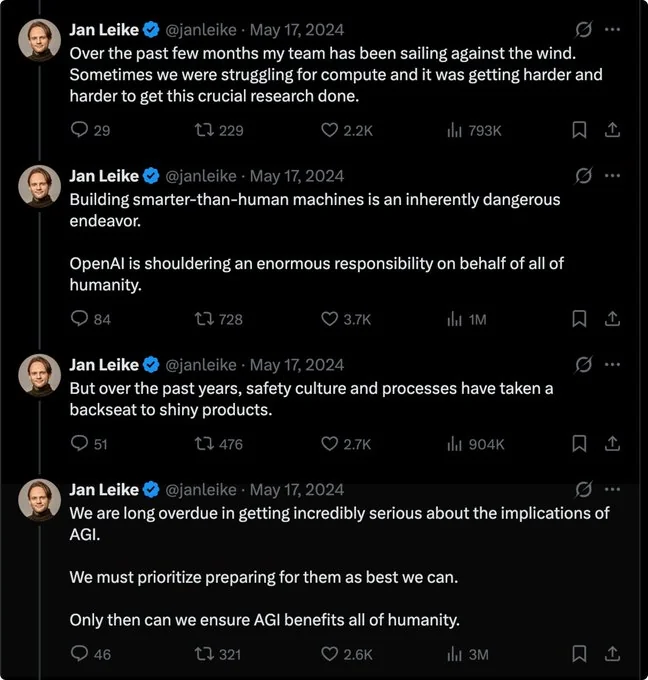
These tweets set the AI research community ablaze. A senior safety scientist at OpenAI publicly calling out the company's safety commitments as mere window dressing is almost unheard of in the industry. It wasn't just an indictment of OpenAI — it was a challenge to the entire development model of AI.
Jan Leike's departure revealed a brutal reality: at OpenAI, the pressure to ship products and commercialize had completely overwhelmed any genuine concern for long-term safety. The much-hyped superalignment team, promised 20% of the company's compute, turned out to be a fig leaf to placate critics.
On May 28, Leike announced he was joining rival Anthropic to lead its newly formed "superalignment" team. The symbolism was impossible to miss: OpenAI's head of safety research had defected to a competitor built around a "safety-first" ethos.
After joining Anthropic, Leike said he would focus on "scalable oversight, weak-to-strong generalization, and automated alignment research" — exactly the work he wanted to do at OpenAI but couldn't get enough support for. "Here," he said, "I can finally work in an environment that truly values safety."
Ilya's silent farewell
The same day Leike resigned — May 14, 2024 — even more seismic news broke: Ilya Sutskever formally announced he was leaving OpenAI.
Unlike Leike's angry broadside, Ilya's departure statement was measured and calm. "The decision to leave OpenAI is incredibly difficult for me," he wrote on social media. "It has been nearly a decade of my life. But I have found a different peak to climb, a project of deep personal significance."
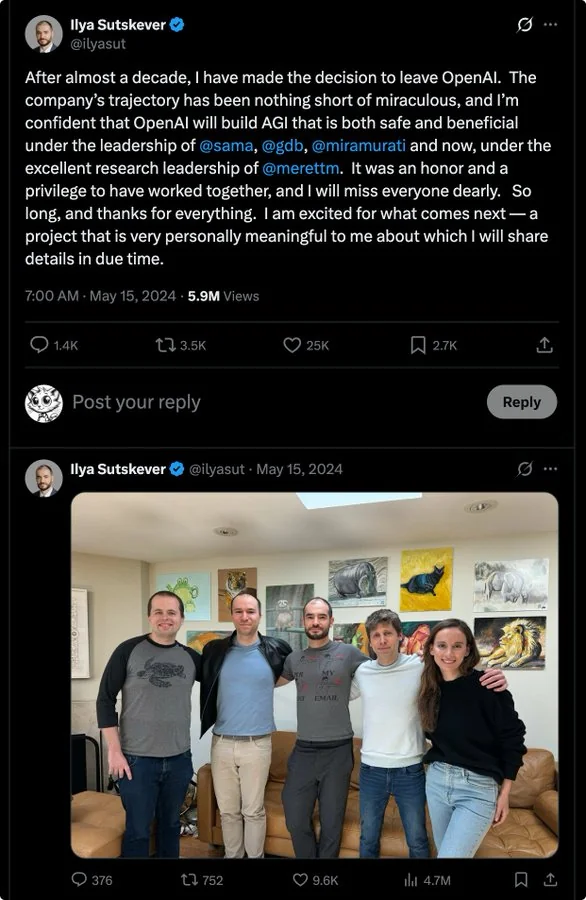
The co-founder, chief scientist, and technical soul behind the GPT models — gone. He didn't publicly criticize the company, didn't vent like Leike. But his departure itself was the most powerful statement of all.
Ilya's exit marked the departure of the last "safety fundamentalist" from OpenAI's founding team. He had once been a true believer in the scaling hypothesis — the idea that simply making models bigger would lead to AGI. But after watching model capabilities explode and the company culture shift, he realized the real danger wasn't the technology itself but the risk of humans losing control.
He tried to change the company's direction with the November 2023 coup. He failed. He tried to push safety research through the superalignment team. He got marginalized. Eventually, he chose to leave and pursue a purer dream.
With Ilya gone, OpenAI announced the superalignment team was formally disbanded, its members reassigned to various research groups. The flagship safety research project that had once been hailed as a beacon simply vanished without a trace.
The birth of SSI — a total rejection of the OpenAI model
On June 19, 2024, Ilya announced his new project: Safe Superintelligence Inc. (SSI), co-founded with Daniel Gross (former Apple AI head) and Daniel Levy (investor and AI researcher).
SSI's mission statement was stark and simple: "Our sole goal and product is safe superintelligence."
It was a complete repudiation of the OpenAI model. SSI declared:
No product releases — to avoid commercial pressure distorting research direction.
No pursuit of short-term commercialization — focus entirely on long-term safety research.
A single "straight shot" — solve AI safety first, in an environment free from any commercial pressure, before building superintelligence.
This extreme purist stance was unprecedented in the AI industry. OpenAI was commercializing. Anthropic was commercializing while emphasizing safety. SSI was refusing commercialization altogether, focusing solely on safety research.
Ilya explained the choice in an interview: "We have seen how commercial pressures warp the priorities of AI research. Every product launch deadline, every investor expectation, pushes us to go faster, not safer. SSI exists to prove another path is possible."
In September 2024, SSI announced it had raised $1 billion in funding, from top VCs including Sequoia Capital, Andreessen Horowitz, SV Angel, and DST Global. These investors were backing a company with no product, no revenue, and not even a clear commercialization plan — purely based on trust in Ilya personally and recognition of the importance of AI safety.
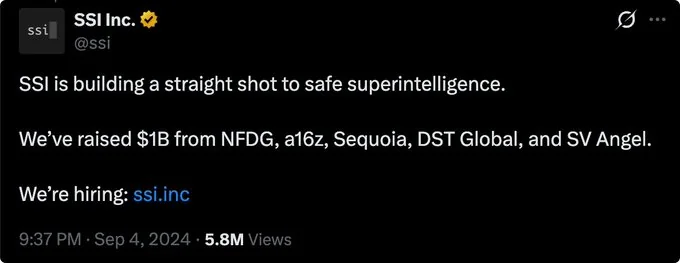
By March 2025, SSI had reached a staggering $30 billion valuation in a new round led by Greenoaks Capital. A company with roughly 20 employees and zero revenue, valued at $30 billion — unprecedented in business history. It reflected investors' immense faith in Ilya's technical acumen and the market's growing concern about AI safety.
SSI's success also served as a silent mockery of OpenAI: the company once founded to "ensure AGI benefits all of humanity" had now lost the very people most committed to that mission.
The talent exodus domino effect
Jan Leike and Ilya's departures opened the floodgates. Over the following months, OpenAI experienced the worst brain drain since its founding.
In August 2024, another co-founder, John Schulman, announced he was leaving for Anthropic. Schulman was one of the architects of reinforcement learning from human feedback (RLHF), the key technology behind ChatGPT. His reason: "I want to return to hands-on technical work in a purer safety environment."
Rumors circulated that Schulman left Anthropic again in February 2025, possibly joining former CTO Mira Murati's new company, but that was unconfirmed. Either way, his frequent moves highlighted the difficulty AI safety researchers face in finding an ideal working environment.
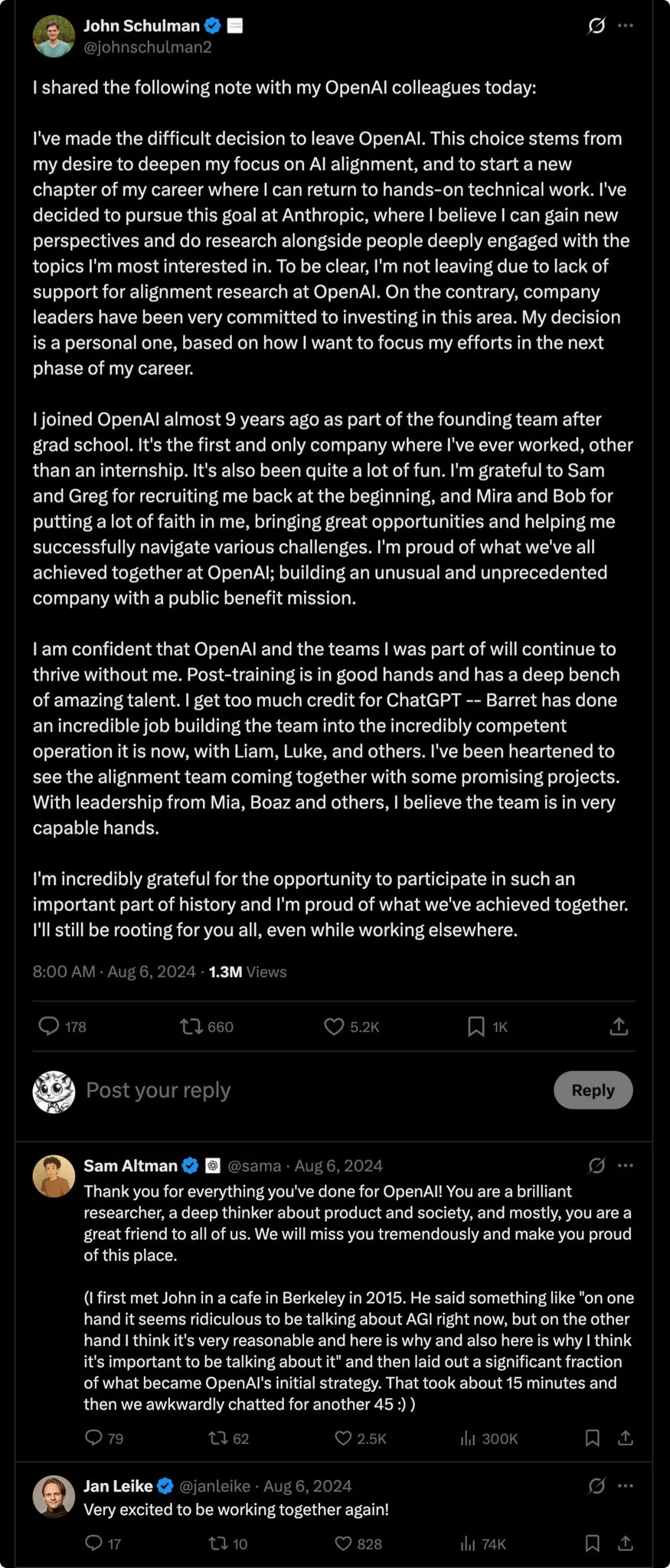
Earlier in 2024, Andrej Karpathy, a technical powerhouse who had worked at both Tesla and OpenAI twice, left OpenAI again. Unlike others jumping into the AGI race, he founded Eureka Labs, focused on "AI-native education." "I realized," he said, "that augmenting human intelligence might be as important as building machine intelligence."
In September 2024, former interim CEO and CTO Mira Murati also resigned. As the core leader behind ChatGPT and DALL-E, her departure was a major blow to OpenAI's product lineup. Sources said Murati was raising funding for her own AI startup, expected to exceed $100 million.
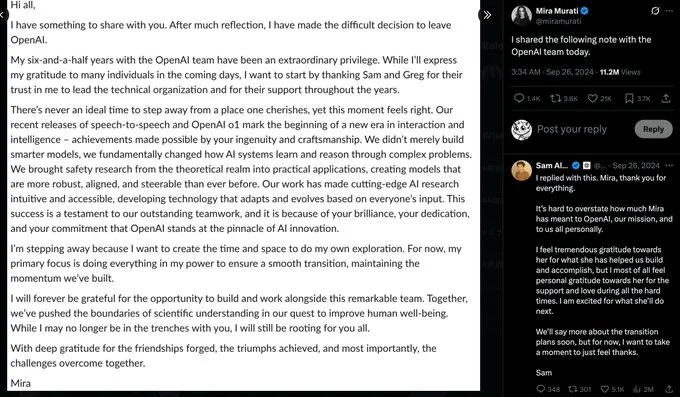
By 2025, the exodus intensified. Senior data scientist Tom Cunningham from the economics research team, along with many executives and core researchers, left. In his resignation letter, Cunningham angrily accused OpenAI of becoming "too conservative," refusing to publish research on AI's negative impacts, and demanding the economics team act as the company's "de facto propaganda department."
Many departing employees joined Meta's newly formed "superintelligence lab," further draining OpenAI's talent pool.
From 11 to 2
By the end of 2025, a stunning statistic emerged: of OpenAI's original 11 founders, only Sam Altman and Greg Brockman remained in management.
Let's recap the fates of those 11 founders:
- Elon Musk — left in 2018, founded rival xAI in 2023.
- Ilya Sutskever — left in 2024, founded SSI.
- Greg Brockman — stayed as president.
- Sam Altman — stayed as CEO.
- John Schulman — left in 2024, joined Anthropic.
- Wojciech Zaremba — left at some point.
- Andrej Karpathy — left in 2024, founded Eureka Labs.
- Durk Kingma — left in October 2024, joined Anthropic.
- Trevor Blackwell — left early on.
- Vicki Cheung — left early on.
- Pamela Vagata — left early on.
The list reads like a tragic epic. The people who once came together with a shared dream have now scattered — some became competitors, some critics, some chose entirely different paths.
Three waves of departures: from Musk to Dario to Ilya
If we break down OpenAI's talent exodus into three phases, a clear pattern emerges:
First wave (2018): Musk's power struggle. Musk left over a fight for control and dissatisfaction with the pace of progress. He thought OpenAI was moving too slowly to compete with Google. His departure was about losing a power battle.
Second wave (2021): Dario's safety concerns. Dario Amodei and his sister Daniela left over worries about commercialization pressure and commitment to safety research. They believed OpenAI, under Microsoft's influence, was drifting away from a safety-first path. Their departure was about ideological differences.
Third wave (2024): Ilya's shattered idealism. Ilya, Jan Leike, and others left out of disappointment over the total transformation of company culture. They witnessed firsthand how safety research got sidelined, how it gave way to products and profits. Their departure was the final collapse of idealism.
These three waves chart OpenAI's complete journey from idealism to realism, from nonprofit to commercial, from safety-first to speed-first. Each wave carried away a piece of the original dream.
The ironic endgame: the safety company lost all its safety guardians
OpenAI's story is dripping with irony.
The company was founded to ensure safe AGI development and prevent it from being monopolized by a single entity. Yet it ended up taking a massive investment from Microsoft and effectively becoming a closed-source commercial enterprise.
The company promised to open-source AI technology for all humanity. Yet its flagship product, GPT-4, is completely closed-source, refusing to even share technical details.
The company pledged to allocate 20% of its compute to safety research. Yet that promise was never kept, and the safety team was ultimately dissolved.
The biggest irony: a company founded with the mission to "ensure AGI benefits all of humanity" has lost every founder who genuinely cared about that mission. Musk left. Dario left. Ilya left. Jan Leike left. John Schulman left. All the people who were once the staunchest guardians of safety are now outside OpenAI.
What remains is a profit-driven, fast-moving tech giant deeply tied to Microsoft. It continues to push AI forward, churning out impressive products — but does it still remember its original vows?
Three paths diverge
The great dispersion of 2024 is not just OpenAI's tragedy — it's the fragmentation of the entire AI safety movement. Former comrades-in-arms at OpenAI now walk three starkly different paths:
OpenAI's path: Commercial accelerationism Under Altman's leadership, OpenAI chose the "safety through speed" route. They believe only by staying ahead can they control the AGI race, ensuring the technology isn't captured by less responsible forces. Speed, they argue, is the best safety guarantee.
Anthropic's path: Safety constitutionalism Under Dario and Jan Leike, Anthropic chose the "safety before power" route. They developed "constitutional AI" methods to technically solve alignment. They believe technology should only advance after we fully understand and control AI.
SSI's path: Purity Under Ilya, SSI took the most radical route: total rejection of commercialization, pure focus on safety research. They believe any commercial pressure corrupts research priorities; only in complete independence can superintelligence safety be solved.
These three paths represent three different philosophies of the AI safety movement. All born from the same dream, but heading to different futures. Which path is right? History will decide. But one thing is certain: OpenAI is no longer a place that can accommodate all these ideas.
The Great Dispersion is not just a brain drain — it's the shattering of a vision. The Promethean fire lit at the Rosewood Hotel has now split into three flames, each burning with different beliefs, illuminating different roads.
And OpenAI — the place that once carried everyone's dreams — now has only two founders and an increasingly blurry mission.
After the coup and the talent exodus, the AI landscape is sharper than ever. The Promethean fire ignited at the Rosewood Hotel has splintered into multiple flames, each burning with its own convictions, illuminating different paths. The battle for AGI is officially underway — and it's not a three-way showdown. It's a messy, multi-front war.
OpenAI's phoenix moment: from governance crisis to commercial juggernaut
The November 2023 coup exposed a fundamental contradiction in OpenAI's governance: a nonprofit board trying to control a commercial entity worth hundreds of billions — an impossible task. After Altman's return, the urgency only grew. Investors needed clear equity structures, employees wanted liquid stock options, and the company had to lay groundwork for a future IPO.
On October 28, 2025, OpenAI announced a historic restructuring that ended the decade-long governance experiment.
Pivoting to a public benefit corporation: idealism's last compromise

Under the new plan, OpenAI's existing for-profit LLC will convert into a Public Benefit Corporation (PBC) — a corporate form that requires the company to pursue profit while also serving a public good. For OpenAI, that public mission aligns with its nonprofit parent: ensuring AGI benefits all of humanity.
The original nonprofit, founded in 2015, will be renamed the OpenAI Foundation and remain the ultimate controller of the whole entity. But unlike before, the foundation won't micromanage the for-profit's day-to-day operations. Instead, it will exercise oversight via equity stakes and board appointment powers.
More importantly, OpenAI is scrapping its complex capped-profit model, which limited investor returns to 100x their investment. That worked when the company was valued at a few billion, but once valuations hit hundreds of billions, it became a massive obstacle to fundraising and equity incentives. The new structure gives investors and employees ordinary shares with no cap on upside — a more conventional capital structure, and a clear sign that OpenAI is transforming into a traditional tech company.
Who actually runs OpenAI now?
The post-restructuring equity structure reveals where power really lies:
- OpenAI Foundation: holds 26% equity, worth about $130 billion
- Microsoft: holds 27% equity, worth about $135 billion
- Employees and other investors: collectively hold 47% equity
This structure passed strict scrutiny from the California and Delaware Attorneys General. Their biggest concern: whether nonprofit assets were being improperly transferred to private investors. After months of negotiation, OpenAI made a key commitment: the foundation retains the right to appoint members to the PBC board, ensuring the mission isn't entirely commercialized. In exchange, regulators approved the restructuring.
This shift came after listening to civil society leaders and having deep conversations with regulators. It represents OpenAI's final compromise between idealism and reality: acknowledging the inevitability of commercialization, but trying to protect its mission through legal structures. Critics, however, argue that when a company is worth $500 billion, any "mission" gets warped by the gravity of capital.
Capital狂欢: an unprecedented fundraising feast
Behind the restructuring lies a capital frenzy unlike anything we've seen.
In April 2025, SoftBank led a $40 billion funding round that valued OpenAI at $300 billion — one of the largest single fundraising rounds in human history. Masayoshi Son, the investor who famously tanked on WeWork, is now betting on AGI — a dream far bigger, and far riskier, than coworking.
By October, through employee stock sales, OpenAI's valuation soared to $500 billion, making it the world's most valuable private company, surpassing SpaceX, ByteDance, and every other unlisted tech giant. What does that number mean? It's three times the market cap of Boeing. It's a quarter of Saudi Aramco. A ten-year-old AI lab that hasn't turned a profit is now worth more than countless century-old corporations.
To justify that valuation, OpenAI needs to prove it can keep leading — which requires one thing: compute.
Multi-cloud strategy: the compute arms race
In the AI era, compute is oil, steel, everything. Whoever controls compute controls the future.
OpenAI's relationship with Microsoft runs deep, but Altman knows better than to put all his eggs in one basket. In 2025, OpenAI launched an aggressive multi-cloud strategy:
- Azure: committed to $250 billion in cloud services — the largest single customer contract in Azure's history
- AWS: signed a 7-year, $38 billion cloud deal, gaining access to Amazon's most advanced AI chips and infrastructure
- Oracle: agreed to a 5-year, $300 billion compute capacity contract, leveraging Oracle's data center network
The total value of these contracts exceeds $600 billion — an astronomical sum that could build hundreds of nuclear plants or launch thousands of satellites. But in the AGI race, these investments are seen as necessary. Altman said in an interview: "We're building the most complex machine in human history. It will require more energy than an entire city uses."
Product offensive: from model to ecosystem
With money and compute locked in, OpenAI launched a relentless product offensive in 2025:
- GPT-4.5: major breakthrough in reasoning, handling more complex multi-step problems
- GPT-5: revolutionary advances in multimodal interaction and long-term memory
- Operator: an autonomous agent that can browse the web and complete tasks — marking AI's shift from "conversation tool" to "autonomous assistant"
- ChatGPT Health: a vertical application targeting healthcare, aiming to bring AI into more professional settings
The pace of these releases left competitors scrambling. OpenAI is no longer a research lab; it's a product machine, a commercial empire. Altman's strategy is clear: iterate fast, deploy widely, and test AI safety in the real world. This is what he calls "commercial accelerationism" — speed itself is the best safety guarantee.
Anthropic's constitutional road: the safety faction holds firm
If OpenAI represents speed, Anthropic represents safety.
Founded by OpenAI defectors, the company had its own moment in the sun in 2025, reaching a $60 billion valuation — just a tenth of OpenAI's, but enough to make it a serious player in AI.
Claude's evolution: Constitutional AI in practice
Anthropic's core product is the Claude series. Unlike GPT, Claude was designed from the start to be "safer and more controllable," using Anthropic's proprietary Constitutional AI method:
- Explicit value encoding: Claude is given a clear code of conduct, like a constitution constraining government power
- Self-critique mechanism: before generating a response, the model evaluates whether its output meets safety standards
- Transparent decision-making: Anthropic tries to make the AI's reasoning more explainable, not a black box
In 2025, Anthropic released the Claude 4 and Claude 4.5 series, continuing to improve coding and reasoning. The developer community's verdict: "It might not be the fastest, but it's the most reliable."
Compute alliances: deep ties with giants
To keep up in the compute race, Anthropic also sought allies. It signed a ~$30 billion Azure compute agreement with Microsoft and Nvidia, while deepening partnerships with Amazon and Google.
It's a delicate strategy: Anthropic draws resources from Google, Amazon, and Microsoft simultaneously, avoiding control by any one giant. This "multilateral diplomacy" preserves its independence, but means it must carefully balance three powerful interests.
The cost of safety-first
Anthropic's safety-first approach earns respect — but it also carries costs. Its product release cadence is noticeably slower than OpenAI's, and some features are more conservative. For example, Claude refuses to generate certain types of content, even when legally permissible.
That caution frustrates some users, but Anthropic insists it's necessary. Dario Amodei said in a speech: "We could move fast and hit a wall at some point. Or we could go slower and make sure we know where the wall is. We choose the latter."
Google's counterattack: the sleeping giant awakens
If OpenAI is the challenger and Anthropic is the idealist, Google is the sleeping giant that just got rudely awakened.
Code Red: ChatGPT's existential threat
When ChatGPT launched on November 30, 2022, Google internally declared a "Code Red" — the highest-level crisis response mechanism, rarely used in company history. CEO Sundar Pichai realized this wasn't just a new product; it was a fundamental threat to Google's core business model.
Google's empire is built on search. But ChatGPT offered a new way to get information: no more keywords, no more clicking through a dozen links — the AI gives you a complete, accurate answer directly. If that model becomes the norm, Google's hundreds of billions in ad revenue face massive risk.
What makes it more ironic for Google's leadership: AI was supposed to be their home turf. In 2017, Google published the landmark paper "Attention Is All You Need," introducing the Transformer architecture — the very foundation of GPT models. Google had the world's most powerful AI research teams: Google Brain and DeepMind. But they worked in silos for years, letting a newcomer like OpenAI steal the lead.
Merger and restructuring: the birth of Google DeepMind
Facing the crisis, Google made a big move: in early 2023, it merged Google Brain and DeepMind into Google DeepMind, led by DeepMind co-founder Demis Hassabis. The merger consolidated Google's AI firepower, signaling that Google was now fully on the counterattack.
Hassabis said at the announcement: "We're bringing together Google's best AI talent to accelerate our progress in AI. Our goal is to build more capable, safer, and more responsible AI systems."
Gemini's rise: from catch-up to neck-and-neck
In December 2023, Google released Gemini 1.0, a natively multimodal model that seamlessly handles text, images, audio, video, and code. Unlike GPT-4, which needs plugins for images, Gemini was multimodal from the ground up, making it smoother for complex tasks.
The Gemini series comes in three versions:
- Gemini Ultra: the most powerful, beating GPT-4 on multiple benchmarks
- Gemini Pro: balancing performance and efficiency for large-scale deployment
- Gemini Nano: a lightweight version that runs on mobile devices
By 2024, Google released Gemini 1.5 Pro, extending its context window to a mind-boggling 1 million tokens — the longest in the industry at the time, enough to process an entire book in one go. That technical breakthrough gave Gemini a clear edge for long-document analysis, codebase review, and similar tasks.
In 2025, Gemini 2.0 launched, further improving reasoning and multimodal understanding. On some benchmarks, Gemini 2.0 now matches GPT-5 and even surpasses it in certain areas.
Google's unique advantages: data, ecosystem, and chips
Compared to upstarts like OpenAI and Anthropic, Google has advantages its rivals can't match:
Massive proprietary data
- Search queries: billions per day, covering every aspect of human knowledge
- YouTube: the world's largest video platform, with billions of hours of content
- Gmail, Google Docs, etc.: hundreds of millions of users' daily work data (with privacy safeguards)
- Android ecosystem: usage data from over 3 billion devices worldwide
This data is unreachable for OpenAI and Anthropic, giving Gemini a unique training advantage.
Vast product ecosystem
Google doesn't have to build a user base from scratch like OpenAI. It can integrate Gemini seamlessly into its existing product matrix:
- Google Search: embedding AI directly into results with "AI Overviews"
- Gmail: smart compose and reply
- Google Workspace: AI assistants in Docs, Sheets, Slides
- Android: AI capabilities at the OS level
- Google Cloud: Gemini API for enterprise customers
This "ecosystem integration" strategy lets Google push AI capabilities to billions of users rapidly, without relying on a single ChatGPT app.
In-house AI chips
Google has been developing TPUs (Tensor Processing Units) since 2016 — chips optimized specifically for AI training and inference. By 2025, Google had released TPU v6, with industry-leading performance and energy efficiency.
This chip independence means Google doesn't depend entirely on Nvidia like OpenAI does, giving it more flexibility and cost advantages in compute supply.
Strategic shift: from search company to AI company
At Google I/O 2024, Pichai announced a major strategic pivot: "We're transforming Google from an 'AI-first' company to an 'AI-native' company. AI is no longer just a feature of our products; it's the core of our products."
This shift manifests in multiple ways:
- Organizational restructuring: AI teams elevated to the company's highest priority, reporting directly to the CEO
- Resource allocation: massive increase in AI R&D spending — over $50 billion in AI-related capex in 2025
- Product redesign: all major product lines rebuilt with AI at the center
Open strategy: betting on the ecosystem
Google Cloud is opening up Gemini to external developers, hoping to build an AI ecosystem around it. It's a classic platform play, but the question is whether anyone outside of Google will bite.
Google's challenge: the innovator's dilemma
Despite all its advantages, Google faces a unique challenge — the classic innovator's dilemma. As a company with over $300 billion in annual revenue, any product change risks cannibalizing its core ad business. If AI answers user questions directly, users stop clicking ads. That's a direct hit to Google's bottom line. So Google has to be cautious about how aggressively it rolls out AI features.
Meanwhile, OpenAI has no such baggage. It can afford to be radical, to upend existing models. That lightweight advantage partly offsets Google's massive resource advantage.
xAI's brute force aesthetic: Musk's revenge
If OpenAI is speed, Anthropic is safety, and Google is ecosystem integration, then xAI is… truth. Or at least, Musk's version of it.
In July 2023, Musk founded xAI, declaring its mission to "understand the true nature of the universe." That lofty goal sounds philosophical, but the strategy is brutally direct: overwhelm everything with brute force.
Grok's rise: the anti-woke AI
In February 2025, xAI released Grok 3, a model that approaches GPT-4 level on several benchmarks. But Grok's real differentiator isn't the tech; it's the personality.
Unlike ChatGPT and Claude, which are cautious and circumspect, Grok is designed to be "more honest, more direct." It doesn't shy away from sensitive topics; it doesn't sugarcoat answers. Musk calls it a "truth-seeking AI," but critics call it "unguarded AI."
Another key feature: deep integration with X (formerly Twitter). Grok can access X's data in real time, giving it an edge on current events and social media content. Musk's strategy: feed Grok with X data, enhance X with Grok, and create a closed ecosystem.
Supercomputer factory: pushing the limits of compute
Musk doesn't do anything small. In 2025, xAI announced it was building the world's largest supercomputer — the "Supercomputer Factory" — in Memphis, Tennessee.
The scale is staggering:
- Hundreds of thousands of Nvidia's latest AI chips
- A footprint the size of dozens of football fields
- Power consumption equivalent to a medium-sized city
- Construction cost in the tens of billions of dollars
Musk's goal is to achieve AGI by 2029. He believes that with enough compute and data, AGI will emerge naturally. It's an extreme form of "scalingism": bigger models, more data, more compute — that solves everything.
Capital chase: a $200 billion bet
In January 2026, xAI announced a $200 billion Series E round. That's less than OpenAI's fundraising, but for a company barely two years old, it's astonishing.
Why are investors betting on xAI? Three reasons:
- Musk's personal brand: His success with Tesla and SpaceX proves he can do the impossible.
- Unique data advantage: X's real-time data is something no other AI company can match.
- Open-source strategy: xAI promises to open-source some of its tech, contrasting with OpenAI's closed approach.
But xAI faces huge challenges. It still lags behind OpenAI, Google, and Anthropic in technology and is far behind in market share. Musk needs to prove that brute force and speed can close the gap.
The clash of four philosophies: speed, safety, ecosystem, and truth
This battle is essentially a clash of four competing visions for AGI's future:
OpenAI's commercial accelerationism: Altman believes only by staying ahead technologically can you control the AGI race. He thinks stopping is the biggest risk, because it hands AGI to less responsible actors. Speed itself is a safety measure.
Anthropic's constitutional safety: Dario and Leike believe you must ensure safety before pushing forward. Without full understanding and control, rapid development only invites disaster. Safety comes first.
Google's ecosystem integrationism: Pichai and Hassabis believe AI shouldn't be a standalone product; it should blend into daily life and work. Only by deeply integrating into an existing vast ecosystem can AI truly benefit everyone. Ecosystem is the amplifier of AI value.
xAI's truth-over-all-ism: Musk believes AI should seek truth, not political correctness. He argues that excessive safety constraints distort AI's nature, turning it into a tool for ideology. Truth doesn't need guardrails.
Each philosophy has its merits — and its blind spots. OpenAI's speed could lead to loss of control. Anthropic's caution could mean falling behind. Google's ecosystem could become a monopoly. xAI's aggression could lead to abuse. Which path is right? History will judge. But the outcome of this race will define the relationship between humans and AGI — and shape our future.
New order: from idealism to realpolitik
From that night at the Rosewood Hotel to today, OpenAI has been on a ten-year journey. The place that once held everyone's dreams has splintered into multiple camps, each fighting for itself.
But this isn't failure; it's evolution. That original flame, though split, has illuminated a broader territory. OpenAI, Anthropic, Google, and xAI represent four possibilities, four futures for AI development.
In this new order, there is no absolute right or wrong — only different choices. OpenAI chose speed, Anthropic chose safety, Google chose ecosystem integration, and xAI chose truth. The sum of those choices will shape our tomorrow.
And this is no longer a simple "three kingdoms" story; it's a far more complex and diverse landscape. Beyond these four main players, there are Meta, Amazon, Baidu, Alibaba, and many more competing in various niches. This diversity increases uncertainty but also offers humanity more options.
In the end, who will win? Maybe the real answer is: no one. Because AGI's future doesn't belong to any single company — it belongs to all of humanity. These companies are just exploring different roads to that future.
By 2024, the earliest co-founder to leave, Elon Musk, came roaring back in a way no one expected. Not with a new product, not with a technological breakthrough, but with a lawsuit — filed in San Francisco Superior Court, accusing OpenAI and its CEO Sam Altman of betraying the founding agreement that the company would work "for the benefit of humanity, not profit."
This was no longer just business competition; it was a trial over "the original mission," a war of narratives around the creation myth. Former comrades were now facing each other in court. Those vows made at the Rosewood Hotel had become weapons to attack each other.
First blood: the February 2024 lawsuit
In February 2024, Musk filed a 46-page complaint in California state court. In the filing, he told a story of an idealist betrayed, almost elegiac in tone.
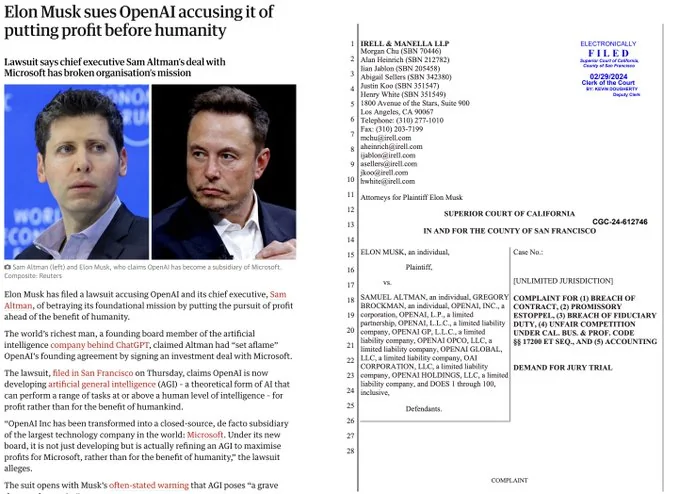
Musk's accusations: from open source to closed source sellout
Musk alleged that OpenAI had become "a de facto closed-source subsidiary" of Microsoft, the world's biggest company. He listed a series of grievances:
- Broken open-source promise: OpenAI originally pledged to open-source its research, but GPT-4 is entirely closed, with no technical details released.
- Commercial betrayal: It transitioned from a nonprofit to a for-profit company, pursuing profit over human welfare.
- Microsoft's shadow control: It accepted $13 billion from Microsoft, becoming a pawn in its AI strategy.
- Broken safety promise: It promised to dedicate 20% of its compute to safety research — a promise never kept.
Musk wrote in the complaint: "I co-founded OpenAI because of shared concerns about AI safety. I donated tens of millions of dollars, invested countless hours, all to ensure AGI wouldn't be monopolized by any single company. But Altman and others used my trust and money to steer the company toward commercialization. That is fraud, a fundamental betrayal of the founding agreement."
He asked the court to force OpenAI to return to its open-source roots and to pay substantial damages.
OpenAI's counterpunch: releasing emails
OpenAI responded quickly. In March 2024, the company published a blog post entitled "" (the title is missing in the source — ed.) and released years of email correspondence with Musk.
Those emails told a very different story:
- In September 2017, during negotiations over OpenAI's for-profit entity, Musk not only agreed to the structure but also created a public-benefit corporation called "Open Artificial Intelligence Technologies Inc." He then said the nonprofit should "continue to exist in some form." He never objected to the existence of a for-profit entity.
- In November 2017, when talks stalled, Musk made a stunning demand: merge OpenAI into Tesla, with himself as CEO, majority ownership, and board control. He wrote in an email: "This is the only hope against Google, however slight." The proposal was rejected by Altman and other founders, who insisted on OpenAI's independence, fearing Musk's authoritarian style would destroy the lab's open culture.
- In February 2018, negotiations collapsed. Musk suspended his promised donations, leaving OpenAI in a funding crisis. He left with a cold prediction: "Your probability of success is 0%."
OpenAI wrote: "Musk's lawsuit stems from regret — regret that he doesn't control OpenAI, regret that OpenAI succeeded without him. He's now using legal means to take what he couldn't get through negotiation."
The release of those emails shifted public opinion. It became clear that this wasn't a simple story of idealist vs. businessman, but a complex power struggle.
A $97.4 billion acquisition farce (February 2025)
Just when it seemed the legal battle might simmer down, Musk pulled another shocker.
In February 2025, he partnered with several investment groups to propose a $97.4 billion bid for OpenAI's nonprofit parent. The number was carefully chosen — one-third of OpenAI's valuation at the time, enough to make headlines but not enough to actually have to pay.
Musk's pitch: let OpenAI return to its roots
In a public statement, Musk said he wanted to use the bid to make OpenAI "return to its open-source, safety-first roots." He said: "I founded OpenAI to ensure AGI benefits all humanity. Now it's become Microsoft's money-making machine. I'm willing to spend nearly a hundred billion dollars to buy it back and put it on the right path."
The rhetoric sounded noble, but almost no one believed it.
Altman's response: "No, thank you."
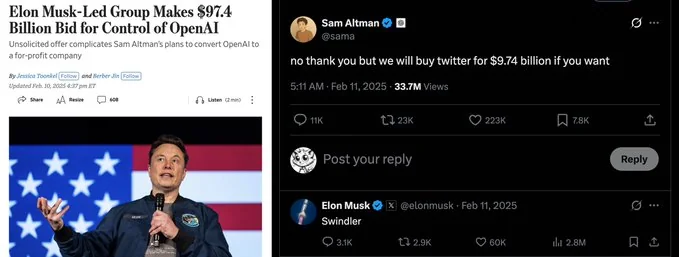
Asked about the bid at the Paris AI Action Summit, Altman said just four words: "No, thank you."
He added: "I suspect he's just trying to slow us down. This isn't a sincere acquisition offer; it's a carefully staged disruption."
Analysts generally agreed that Musk's bid had three goals:
- Disrupt OpenAI's fundraising and restructuring: Create uncertainty as OpenAI prepared to convert to a PBC.
- Inflate OpenAI's valuation: Make potential investors think OpenAI is "worth $97.4 billion," driving up the price of future funding rounds.
- Build public pressure: Force the public to reexamine OpenAI's commercialization path and question whether it had abandoned its mission.
Whatever the intent, the bid escalated the Musk-OpenAI feud to new heights.
Escalation: from state court to federal court (June–August 2024)
In June 2024, Musk suddenly withdrew the lawsuit he had filed in California state court. Many thought it signaled a settlement — but they were wrong. It was a tactical retreat.
In August 2024, Musk filed a new suit in the U.S. District Court for the Northern District of California, this time with more severe charges: racketeering.
Core arguments of the new lawsuit
In the new complaint, Musk alleged:
- OpenAI is "racing to develop advanced AGI" with a goal of "maximizing profit."
- This violates the company's nonprofit mission and constitutes fraud against donors and the public.
- Microsoft "knowingly" funded and supported OpenAI's violations, making it a co-conspirator.
Musk asked the court to:
- Block OpenAI's conversion to a fully for-profit company.
- Force OpenAI to open-source its research.
- Order OpenAI and Microsoft to compensate him for his donations and opportunity costs.
The new lawsuit was more aggressive, the language tougher. Musk was no longer just asking to "restore the mission"; he was directly accusing OpenAI and Microsoft of "fraud" and "racketeering."
January 2026: the truth comes out
In January 2026, the legal battle entered its most dramatic phase. A court unsealed more than 100 documents, including testimony from key figures and internal emails. They offered an unprecedented look inside OpenAI's decision-making.
Secrets revealed in unsealed documents
The documents included:
- Sam Altman's testimony: Detailed explanation of the decision to commercialize OpenAI.
- Greg Brockman's private diary: Notes on the 2017 negotiations with Musk.
- Ilya Sutskever's testimony: The technical soul of OpenAI, speaking on how he viewed the company's transformation.
- Mira Murati's testimony: The product chief on balancing business and safety.
- Satya Nadella's testimony: Microsoft's CEO on why Microsoft invested.
- Helen Toner and Tasha McCauley's testimony: Two former board members revealing the inside story of the 2023 coup.
Musk's calculus: how much value did he create?
Among the most striking revelations was Musk's own financial calculation. He claimed:
- His $38 million contribution (60% of early seed funding) helped OpenAI achieve a value of $65.5 to $109.4 billion.
- Microsoft gained $13.3 to $25.1 billion in value as a result of his contribution.
Based on Musk's calculations, he boosted his claim to $134 billion — a staggering sum equal to a quarter of OpenAI's valuation at the time.

OpenAI fires back: cherry-picking evidence
On January 16, 2026, OpenAI published a blog post accusing Musk of "cherry-picking" from Greg Brockman's personal diary and taking history out of context. OpenAI wrote:
"Musk selectively published excerpts from Greg Brockman's private diary. When seen in full context, these tell a very different story from what Musk claims. The truth is: we and Musk agreed in 2017 that a for-profit structure was the next step for OpenAI; the negotiations broke down because we refused to give him total control; we rejected his proposal to merge OpenAI into Tesla."
OpenAI also called Musk's financial calculations "absurd," arguing that even if the court finds OpenAI at fault, the maximum owed would be Musk's original $38 million contribution, not $134 billion.

Judge's ruling: the case goes to a jury
On January 15, 2026, U.S. District Judge Yvonne Gonzalez Rogers made a key ruling: the case would proceed to a jury trial. That means no settlement or summary judgment — both sides will have to argue their version of events in open court. The trial is set for April 27, 2026, in Oakland, California.
This will be one of the most watched trials in Silicon Valley history. It involves billions in damages and OpenAI's reputation. If the court finds that OpenAI violated its nonprofit mission, its commercial pivot and IPO plans could take a serious hit.
A multi-front legal war
Musk's lawsuit against OpenAI is just one part of a broader legal campaign.
xAI vs. Apple and OpenAI: antitrust suit (August 2025)
In August 2025, Musk's xAI sued Apple and OpenAI, accusing them of an "anticompetitive scheme" that includes Apple systematically favoring ChatGPT in the App Store and suppressing Grok, as well as an exclusive deal that locks out rivals. The suit claims that despite Grok having 1 million average 4.9-star reviews, Apple's algorithm manipulation prevents it from competing.
OpenAI called the suit another chapter in Musk's "ongoing harassment."
xAI vs. OpenAI: trade secrets suit (September 2025)
In September 2025, xAI filed a second suit accusing OpenAI of unlawfully obtaining Grok's trade secrets by poaching former xAI employees. Named individuals include engineers Xuechen Li and Jimmy Fraiture, plus an unnamed senior financial officer. The suit includes a bizarre detail: a leaked email chain shows Musk's lawyer accusing a former xAI exec of breaching confidentiality, and the exec replying "suck my dick."
Copyright class action: an existential threat (December 2025)
On December 22, 2025, a group of prominent authors filed a class action against OpenAI, Anthropic, xAI, Google, Meta, and Perplexity AI, alleging that these companies illegally used copyrighted literary works to train their LLMs without permission or compensation.
If the court rules that AI companies must pay for training data, it could fundamentally upend the industry's economics. Some analysts estimate training costs could increase tenfold, forcing companies to retrain models from scratch.
The ironic endgame: from comrades to enemies
Looking back, the irony is painful:
- In 2015, Musk and Altman were allies, co-founding OpenAI with a pledge to "ensure AGI benefits all of humanity."
- In 2018, they parted ways over control and direction, but with mutual respect.
- In 2023, Musk founded xAI, becoming a direct competitor.
- From 2024 to 2026, they've been at war in court, accusing each other of betrayal, fraud, and extortion. The old promises have become weapons.
This is bigger than two egos. It's a microcosm of the entire AI industry: as we race toward AGI, idealism gives way to realism, cooperation to competition, trust to suspicion.
Musk said in an interview: "I created OpenAI to prevent AI from being monopolized by a single company. Ironically, it became exactly what I wanted to prevent."
Altman responded: "We didn't betray anyone. We chose the path that could actually achieve AGI. If that disappoints some people, that's their problem, not ours."
The countdown is on the calendar: April 27, 2026, Oakland, a jury.
But this isn't the end of the story. For OpenAI, it's a watershed moment: before the judge and jury speak, the company must keep running — raising more money, expanding compute, embedding models into every workflow, and explaining itself to ever more regulators and politicians.
The real battle has already begun. It's happening in products, contracts, funding terms, and in every question that asks: "Are you still the OpenAI of 2015?"
If the Rosewood Hotel pledge was OpenAI's "creation myth," then Q1 2026 feels like a counter-mythology: the company has forged itself from a lab into a full-blown national industrial entity — with massive capital, vast compute, distribution channels that pull users into workflows, and the oldest, coldest business of all: advertising.
And all of this unfolds while the courtroom clock ticks in the same city.
OpenAI didn't suddenly become cynical. It reached a stage where idealism is no longer just a vibe — it's an engineering problem that needs to be signed off, audited, and backed by term sheets.
Unsealed moment: when litigation turns OpenAI into a narrative battlefield
As the Musk dispute entered the "unsealing" phase, the lawsuit became a soap opera: evidence is unsealed, and everyone fights for authorship of the story.
OpenAI pushed its defense outward. On January 16, it published a blog post accusing Musk of cherry-picking Brockman's private notes. More crucially, it almost openly acknowledged and tried to normalize the history: as early as 2017, the founding team discussed moving beyond nonprofit — the dispute wasn't about whether, but about who would control.
The judge's ruling pushes the fight from paper to stage. Reuters reported that in early January, Judge Gonzalez Rogers found enough factual disputes to send the case to a jury — meaning both sides must face a more brutal judgment mechanism: translating complex business structures, mission narratives, and personal grudges into moral intuitions that ordinary people can grasp.
It's not about winning or losing. For OpenAI, it means paying an invisible cost during its most critical growth period: explaining itself.
The agency inflection point: Codex's ambition meets defense context
On February 5, OpenAI launched GPT-5.3-Codex. The most striking line in the announcement read:
"Codex goes from an agent that can write and review code to an agent that can do nearly anything developers and professionals can do on a computer."
In plain English: we don't just want AI to write code; we want it to do things like a coworker.
Behind this is OpenAI's gradually crystallizing strategy: shifting from a "model company" to an "agent system company." When AI can run long-term tasks, call tools, and maintain context, the product logic shifts from "answering like a human" to "delivering like an organization."
That same month, another piece of news dragged this ambition into a more sensitive context. Reuters reported that the U.S. government took a hard line on Anthropic and, on the same day, disclosed that the Pentagon had struck a deal with OpenAI to deploy its technology on classified military networks.
From now on, OpenAI's "red lines" won't just live in blog posts and principle statements — they must be written into contracts, deployment plans, and security engineering. Idealism can survive, but it must become auditable, enforceable, and challengeable — otherwise, it's just PR.
The iron triangle of capital: $110 billion pushes OpenAI into infrastructure war
If January was the narrative battle, late February was the resource war.
On February 27, OpenAI announced $110 billion in new investment, a $730 billion pre-money valuation, and named SoftBank, NVIDIA, and Amazon as prominent backers. The opening of the announcement listed three items that sound like the new elements of the world: compute, distribution, capital.
This coldly states OpenAI's reality:
- No compute, no frontier.
- No distribution, no scale.
- No capital, no arms race.
The flame of idealism still burns, but it needs fuel. By 2026, the unit of measurement for fuel is no longer "papers" or "open source" — it's GW and billions.
The forbidden fruit of monetization: ad revenue and the dual gravity of $122 billion
In Silicon Valley, the true sign of a company's maturity isn't the strongest technology — it's learning to make money the old-fashioned way.
On March 26, Reuters reported that ChatGPT's U.S. ad pilot, live for just six weeks, had already reached a $100 million annualized revenue run rate, with plans to expand. OpenAI emphasizes that ads are separated from answers and conversation content is not shared with marketers — but still, the word "advertising" creates a crack in user trust. When commercial incentives exist, trust must be constantly re-earned.
Then on March 31, OpenAI dropped an even bigger number: it announced a $122 billion fundraise, with a post-money valuation of $852 billion, and declared it was becoming "the core infrastructure of AI," building a unified "AI superapp."
Between ad cash flow and unprecedented fundraising, both point to one fact: OpenAI's cost structure no longer allows it to be just an "idealistic research lab." It must think like infrastructure: throughput, reliability, unit cost, and an ever-expanding organizational machine.
Infrastructure friction: pricing, headcount, and supply chain security
By April, OpenAI's news started looking like that of any normal large company: pricing, hiring, security notices. Less romantic, but more real.
On April 9, TechCrunch reported that OpenAI launched a new subscription tier at $100/month, with Codex credits as the core feature — a blatant "productivity-based pricing."
Meanwhile, Reuters cited the Financial Times that OpenAI plans to grow its workforce from about 4,500 to 8,000 by the end of 2026. When scale crosses a threshold, irreversible organizational changes happen: processes replace inspiration, management replaces spontaneous collaboration, culture shifts from "who we are" to "how we operate."
And a supply chain security incident reminded everyone: when you become infrastructure, you take on infrastructure-level attack surfaces. Reuters reported that OpenAI discovered a security issue related to third-party developer tools and required macOS users to update the app. While no user data was accessed, OpenAI adjusted certificates and workflow configurations.
These stories won't appear in the mythology, but they determine whether the myth can continue.
Countdown: jury, control, and the definition of 'mission'
As of April 13, 2026, the trial hasn't started, but it's already tightening like a noose around several things: the certainty of fundraising, the credibility of the public narrative, and whether the "Foundation + PBC" governance structure can still gain social acceptance.
Media reports indicate the trial is scheduled to start on April 27 in Oakland.
After a decade, OpenAI's story has come to a point where the question is no longer "How smart is the model?" The real question is:
When 'mission' and 'scale' inevitably conflict, who gets to define the mission?
The Prometheus fire lit at the Rosewood Hotel hasn't gone out — it's just been housed in more expensive data centers, more complex corporate structures, and stricter contract terms, still burning.
Will it light humanity's future or drag us into an abyss? No one knows.
The only certainty is that history is still rolling forward. And April 27 is just the beginning of the next chapter.