
Chris McGuire, a senior fellow at the Council on Foreign Relations who previously worked at the White House National Security Council and the Department of Defense, says DeepSeek's V4 model hasn't changed the US-China AI competition. He points out that DeepSeek itself admits its reasoning abilities "lag behind frontier models by about 3 to 6 months," comparing it to GPT-5.2 and Gemini 3.0 Pro from six months ago.
https://twitter.com/ChrisRMcGuire/status/2047541690013999490
He also questions why V4's report doesn't disclose the specific GPU models used for training — V3 claimed 2,000 H800s at a cost of $5.57 million. The silence, he suggests, implies the use of the export-restricted NVIDIA Blackwell chip. (US officials made similar anonymous claims in February; NVIDIA called them "far-fetched." DeepSeek denies using Blackwell, saying it trained on H800 and Huawei Ascend 910C.)
https://twitter.com/amasad/status/2047547275682214384
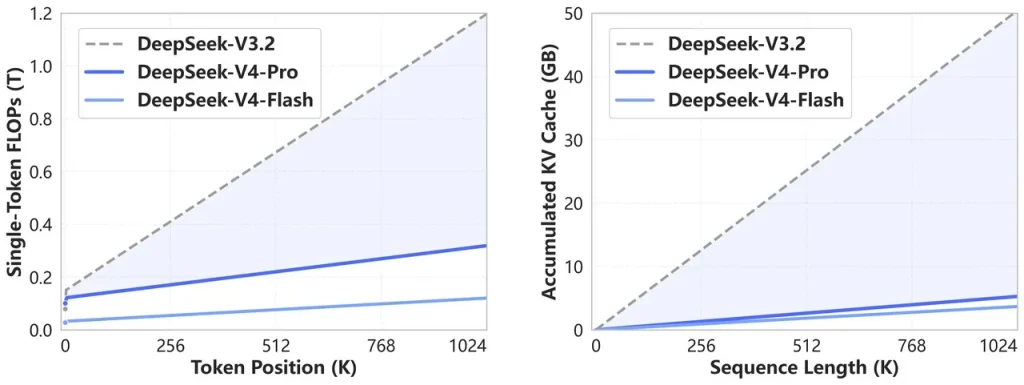
Replit CEO Amjad Masad fired back. He argues that while US politicians and lobbyists hype up "Chinese distillation" fears, Chinese scientists are openly sharing real AI breakthroughs. He cites structural innovations listed in DeepSeek's official posts, including token-level attention compression (DeepSeek Sparse Attention) and big efficiency gains in long-context compute. V4-Pro's per-token inference compute and KV cache usage at 1M context are far lower than V3.2's. Masad says these architecture-level innovations have nothing to do with training data distillation — and everyone, including US labs of all sizes, benefits from the open source. DeepSeek also recently open-sourced its GPU kernels, revealing two new architecture components.